At first glance, it may look like a cluster of tiny translucent grapes gently swaying underwater. You might discover them hidden beneath a rock during low tide, tucked inside a seashell, or attached to the walls of a dark underwater crevice.
But what you’re actually seeing is far more extraordinary.
Those delicate strands are octopus eggs — carefully protected by a mother making one of the most heartbreaking sacrifices in the animal kingdom.
Beneath the surface of the ocean, a silent story unfolds every day. It is a story of survival, unconditional devotion, and nature’s incredible cycle of life. For marine lovers, divers, beachgoers, and curious travelers, understanding what these fragile eggs represent could help protect an entire future generation of ocean life.
A Hidden Nursery Beneath the Sea
Octopus eggs are one of the ocean’s best-hidden wonders. Depending on the species, they may appear as:
- Small pearl-like beads
- Tiny translucent sacs
- Long strings of delicate eggs
- Clusters resembling miniature grapes
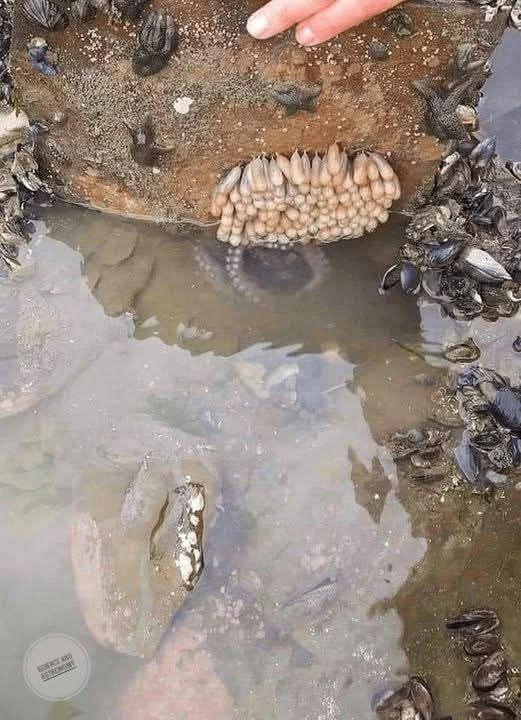
Female octopuses carefully attach these eggs to protected surfaces inside dens, caves, coral formations, or sheltered rocks where predators are less likely to reach them.
Some species even use discarded bottles, shells, or underwater debris as nesting sites.
Because they blend naturally into their surroundings, many people pass by them without realizing they are witnessing one of the most important stages of marine life.
The Incredible Role of the Octopus Mother
What makes this story truly remarkable is what happens after the eggs are laid.
Unlike many ocean creatures that abandon their eggs, the mother octopus stays behind to guard them constantly.
And she does something almost unimaginable.
She stops eating entirely.
For weeks, months, or even years depending on the species, the mother dedicates every remaining ounce of energy to protecting her unborn offspring.
Her mission becomes singular: keep the eggs alive.
A Tireless Guardian
During this time, the mother octopus never truly rests.
She carefully cleans the eggs using her arms and suckers to remove bacteria, algae, and harmful debris. She continuously circulates fresh oxygen-rich water across the eggs to help them develop properly.
At the same time, she fiercely defends the nest from predators.
Fish, crabs, eels, and other marine hunters constantly threaten the fragile eggs, but the mother remains at her post no matter how weak she becomes.
Marine biologists often describe this period as one of the most extreme examples of parental dedication found anywhere in nature.
A Sacrifice Written Into Nature
As the eggs develop, the mother octopus slowly begins to deteriorate physically.
This process is known as senescence — a natural biological stage controlled by specialized glands within her body.
Because she no longer hunts or eats, her body gradually shuts down. Her strength fades. Her skin loses color and texture. In some species, scientists have even observed self-destructive behavior during the final stages of life.
Yet despite her suffering, she continues protecting the eggs until the very end.
Once the baby octopuses finally hatch and swim away into the ocean currents, the exhausted mother usually dies shortly afterward.
For most octopus species, this is the only time a female reproduces in her entire life.
She gives everything for one final purpose: ensuring the next generation survives.
Some Octopus Mothers Guard Eggs for Years
One of the most astonishing discoveries in marine science involved deep-sea octopuses that brood their eggs for incredibly long periods.
Researchers have documented species guarding eggs for more than four years without leaving the nest.
This is considered one of the longest parental care periods ever recorded in the animal kingdom.
Cold ocean temperatures slow the development of the eggs dramatically, forcing mothers to remain in place for years while slowly starving.
It is a level of patience and sacrifice almost impossible to imagine.
Why Humans Should Never Disturb Octopus Eggs
Unfortunately, many people accidentally damage octopus nests simply because they don’t understand what they are seeing.
Curious beach visitors may touch the eggs, move rocks, or disturb the mother while taking photos.
Even small disturbances can have devastating consequences.
If frightened or stressed, the mother may abandon the eggs completely. Without her protection and constant cleaning, the developing embryos often die quickly from predators, bacteria, or lack of oxygen flow.
This is why marine conservation groups strongly encourage people to observe from a respectful distance.
What To Do If You Discover Octopus Eggs
If you ever encounter octopus eggs in the wild, experts recommend following a few simple rules:
Do Not Touch Anything
Avoid touching the eggs, the surrounding rocks, or the mother octopus herself.
Even gentle interaction can disrupt this delicate process.
Observe Quietly From a Distance
Take photos if you want, but avoid shining bright lights directly into the nest or crowding the area.
Respectful observation helps protect both the animals and the ecosystem around them.
Educate Others
Many people simply do not know how extraordinary and fragile this stage of marine life truly is.
Sharing knowledge about octopus mothers can help protect future ocean ecosystems and encourage more responsible wildlife behavior.
Why This Story Resonates With So Many People
The octopus mother’s journey touches people deeply because it reflects something universally understood: sacrifice for future generations.
Her story is not just about biology.
It is about instinct, resilience, protection, and unconditional devotion — themes that resonate far beyond the ocean itself.
In a world where much of nature remains hidden beneath the waves, moments like these remind us how extraordinary marine life truly is.
The Ocean Still Holds Countless Wonders
Every tide pool, coral reef, and underwater cave contains stories most people will never see firsthand.
The quiet dedication of an octopus mother is just one example of the incredible mysteries still unfolding beneath the ocean’s surface every single day.
By learning more about marine ecosystems and respecting wildlife habitats, people can play an important role in protecting these fragile natural cycles for future generations.
Final Thoughts
If you ever spot delicate pearl-like clusters hidden beneath a rock or tucked inside a small underwater den, pause before reaching out.
You may be witnessing one of the ocean’s most powerful acts of motherhood.
A mother octopus, silently guarding her unborn young, sacrificing her own survival so that hundreds — sometimes thousands — of tiny lives can begin.
Sometimes the most extraordinary stories in nature happen quietly, far away from human eyes.
And sometimes, the best thing we can do is simply let nature continue undisturbed.


