A dramatic viral video recently sparked panic online after claiming to show hundreds of crocodiles invading a beach in Brazil.
The footage quickly exploded across social media platforms, gathering millions of views, thousands of comments, and widespread reactions from stunned viewers around the world.
At first glance, the clip certainly looks terrifying.
Dozens — possibly hundreds — of massive reptiles can be seen covering what appears to be a sandy shoreline while others slide slowly into the water nearby. The sheer number of animals shocked viewers, with many people calling it one of the “most dangerous beaches on Earth.”
But as the video continued spreading online, experts and local residents began pointing out something important:
The viral story wasn’t entirely true.
How the Viral Confusion Started
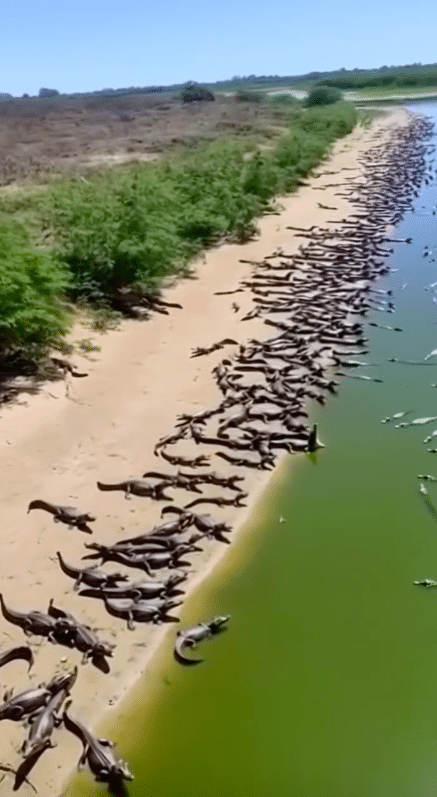
The clip gained major attention after being shared online with alarming captions describing the situation as a crocodile “invasion.”
One widely shared post claimed that beaches in Brazil had been flooded by thousands of crocodiles and that local residents were panicking in fear.
That description fueled intense reactions online.
Some social media users immediately connected the footage to climate change, suggesting rising temperatures were forcing dangerous animals into human-populated areas.
Others described the scene as something out of a horror movie.
But many viewers started questioning the claims almost immediately.
The Animals Weren’t Actually Crocodiles
One of the biggest misunderstandings involved the animals themselves.
The reptiles shown in the video are not true crocodiles.
According to wildlife experts and local commenters familiar with the region, the animals are actually yacare caimans — a species closely related to alligators and crocodiles.
Caimans are common throughout parts of South America, especially in wetlands and river systems.
They often gather in large numbers in areas where food and environmental conditions are favorable.
The “Beach” Wasn’t a Beach at All
Another major detail was also incorrect.
The location shown in the video is not a coastal ocean beach.
The footage was actually filmed along a riverbank in the Pantanal region of Brazil — one of the largest tropical wetland ecosystems in the world.
Once longer versions of the video surfaced online, viewers could clearly see the environment was inland rather than coastal.
That completely changed the story.
The reptiles were not invading tourist beaches or populated swimming areas.
They were simply resting in their natural habitat.
Why So Many Caimans Were Gathered Together
To many people unfamiliar with the Pantanal, the massive gathering looked alarming.
But for locals, scenes like this are not unusual.
The Pantanal is known for having one of the largest concentrations of crocodilian species on Earth. Wildlife organizations estimate that millions of caimans inhabit the region.
These reptiles are ectothermic, often referred to as cold-blooded animals, meaning they rely on external temperatures to regulate their body heat.
That’s why they frequently gather along riverbanks to sunbathe.
During certain seasons, large groups may rest together along muddy shores and shallow waters.
So while the viral clip looked shocking online, the behavior itself was completely natural.
The Original Source of the Footage
As internet investigators traced the video back to its source, they discovered it had originally been uploaded by a Brazilian outdoor and sporting company located in the Pantanal region.
The original caption was far less dramatic.
Instead of warning about invasions or panic, the uploader simply joked about never seeing so many caimans gathered together at once.
There was no mention of beaches being overtaken.
No emergency.
No public panic.
Just wildlife behaving normally in one of the richest ecosystems in South America.
Social Media Reactions Divided the Internet
Despite the clarification, reactions online remained intense.
Some viewers were fascinated by the enormous concentration of reptiles.
Others argued the animals weren’t invading anything at all.
One commenter summarized the situation perfectly:
“Don’t call it an invasion. Humans moved into their habitat first.”
That comment sparked wider discussions about wildlife conservation and how quickly misleading captions can distort reality online.
Many people admitted they believed the original claims before learning the full story.
Understanding the Pantanal Ecosystem
The Pantanal stretches across parts of:
- Brazil
- Bolivia
- Paraguay
It is considered one of the most biodiverse wetland systems on the planet.
The region supports:
- Jaguars
- Giant otters
- Capybaras
- Anacondas
- Thousands of bird species
- Millions of caimans
Because waterways dominate the landscape, reptiles thrive there naturally.
Large gatherings of caimans along riverbanks are considered a normal part of the ecosystem rather than a danger or invasion.
Why Viral Videos Can Be Misleading
The dramatic captions attached to the footage played a major role in its spread.
Social media often rewards shocking content, especially when videos trigger fear or surprise. But without context, even completely ordinary wildlife behavior can appear dangerous or apocalyptic.
In reality:
- The animals were not attacking people.
- The location was not a public beach.
- Residents were not panicking.
- The reptiles were simply in their natural environment.
The story serves as another reminder that viral clips don’t always tell the full truth.
Final Thoughts
The video of “crocodiles taking over a Brazilian beach” may have looked terrifying, but the reality behind the footage is far less dramatic.
What viewers actually saw was a group of caimans resting peacefully along a riverbank deep within one of the world’s largest wetland ecosystems.
No invasion.
No chaos.
Just nature behaving exactly as it always has.
And while the clip certainly captured the internet’s attention, it also revealed how quickly misinformation can spread when shocking visuals appear without proper context.


