What started as a relaxing evening with friends quickly turned into a frightening moment one family won’t forget anytime soon.
Everyone was gathered around chatting when a sudden loud bang erupted from the kitchen.
“It sounded like something exploded,” the homeowner recalled.
The group rushed toward the noise only to discover shattered glass scattered across the floor. The oven door had completely shattered — even more shocking, the oven wasn’t even turned on.
Thankfully, no one was injured.
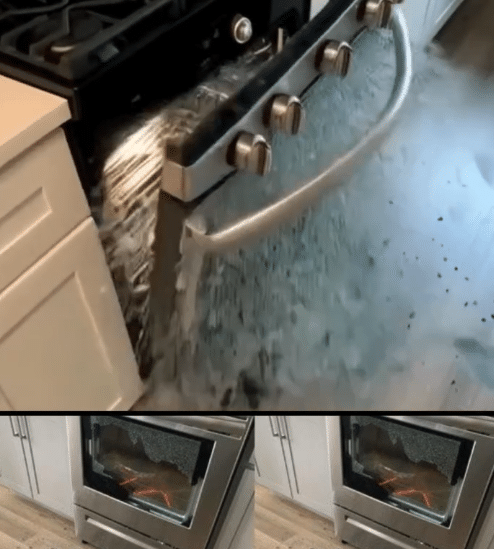
But the incident left everyone asking the same question:
How can an oven glass door suddenly explode by itself?
The Surprising Truth About Oven Glass
Although it sounds unbelievable, spontaneous oven glass breakage is more common than many people realize.
Most modern ovens use tempered glass, a specially treated material designed to withstand high heat and rapid temperature changes. Tempered glass is much stronger than ordinary glass, but under certain conditions, it can suddenly shatter without warning.
When it breaks, it often explodes into hundreds of tiny pieces accompanied by a loud popping or blasting sound — exactly like what many homeowners describe hearing.
What Causes an Oven Door to Shatter?
Experts say several factors can contribute to sudden oven glass failure.
1. Thermal Stress
One of the most common causes is thermal stress.
During cooking, oven glass repeatedly expands and contracts as temperatures rise and fall. Over time, tiny invisible weaknesses can develop inside the glass.
Even if the oven is not actively being used, leftover stress from previous heating cycles may eventually cause the glass to fail unexpectedly.
Rapid temperature changes can make the problem worse, including:
- Opening a very hot oven suddenly
- Splashing cold liquid onto warm glass
- Placing frozen items near heated surfaces
- Uneven heating inside the oven
Eventually, the internal pressure becomes too much for the glass to handle.
And then — it shatters.
2. Tiny Manufacturing Defects
In some cases, microscopic flaws inside tempered glass can remain hidden for months or even years before suddenly causing the panel to break.
These imperfections are often impossible to detect with the naked eye.
A small nick near the edge of the glass can slowly weaken the entire structure over time until one day the pressure releases all at once.
3. Damage Around the Edges
The edges of tempered glass are especially vulnerable.
Even a small bump from cookware, repeated slamming of the oven door, or pressure from loose hinges can create stress points.
The damage may seem insignificant at first, but eventually it can trigger catastrophic failure.
Why It Sometimes Happens When the Oven Is Off
Many people are shocked when oven glass breaks while the appliance isn’t running.
But experts explain that tempered glass stores internal tension. Once the structural balance is disrupted, the glass can fail at any moment — even hours after the oven has cooled down.
That’s why some homeowners report hearing a loud explosion in the middle of the night or long after dinner is over.
How to Reduce the Risk
While spontaneous glass breakage can’t always be prevented, experts recommend several precautions:
- Avoid slamming the oven door
- Don’t place heavy cookware against the glass
- Never splash cold water onto hot glass
- Inspect the oven regularly for chips or cracks
- Replace damaged seals or loose hinges quickly
- Allow the oven to cool gradually after use
Routine maintenance can significantly reduce stress on the glass over time.
A Reminder Many Homeowners Never Expect
For the family in this viral story, the experience was both terrifying and eye-opening.
What seemed impossible at first turned out to be a real — and surprisingly well-documented — household hazard.
Thankfully, no one was standing near the oven when the glass shattered.
But the incident serves as a powerful reminder that even everyday appliances can fail unexpectedly under the right conditions.
And sometimes, the loudest warning comes when everything appears perfectly normal.