Many drivers are familiar with common road markings like yellow center lines, white lane dividers, and crosswalk indicators.
But in some parts of the United States, people have recently started noticing something unusual:
A thin blue line painted directly between the yellow center lines of certain roads.
The unexpected marking has sparked curiosity online, with many drivers wondering whether it represents a new traffic rule, emergency lane, or hidden safety signal.
The real meaning, however, is more symbolic than many people realize.
What the Blue Line Represents
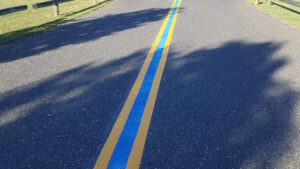
In communities such as Ocean City, blue lines painted on roads are intended as a tribute to law enforcement officers.
The marking is often connected to the “Thin Blue Line” symbol, which has long been associated with police departments and officers serving their communities.
According to local officials, the line was added as a gesture of recognition for officers who work to maintain public safety and respond to emergencies every day.
In some locations, the painted line reportedly leads toward a local police department or municipal building.
Why Some Communities Support It
Supporters of the blue road markings say they serve as a visible reminder of the sacrifices law enforcement officers make while protecting local neighborhoods.
Officials in Ocean City explained that the line was designed to honor officers working in a busy coastal community that experiences large crowds, tourism, and public safety challenges throughout the year.
Many residents viewed the project as a sign of appreciation and community support.
Not an Official Traffic Instruction
One important detail many drivers misunderstand is that the blue line is generally symbolic — not a standard traffic control marking.
It does not change driving laws, lane directions, or road rules.
Drivers should continue following normal traffic markings and local regulations exactly as usual.
Transportation experts note that official roadway markings in the United States are generally standardized under national traffic safety guidelines, while decorative or commemorative markings are often approved locally.
Why the “Thin Blue Line” Symbol Sparks Debate
Although many people see the symbol as a way to support police officers, the “Thin Blue Line” has also become controversial in some communities.
Critics argue that the symbol can carry political or social associations depending on context and public perception.
Others believe it should remain strictly connected to honoring fallen officers and first responders.
As a result, reactions to blue road markings have varied across the country.
Some residents praise the gesture, while others question whether public roads should include symbolic or politically interpreted imagery.
Similar Symbolic Road Markings Exist Elsewhere
Blue lines are not the only symbolic markings used in communities.
Across the United States, some cities have added:
- Red lines honoring firefighters
- Green markings for environmental awareness
- Rainbow crosswalks supporting LGBTQ+ communities
- Memorial roadway signs for veterans or public servants
These projects are often intended to reflect local identity, history, or public appreciation efforts.
Road Safety Still Comes First
Despite the public conversation surrounding blue lines, traffic officials continue emphasizing that drivers should remain focused on standard road safety practices above all else.
Experts recommend:
- Paying close attention to official traffic signs
- Avoiding distractions while driving
- Following speed limits and lane markings
- Staying alert in unfamiliar areas
Symbolic markings may attract attention, but they do not replace official roadway instructions.
Final Thoughts
The blue line appearing on certain roads is not a hidden traffic warning or mysterious new driving rule.
In many communities, it is simply a symbolic tribute to law enforcement officers and their role in public safety.
Whether viewed as meaningful recognition or a topic of public debate, the markings have certainly captured drivers’ attention and sparked conversations nationwide.
And for many people, it became another reminder that even small changes on familiar roads can carry much larger meanings.


