A viral video claiming to show a grizzly bear rescuing a trapped deer in Jasper National Park has captured global attention, leaving millions of viewers amazed, emotional, and curious. But as compelling as the footage appears, the truth behind the story reveals a fascinating look at how modern technology is reshaping online content.
According to the original description , the scene is set on October 14, 2025, along a quiet mountain pass in Jasper National Park, Canada. What begins as a tense wildlife situation quickly transforms into something that looks almost unbelievable.
The Scene That Captivated Millions
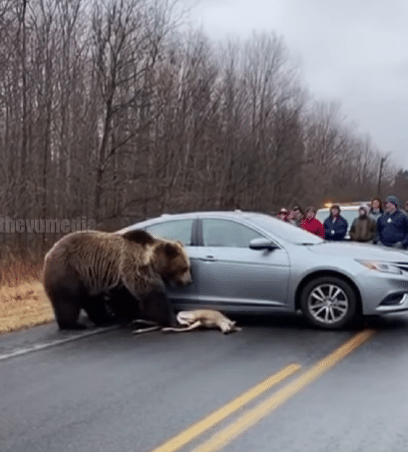
The video opens with a small buck trapped beneath a stationary sedan. Its body appears wedged under the vehicle, struggling to break free. Nearby, a few bystanders can be heard reacting with concern, but they remain at a distance—understandably cautious given the unpredictability of wildlife.
For a moment, the situation seems hopeless.
Then, from the edge of the forest, a massive grizzly bear emerges.
The mood instantly shifts. Concern turns into fear as viewers—and those in the video—anticipate what might happen next. In real-world scenarios, such an encounter could be extremely dangerous.
But instead of aggression, the bear does something unexpected.
An “Unreal” Rescue Moment
The bear approaches the vehicle calmly and places its powerful paws against the car. With what appears to be ease, it lifts the sedan just enough for the trapped deer to escape.
Within seconds, the deer scrambles free and runs back into the forest.
The bear then gently lowers the vehicle and walks away, disappearing into the trees as quietly as it arrived.
The entire sequence feels almost cinematic—too perfect, too precise, and emotionally powerful in a way that immediately resonated with viewers.
Why the Internet Couldn’t Look Away
Video: Deer chasing a bear on the highway?!
Once shared online, the video spread rapidly across social media platforms. Millions of people watched, commented, and reshared the clip.
Reactions ranged from disbelief to admiration:
- Some called it “the most wholesome wildlife moment ever”
- Others compared it to scenes from animated films
- Many expressed emotional reactions, saying the video gave them hope or joy
The idea of a powerful predator helping another animal challenged expectations and created a rare, feel-good narrative that people wanted to believe.
The Truth Behind the Video
Despite its realism, the video is not real.
It was created using artificial intelligence and clearly labeled as fictional entertainment.
No grizzly bear lifted a car, and no deer was rescued in this way. The entire scene was digitally generated to tell a compelling and imaginative story.
Even after this revelation, the video continued to gain traction.
The Rise of AI-Generated Content
This viral moment highlights a growing trend: AI-generated videos that blur the line between reality and fiction.
With advancements in visual technology, creators can now produce highly realistic scenes that are emotionally engaging and visually convincing. This opens up new opportunities for storytelling—but also raises important questions about authenticity and media literacy.
Viewers are now faced with a new challenge:
How do we distinguish between what’s real and what’s created?
Why It Still Resonates
Even though the video is fictional, its impact remains strong.
The story taps into something universal—the idea of unexpected kindness in a place where it seems unlikely. A predator helping prey is a powerful narrative twist that captures attention and emotion instantly.
In a fast-moving digital world filled with negative headlines, even fictional moments of compassion can feel refreshing.
That emotional connection is what keeps people watching, sharing, and discussing the video long after they learn the truth.
A Reminder for the Digital Age
This story serves as both entertainment and a reminder.
While AI technology allows for creative and engaging content, it also reinforces the importance of critical thinking when consuming media online. Not everything we see—even if it looks completely real—is based on actual events.
At the same time, it shows the power of storytelling.
Whether real or imagined, stories that evoke emotion, curiosity, and wonder will always find an audience


