
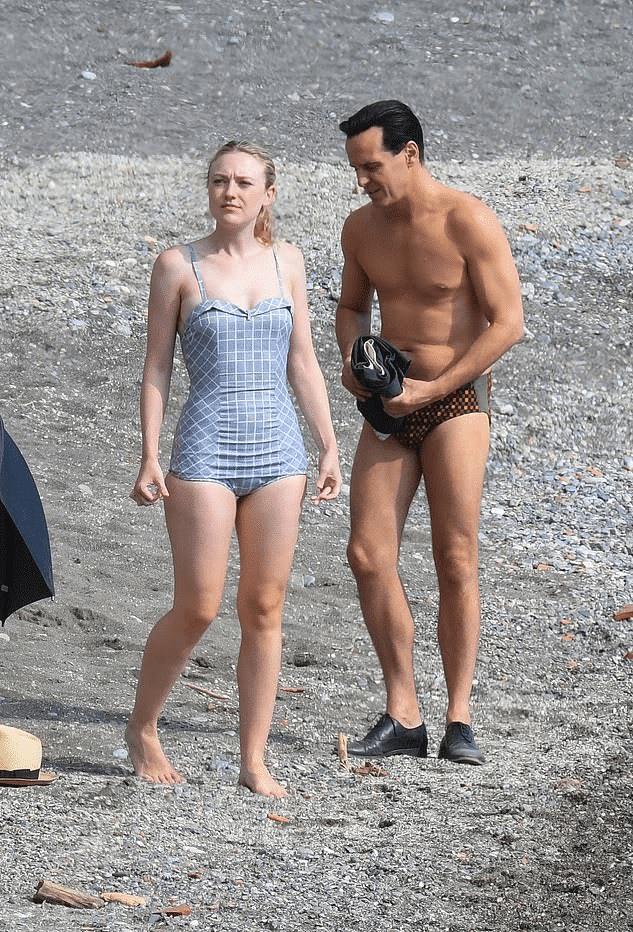
At first glance, the photographs seem to show two actors enjoying an easy afternoon by the Italian coast. The sea is calm, the light is bright, and the clothing looks perfectly suited to a warm day near the water.
But these are not vacation pictures.
The woman is Dakota Fanning, and the man beside her is actor and musician Johnny Flynn. They were photographed in Italy while filming Ripley, the 2024 television adaptation of Patricia Highsmith’s celebrated novel The Talented Mr. Ripley.
Fanning played Marge Sherwood, while Flynn played Dickie Greenleaf. Their relaxed seaside appearance was part of the carefully constructed world of the series—a world that would later be transformed into striking black-and-white images for Netflix audiences.
A Story With a Long Screen History
Patricia Highsmith introduced readers to Tom Ripley in 1955. Her novel told the story of a young American who becomes fascinated by wealth, identity, and the possibility of taking another person’s place.

The character has inspired several acclaimed screen adaptations. Many moviegoers remember Alain Delon in Purple Noon from 1960. Others hold a special place for Anthony Minghella’s 1999 film The Talented Mr. Ripley, starring Matt Damon, Jude Law, Gwyneth Paltrow, Cate Blanchett, and Philip Seymour Hoffman.
That 1999 version remains memorable for its sunlit Italian locations, glamorous costumes, and quietly growing tension.
The newer Ripley series did not try to repeat the earlier film. Writer-director Steven Zaillian chose a slower, more deliberate approach, expanding the story across eight episodes and giving viewers more time to observe the characters’ suspicions, silences, and shifting relationships.
Dakota Fanning as Marge Sherwood
Dakota Fanning has spent most of her life in front of cameras. She became widely known as a child through acclaimed performances in films including I Am Sam, Man on Fire, War of the Worlds, and Charlotte’s Web.
As an adult, she has continued choosing roles across film and television, avoiding the trap of being remembered only for childhood success.
In Ripley, Fanning plays Marge Sherwood, an American writer living in Italy with Dickie Greenleaf. Marge has a sharper sense of observation than many people around her. She notices details, questions inconsistencies, and gradually becomes uneasy about Tom Ripley.
The longer television format gave the character room to breathe. Marge is not simply an observer standing outside the central drama. She has her own interests, her own intelligence, and her own growing awareness that something in Dickie’s world has changed.
Fanning brought a restrained strength to the role, allowing Marge’s uncertainty to build gradually rather than turning every suspicion into a dramatic display.
Johnny Flynn and the Character of Dickie Greenleaf

Johnny Flynn played Dickie Greenleaf, the wealthy American expatriate whose life in Italy becomes the object of Tom Ripley’s fascination.
Flynn is known not only as an actor but also as a singer-songwriter and stage performer. His previous screen work includes Beast, Emma., and Stardust.
As Dickie, he creates the portrait of a young man who seems to have everything: money, freedom, beautiful surroundings, and time to pursue artistic ambitions. He paints, swims, visits cafés, and lives with an ease that Tom finds irresistible.
But that ease is also central to the danger of the story. Dickie does not fully understand how closely he is being watched or how deeply Tom wants the life he appears to take for granted.
The beach scenes with Marge help establish Dickie’s world before Tom Ripley begins to change its atmosphere.
Why the Photos Look So Different From the Finished Show
One of the most fascinating details about these production images is their color.
The actors stand beside a blue sea in period swimwear, surrounded by the natural tones of the Italian coastline. Yet viewers of Ripley know the finished series almost entirely through black, white, and shades of gray.
Steven Zaillian planned the series as a black-and-white production from the beginning. That decision affected every department, including costumes, lighting, production design, makeup, and cinematography.
A pattern, fabric, or color that looked right in person also had to create the right contrast once filmed in monochrome. Costume designers Maurizio Millenotti and Giovanni Casalnuovo helped build a wardrobe that could work within this unusual visual system.
The behind-the-scenes images reveal the vibrant real world that existed before the camera turned it into a cool, elegant noir landscape.
Italy as a Working Film Location
The beauty of Ripley comes partly from its Italian locations, but the series was not simply a travel postcard.
Production took place in locations including Atrani, Naples, Rome, Palermo, Venice, Capri, and Anzio. Different areas often stood in for one another, allowing the production team to build a convincing early-1960s Italy from many separate places.
Dakota Fanning spent months in Italy during the filming process. For the cast and crew, it was a long work assignment involving travel, costume fittings, changing locations, rehearsals, and demanding days on set.
The coastal scenes may appear effortless, but they required detailed planning. Camera placement, light, weather, period design, and the movement of actors all had to support the story’s growing tension.
Andrew Scott’s Unsettling Tom Ripley
Andrew Scott played Tom Ripley in the series. His version of the character is quieter and older than some earlier screen interpretations.
Scott’s Tom is always watching. He studies people’s homes, routines, voices, and possessions with intense concentration. Italy’s beauty does not soften the story; instead, it becomes part of the contrast between the peaceful setting and Tom’s increasingly dangerous ambitions.

The black-and-white cinematography helps make even familiar locations feel mysterious. A staircase, a hotel hallway, a train compartment, or a quiet beach can seem filled with unspoken threat.
This was a key difference from the richly colored 1999 film. Both versions use Italy beautifully, but Ripley turns that beauty into part of a darker psychological design.
From Showtime Plans to a Netflix Premiere
The series was initially developed for Showtime, which is why early reports sometimes describe it as an upcoming Showtime project.
By the time it was completed, however, Ripley had moved to Netflix. All eight episodes premiered on April 4, 2024.
The finished production was widely recognized for its craftsmanship. It received 13 Emmy nominations and won four awards, including honors for Steven Zaillian’s direction and Robert Elswit’s cinematography.
Those awards underline what the casual-looking beach photographs cannot fully show: every scene was part of an elaborate visual plan.
Why Behind-the-Scenes Images Are Worth Saving
The photos of Dakota Fanning and Johnny Flynn are more interesting once their true setting is known.
They are not evidence of a secret holiday or a celebrity couple. They document two actors at work, in costume, helping create one of television’s most visually distinctive literary adaptations.
For viewers who remember earlier versions of The Talented Mr. Ripley, the images offer an unusual bridge between generations. They show the colorful, physical reality of a production that audiences would later experience in elegant monochrome.
Dakota Fanning and Johnny Flynn were not simply standing by the sea. They were building Marge and Dickie’s world—one that would soon be disrupted by Andrew Scott’s unforgettable Tom Ripley.