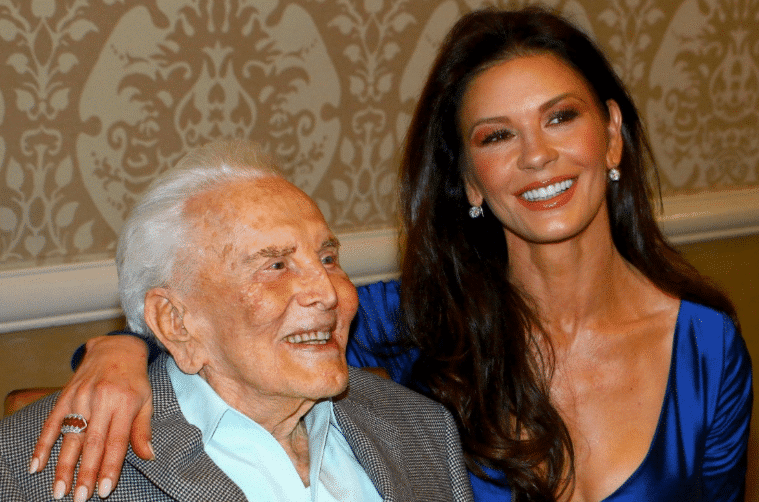
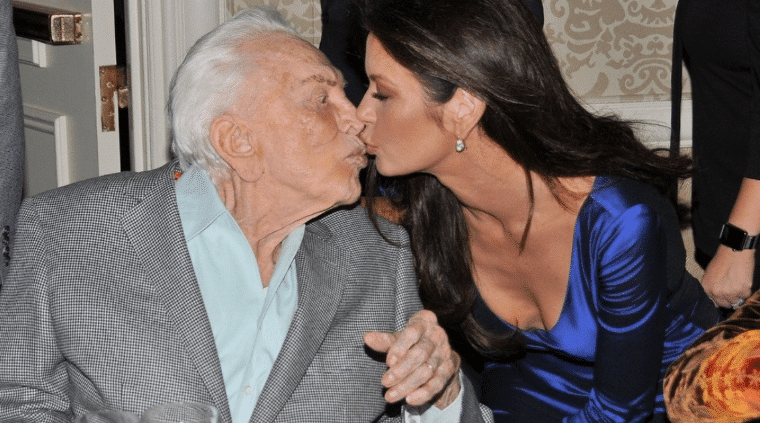
A black-and-white photograph of Catherine Zeta-Jones sharing a kiss on the cheek with Kirk Douglas has circulated online with headlines designed to make viewers wonder what they are seeing.
The truth is far more touching than any rumor.
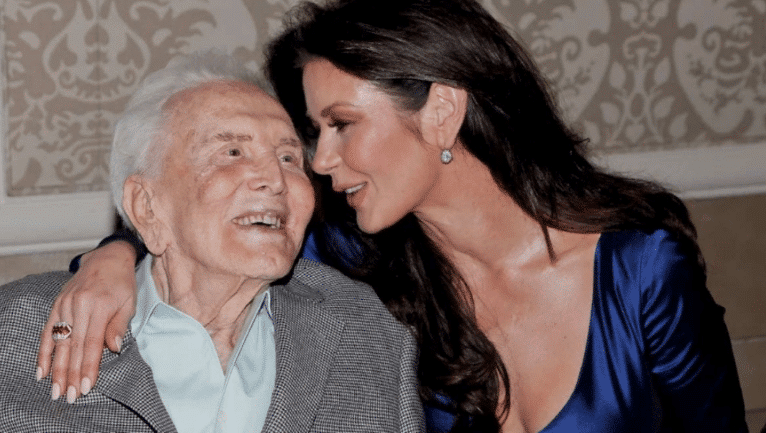
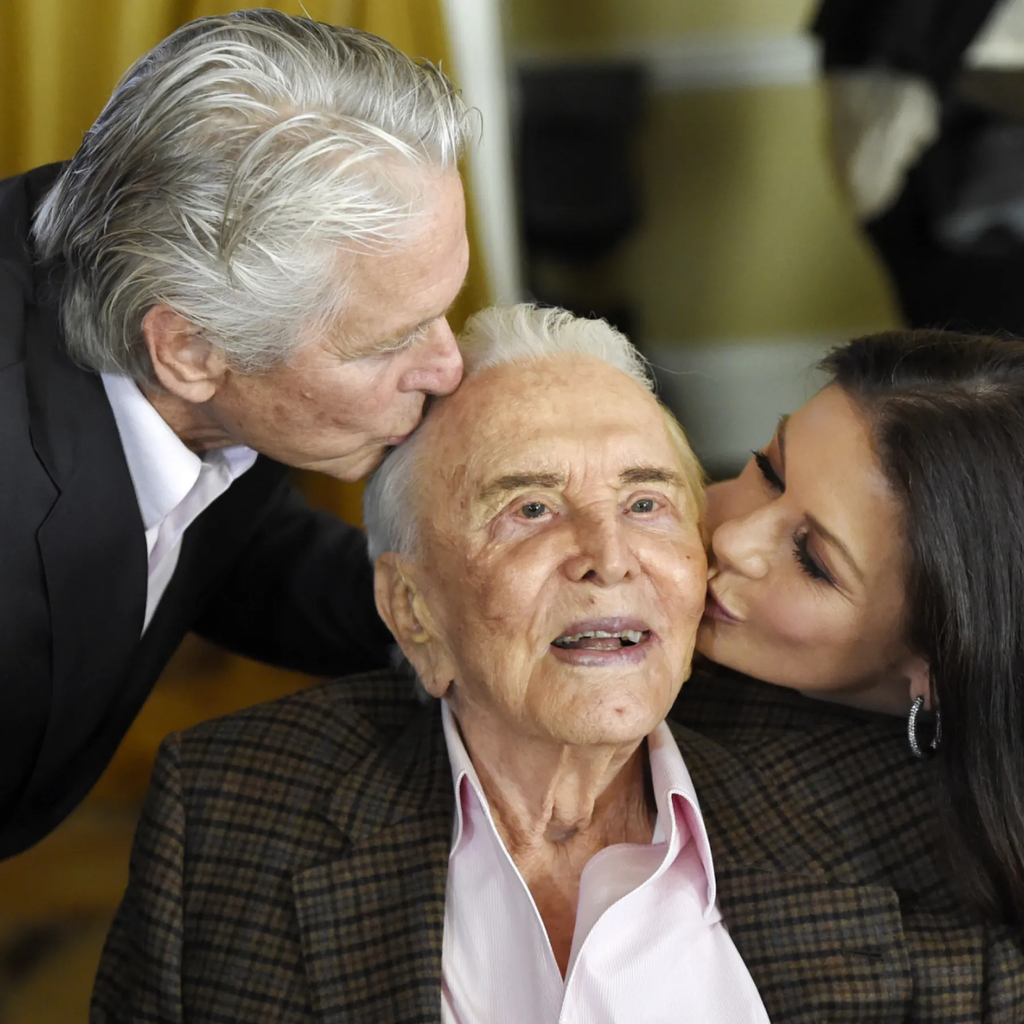
The image captures a family moment between Catherine Zeta-Jones and her father-in-law, Kirk Douglas—one of the defining stars of classic Hollywood. Catherine has been married to Kirk’s son, Michael Douglas, since 2000, and the photograph reflects the affection shared within a well-known Hollywood family.
Kirk Douglas died in 2020 at the age of 103, leaving behind a remarkable body of work and a legacy that reached well beyond the films he made. For those who knew him best, he was also a father, grandfather, and great-grandfather whose presence shaped generations of the Douglas family.
Kirk Douglas Was More Than a Movie Star
Kirk Douglas became one of the great screen actors of the twentieth century through force of personality, discipline, and an unmistakable voice.
Born Issur Danielovitch in 1916, he grew up in a poor immigrant family in Amsterdam, New York. His parents had come to the United States from what is now Belarus, and Douglas worked hard from an early age to pursue an education and a career in acting.
He studied at St. Lawrence University and later attended the American Academy of Dramatic Arts in New York City. The path was not easy, but he built his reputation through theater before making his way into films.
Douglas never seemed interested in playing only agreeable characters. He was drawn to people who were ambitious, flawed, angry, determined, or impossible to ignore. That willingness to take risks made him one of the most compelling actors of his era.
The Performances That Defined an Era
Kirk Douglas earned three Academy Award nominations for Best Actor: for Champion, The Bad and the Beautiful, and Lust for Life.
In Champion, he played a boxer whose rise is complicated by ruthless ambition. In The Bad and the Beautiful, he portrayed a driven Hollywood producer whose brilliance and selfishness are closely intertwined. In Lust for Life, he took on the role of Vincent van Gogh, bringing intensity and vulnerability to the troubled artist.
These performances showed why Douglas mattered. He had a powerful physical presence, but he also understood conflict. His characters were rarely simple heroes. They often forced audiences to see both the strength and damage inside a person chasing success.
That complexity helped set a new standard for dramatic film acting in the postwar years.
The Defiance of Spartacus
For many viewers, Kirk Douglas will always be associated with Spartacus.
Released in 1960, the epic historical drama told the story of a rebellious gladiator who leads an uprising against Rome. Douglas played the title role with the determination and emotional force that had become his trademark.
The film is remembered not only for its scale but also for its importance in Hollywood history. Douglas, who was also a producer on the project, publicly credited screenwriter Dalton Trumbo at a time when Trumbo had been blacklisted. The decision helped challenge one of the industry’s most damaging periods of political exclusion.
That choice reflected something essential about Douglas. He was a major star, but he was also willing to use his influence when he believed it mattered.
A Family Built Around Film
Kirk Douglas’s influence extended naturally into his family.
His son Michael Douglas became a major actor and producer in his own right, winning Academy Awards and building an acclaimed career through films such as Wall Street, Fatal Attraction, and The American President.
Michael married Catherine Zeta-Jones in 2000. By then, she was already an established actor, known for her work in The Mask of Zorro, Entrapment, and later the Oscar-winning musical Chicago.
Together, Michael and Catherine became one of Hollywood’s most visible couples, but their relationship with Kirk was also clearly personal. Family photographs and public tributes often showed warmth, humor, and mutual admiration.
The image of Catherine kissing Kirk on the cheek belongs in that context. It is not a shocking celebrity moment. It is a daughter-in-law showing affection for a beloved family elder.
Catherine Zeta-Jones and Kirk Douglas
Catherine Zeta-Jones has spoken warmly about Kirk Douglas over the years.
She joined a family with deep Hollywood roots, but she also created her own career through discipline and talent. Her performances have ranged from adventure films and thrillers to comedy, drama, and musicals.
Her role as Velma Kelly in Chicago earned her the Academy Award for Best Supporting Actress in 2003. The performance showcased her skill as a singer, dancer, and actor—qualities that placed her firmly among the most versatile performers of her generation.
Kirk Douglas understood the demands of a screen career better than most people. That shared understanding may be one reason the family connection appears to have been so affectionate.
A Life Marked by Resilience
Kirk Douglas lived through more than a century of enormous change.
He survived a helicopter crash in 1991 and suffered a stroke in 1996 that affected his speech. Both experiences required him to adapt to a different life, but he continued writing, making public appearances, and engaging with charitable work.
He and his wife, Anne Buydens, were married for more than six decades. Together, they supported philanthropic causes through the Douglas Foundation, giving to education, health care, arts organizations, and other community efforts.
Douglas’s later years were not simply a long farewell to an old Hollywood career. They were an active continuation of a life built around work, family, recovery, and giving back.
Why the Photograph Still Matters
Celebrity images often travel online without their original context. A warm family gesture can be misrepresented as a mystery, and a cherished memory can be turned into an attention-grabbing headline.
But the real story of this photograph is more meaningful.
It shows Catherine Zeta-Jones and Kirk Douglas as members of one family, connected by affection and by a shared understanding of a life in the public eye. It also reminds viewers that Kirk’s legacy was not limited to his most famous roles.
He was a pioneering actor, a producer willing to take a stand, a survivor, a philanthropist, and the patriarch of a family that continues to contribute to film and culture.
The kiss on the cheek is not surprising once the context is known. It is simply a small, tender expression of the love that surrounded a Hollywood legend long after the cameras stopped rolling.