
For generations of rock fans, the opening notes of a Queen song can be recognized in seconds. A soaring guitar harmony, a dramatic melody, or a single sustained note is often enough to bring back memories of concerts, radio countdowns, and records played until the grooves wore thin.
At the center of that sound was Brian May.
As Queen’s guitarist and one of its principal songwriters, May helped create music that was bold, theatrical, emotional, and unlike anything else on the radio. His work did not merely support the band’s songs. It helped define their identity.
A photograph from a difficult period in someone’s life can travel online without context. But Brian May’s story is far larger than one dated image. It is the story of a musician, songwriter, scientist, and lifelong creative thinker whose work has reached audiences around the world.
The Birth of a Distinctive Sound
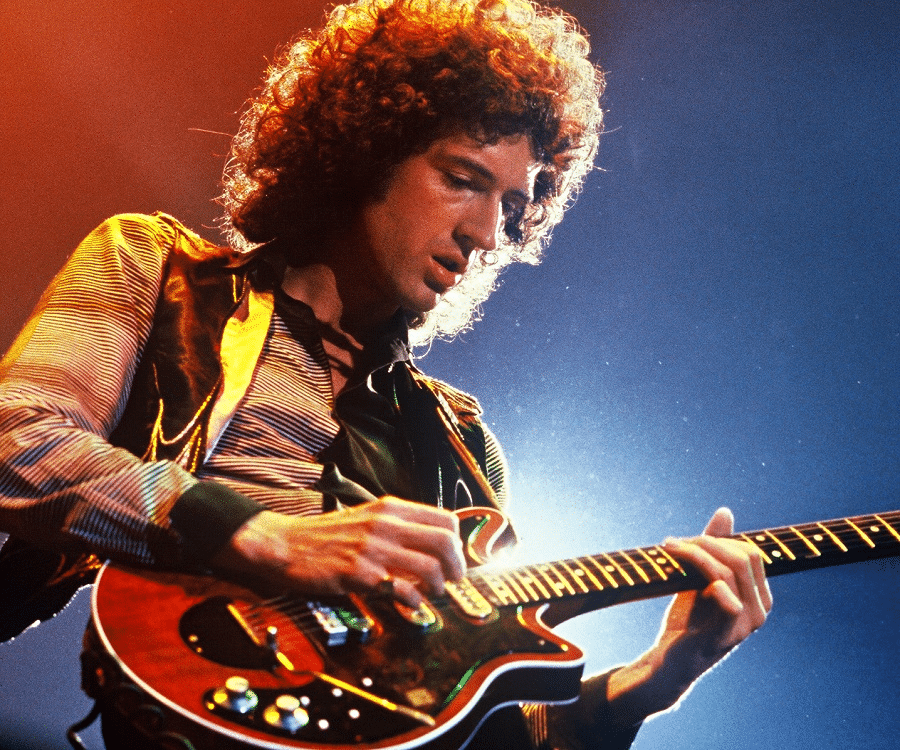
One of the most remarkable facts about Brian May is that he helped build the guitar that became his signature instrument. Known as the Red Special, it was made with his father when May was a teenager.
The instrument was not designed to copy what other guitarists were using. It was built to create a sound of its own. Its unusual construction, combined with May’s careful use of a small coin as a guitar pick, produced tones that could be bright, warm, sharp, or almost orchestral.
That sound became essential to Queen.
When listeners hear the layered guitars in songs such as “Bohemian Rhapsody,” “Killer Queen,” or “We Will Rock You,” they are hearing more than technical skill. They are hearing an artist who treated the guitar as a way to tell a story.
May could make one instrument sound like a choir, a brass section, or a conversation between several voices.
The Early Days of Queen
Queen formed in London in the early 1970s, bringing together Brian May, Freddie Mercury, Roger Taylor, and John Deacon. Each member brought a distinct musical personality, but May’s guitar work gave the band a powerful and recognizable foundation.
The group did not fit neatly into one category. They could be hard rock, glam rock, pop, opera-inspired theater, or stadium anthem—all within the same album.
That variety was a strength. Queen was not interested in making the same song twice, and Brian May’s versatility made that possible. He could play a delicate acoustic part when a song needed tenderness, then shift into a dramatic solo that filled an arena.
The band’s willingness to experiment helped it stand apart from many of its contemporaries. It also made Queen’s catalog feel fresh decades later.
The Guitar Solos Fans Never Forget

Some guitar solos are simply memorable. Brian May’s often feel like complete miniature stories.
His solo in “Bohemian Rhapsody” does not interrupt the song; it deepens the emotion. In “Somebody to Love,” his guitar gives the music a soulful lift. In “Brighton Rock,” he created an extended live showcase that revealed both his technical control and playful imagination.
May also knew that restraint could be just as powerful as speed. He did not fill every space with notes. Instead, he listened to what the song required.
That is one reason his playing continues to inspire younger musicians. His work is not only about ability. It is about melody, atmosphere, and making the instrument serve the larger feeling of a song.
For Queen fans, a Brian May guitar line can bring back the sensation of a packed stadium even when it is heard through a living-room speaker.
A Songwriter in His Own Right
Brian May was not only Queen’s lead guitarist. He also wrote many of the band’s important songs.
“We Will Rock You” became one of the most recognizable crowd anthems in music history. Its simple stomp-stomp-clap rhythm invited listeners to become part of the performance. The song has been played at sporting events, celebrations, and concerts for decades because it creates a feeling of shared energy almost immediately.
May also wrote “The Show Must Go On,” a powerful late-era Queen song that has become a statement of resilience for many listeners.
His songwriting often combined direct emotion with grand musical ideas. He understood how to make a song feel personal and enormous at the same time.
More Than a Rock Musician
Brian May’s life has always included interests beyond the stage. Before Queen’s rise to worldwide fame, he had been studying physics and astronomy. Years later, he returned to academic work and completed his doctorate in astrophysics.
That achievement surprised some people who knew him only as a rock star, but it made perfect sense. The same curiosity that led him to experiment with sound also led him to look toward the stars.
May has spoken about astronomy, stereoscopic photography, and science with genuine enthusiasm. He has shown that creative and academic passions do not have to compete with each other.
His career is a reminder that a person can have more than one calling. A musician can also be a scholar. A public figure can remain a lifelong student.
A Commitment to Animal Welfare
Another important part of May’s public life has been his work for animal welfare. He has used his voice to support causes he cares about and has remained deeply engaged with campaigns intended to protect animals.
For fans, this work adds another dimension to his legacy. It shows a person willing to use fame for something beyond personal success.
Rock history often celebrates the noise, glamour, and spectacle of a career. Brian May’s charitable work points to a quieter kind of influence: the decision to pay attention, speak up, and support change.
Keeping the Context of Old Photographs
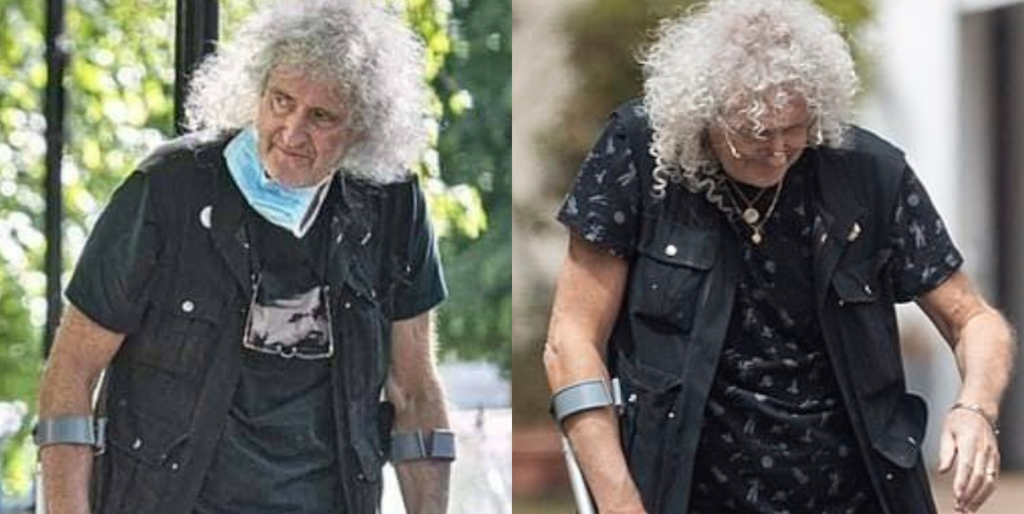
Images from 2020 showing Brian May using crutches are sometimes shared without their original context. They documented a past period of recovery, not a current emergency.
That distinction is important. Public figures deserve accuracy and basic respect, especially when old images are recirculated as if they were new.
Brian May has continued to share music, ideas, and creative work with fans. His career should be remembered through its full context, not reduced to one brief and difficult chapter.
Why Brian May’s Legacy Still Matters
Brian May remains a vital figure because his work with Queen has never gone out of style. New listeners discover the band through films, streaming, live performances, and songs that still appear everywhere from stadiums to family celebrations.
But his legacy reaches beyond Queen’s greatest hits. It includes a guitar built with care, songs written with imagination, a return to scientific study, and a commitment to causes he values.
For longtime fans, Brian May is a reminder of a time when rock bands took big creative risks and made music designed to last. For younger musicians, he remains proof that a distinctive voice is more valuable than following a trend.
The Red Special may have begun as a homemade instrument, but in Brian May’s hands, it became part of the sound of rock history.