Long before reality television brought fashion’s backstage world into living rooms, Janice Dickinson was already known for a larger-than-life presence on the runway.
During the 1970s and 1980s, the modeling industry was changing. Fashion magazines were becoming more international, designers were becoming household names, and certain models began to be recognized far beyond the pages in which they appeared.
Janice Dickinson became one of the faces associated with that transformation. Her confidence, striking look, and direct way of speaking made her difficult to ignore. For many viewers, she would later become even more familiar as a sharp-tongued judge on television. But her story began much earlier, in an era when becoming a recognizable fashion figure required determination, travel, and an unshakable belief in one’s own potential.
Finding Her Own Place in Fashion
Dickinson began pursuing modeling at a time when the business often favored a narrow idea of what a successful model should look like.
She did not quietly accept early rejection. Instead, she continued to pursue opportunities, eventually finding work that took her from New York to Paris and into the fast-moving world of international fashion.

That persistence became one of the defining qualities of her career. Fashion has always been a competitive industry, filled with changing tastes and limited chances to break through. Dickinson’s ability to stand out helped her build a name during a period when models were beginning to gain something closer to celebrity status.
She worked with major photographers, appeared in prominent publications, and became part of the visual language of an era known for bold styling and glamorous editorial photography.
For fans who remember fashion magazines from those decades, her image carries the energy of a time when every new issue felt like a window into another world.
When Models Became Household Names
The word “supermodel” is now used often, but it once described a new kind of cultural figure: a model whose name was known as widely as her face.
In the 1970s and 1980s, modeling began to move beyond the runway. Top names appeared in advertising campaigns, television programs, interviews, and celebrity news. They were no longer simply presenting a designer’s work; they were helping shape public ideas about style, confidence, and modern glamour.

Dickinson was part of that shift. She brought a strong personality to an industry that often expected models to remain silent behind the photographs.
Her willingness to speak frankly made her memorable. Some viewers found her outspoken, while others admired the fact that she did not try to sound like everyone else. Either way, she understood something important: in a crowded profession, being distinctive can be just as valuable as being beautiful.
That sense of individuality helped make her career last well beyond the runway years.
A New Generation Meets Janice Dickinson
Years after her biggest modeling campaigns, Dickinson reached a new audience through America’s Next Top Model.
As one of the show’s early judges, she brought firsthand experience from the fashion world to a competition built around young aspiring models. Her comments were often blunt, but they came from someone who understood the pressure of castings, photo shoots, rejection, and public expectations.
For viewers, Dickinson became one of the show’s most recognizable personalities. She had a dramatic sense of humor, strong opinions, and a refusal to soften every critique.
Reality television can make people seem one-dimensional, but Dickinson’s role also reminded audiences that fashion is a demanding business. A successful photograph may look effortless, yet it depends on preparation, stamina, communication, and the ability to adapt in front of the camera.
Her presence helped make the show’s early seasons especially memorable for many fans.
Life Beyond the Runway

Dickinson did not limit herself to one chapter of her career. She wrote books, appeared on television, and launched her own modeling agency, which later became the focus of the reality series The Janice Dickinson Modeling Agency.
That move showed another side of her professional life. After spending years in front of the camera, she was interested in helping guide younger talent through an industry she knew well.
Her story also reflects the changing possibilities for women in entertainment. A model’s career was once treated as brief by definition, with little discussion of what could come next. Dickinson pushed against that assumption by continuing to work in media, business, and television.
She did not simply remain a memory from an earlier fashion era. She found new ways to use her experience and keep a public voice.
Why Her Career Still Draws Attention
Janice Dickinson remains a compelling figure because she represents more than one generation of popular culture.
Some people remember her from fashion editorials and campaigns. Others know her from America’s Next Top Model. Still others recognize her from reality television, interviews, and her candid approach to public life.
Her career has never followed a quiet or predictable path. That is part of what has made it endure. She has been willing to take risks, speak honestly, and step into unfamiliar roles.

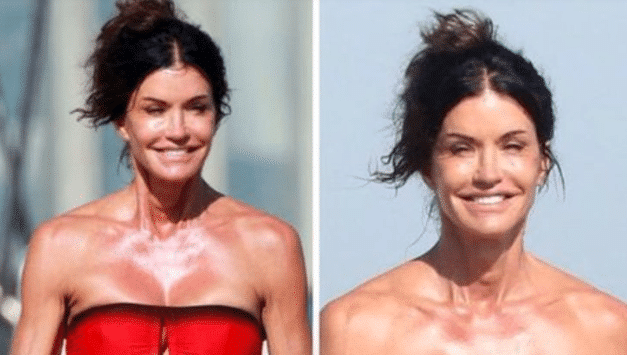
The beach images may draw attention because they show a famous face away from a studio or television set. But the more meaningful story is the work behind that recognition: decades spent building a presence in an industry that rarely stands still.
A Reminder That Style Is More Than One Moment
Fashion is often obsessed with the newest face, the newest look, and the newest trend. Janice Dickinson’s long career offers a useful reminder that real influence is not limited to one photograph or one season.
It comes from character, resilience, and the ability to keep evolving.
She entered fashion when the rules were different, became part of the supermodel era, and later introduced herself to a younger television audience. Along the way, she remained unmistakably herself.
For longtime fans, that is what makes Janice Dickinson’s story worth remembering. She did not simply appear in the fashion world. She helped make it more visible, more dramatic, and more open to personalities who refused to fade quietly into the background.