A quiet photograph of an older gentleman walking beside a blonde woman recently inspired a new wave of curiosity.
Some viewers recognized his thoughtful expression immediately. Others remembered a much younger man with dark hair, intense eyes, and the commanding presence of a romantic hero from another age.
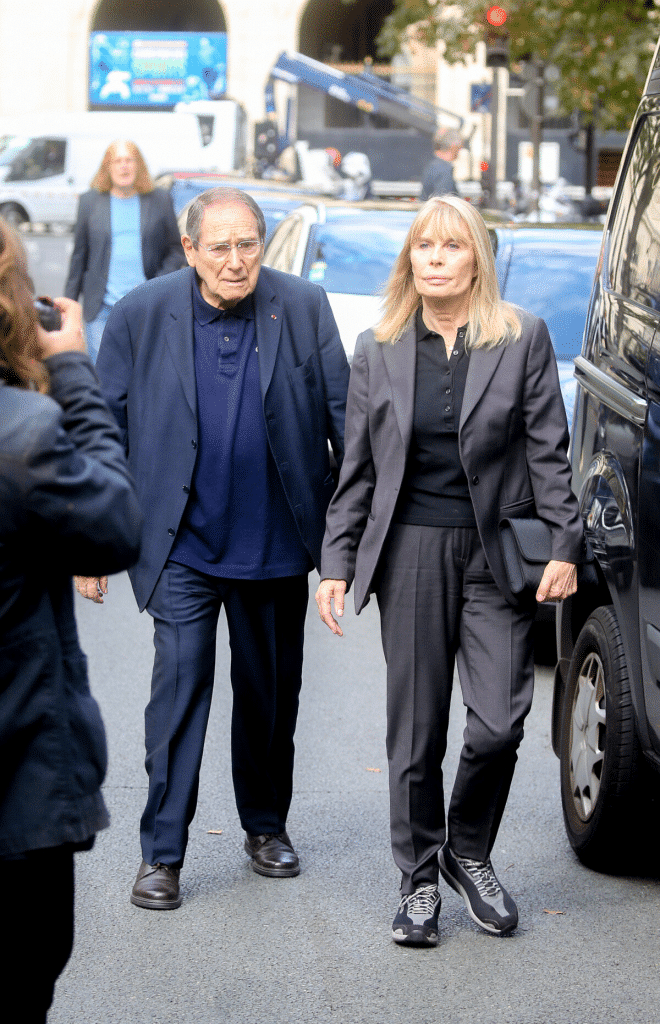
The original webpage described the scene as a “rare recent moment” involving a “mystery woman.” In reality, the photographs are archival. The actor died in 2020, and the woman beside him was not a stranger—she was Candice Patou, his wife of more than four decades.
The man was Robert Hossein, the French actor, filmmaker, screenwriter, and theater director remembered by millions as Joffrey de Peyrac in the celebrated Angélique films.
For French audiences, Hossein represented far more than one famous role. His career stretched across 74 years and included film noir, historical romance, television, literary adaptations, and enormous theatrical productions created for audiences who might never otherwise have entered a traditional playhouse.
A Face That Belonged to Classic European Cinema
Robert Hossein was born in Paris on December 30, 1927.
His earliest professional years unfolded when European cinema was rebuilding after World War II. Movie theaters remained important gathering places, and actors were still introduced to audiences through posters, newspaper advertisements, and carefully composed black-and-white portraits.
At only 19, Hossein wrote and staged his first play, Les Voyous. Around the same period, he appeared in Sacha Guitry’s Le Diable boiteux, beginning a screen career that would eventually place him alongside many of France’s most respected directors and performers.
Video: Robert Hossein in film
His appearance seemed made for the camera.
With a strong profile and an expression that could suggest tenderness, suspicion, or danger, Hossein was frequently cast as men carrying private burdens. He could look romantic without appearing overly polished and threatening without relying on exaggerated gestures.
That combination made him especially effective in crime dramas and emotionally complicated romances.
Working With the Great Directors of His Era
Hossein’s career developed during an exceptional period in French filmmaking.
He appeared in Jules Dassin’s influential crime film Du rififi chez les hommes, which competed at the 1955 Cannes Film Festival. He later worked with directors including Roger Vadim, Claude Autant-Lara, Julien Duvivier, Yves Allégret, and Claude Lelouch.
His leading ladies included some of the most recognizable actresses of European cinema.
He appeared opposite Sophia Loren in Madame Sans-Gêne and Brigitte Bardot in Love on a Pillow. Later generations saw him in films such as Les Uns et les Autres, Venus Beauty Institute, and A Man and His Dog.
For American viewers who discovered foreign films in neighborhood art houses, Hossein’s work may recall a different moviegoing culture.
Imported films did not arrive instantly on streaming services. Audiences often learned about them through newspaper reviews or recommendations from friends. Subtitled screenings could feel like windows into another world—one of Parisian streets, smoky cafés, unfamiliar customs, and stars who carried a different kind of glamour.
Video: Robert Hossein with Brigitte Bardot, Jane Birkin in film
Hossein belonged naturally to that world.
The Role That Made Him a Romantic Icon
His most widely remembered screen role arrived in 1964.
Hossein was cast as Joffrey de Peyrac opposite Michèle Mercier in Angélique, Marquise des Anges. Set in 17th-century France, the film combined romance, court intrigue, danger, and sweeping historical spectacle.
Joffrey was wealthy and powerful, but he was also physically scarred and treated with suspicion by those around him. Hossein played him with dignity, intelligence, and a restrained emotional intensity that made the character deeply appealing.
He returned as Joffrey in several additional films in the series.
The role transformed him into a romantic idol throughout France and across other parts of Europe. Even people who could not remember the titles of every sequel remembered the face, the voice, and the complicated love story at the center of the films.
For viewers who first saw the series decades ago, the images may bring back Saturday matinees, ornate movie palaces, and afternoons when historical adventures offered a welcome escape from ordinary responsibilities.
The costumes may belong to another century, but the emotions were timeless.
Love challenged by circumstance.
A man judged by appearance.
A woman refusing to abandon someone the world had misunderstood.
Those themes helped the films endure long after their original theatrical runs.
He Was Never Satisfied With Acting Alone
Although Joffrey de Peyrac made him famous, Hossein did not want to remain only a leading man.
Beginning in the 1950s, he moved behind the camera and eventually directed approximately 15 feature films. His credits included The Wicked Go to Hell, Toi, le venin, The Vampire of Düsseldorf, Cemetery Without Crosses, and an ambitious adaptation of Victor Hugo’s Les Misérables.
His films often returned to themes of guilt, loyalty, justice, revenge, and moral uncertainty.
They were not always comfortable stories. Hossein appeared interested in people placed under pressure—characters forced to reveal who they truly were when ordinary rules stopped protecting them.
That interest eventually found an even larger home in the theater.
Bringing Theater to People Who Had Never Attended
In 1970, Hossein took charge of the Théâtre populaire de Reims.
His goal was not merely to impress regular theatergoers. He wanted to reach people who believed the theater was too formal, expensive, or distant from everyday life.
The French Ministry of Culture later recalled his determination to approach audiences who had never before entered a theater. At Reims, he helped create productions that used scale, movement, lighting, music, and striking visual arrangements to make classic stories feel immediate.
Hossein understood that many people loved storytelling but felt excluded by cultural institutions.
He tried to remove that barrier.
Instead of asking audiences to admire the theater from a respectful distance, he wanted them to feel surrounded by the story. His productions could resemble historical pageants, cinematic epics, and public ceremonies all at once.
For older Americans, the approach may recall the grand biblical movies and historical roadshows once presented on enormous screens.
There was a sense of occasion.
People dressed for the evening.
Programs were saved as souvenirs.
The audience felt that it had witnessed something too large to be reproduced in an ordinary living room.
A Master of Monumental Spectacle
Hossein became famous for staging large productions based on history, religion, and classic literature.
His subjects included The Battleship Potemkin, Notre-Dame de Paris, the French Revolution, Jesus, and Les Misérables. He also directed established works such as Jean-Paul Sartre’s No Exit and Edmond Rostand’s Cyrano de Bergerac, with Jean-Paul Belmondo in the title role.
One of his most extraordinary achievements was a production of Ben-Hur at the Stade de France.
Presented on a scale more commonly associated with major sporting events, the show attracted approximately 300,000 spectators across only five performances.
That achievement reveals the ambition behind Hossein’s theatrical work.
He did not believe serious culture had to be quiet or restricted to small audiences. A story drawn from literature or history could be presented with the emotional force of a major public event.
He also explored participatory theater, giving spectators an opportunity to express judgments during certain productions. The audience was no longer simply watching justice, history, or morality from a safe distance. It was asked to consider responsibility for itself.
The Woman Beside Him Was Candice Patou
The blonde woman appearing with Hossein in the archival photographs was Candice Patou, a French actress with credits in film, television, and theater.
The couple married in Reims on June 28, 1976. They had a son, Julien, and remained together until Hossein’s death in December 2020.
Their marriage lasted approximately 44 years.
That longevity is especially striking in a profession built around unpredictable schedules, prolonged absences, financial risk, and constant public attention.
Patou understood the creative world from the inside. She was not simply accompanying a famous husband to public events. She had performed professionally herself, including appearances in Les Misérables, Les Uns et les Autres, and other productions connected to French cinema and television.
In one of his final interviews, Hossein spoke with admiration and respect for his wife, crediting her with helping him throughout their years together.
The Final Curtain
Robert Hossein died in a hospital on December 31, 2020, one day after celebrating his 93rd birthday.
His death ended a 74-year career devoted to cinema and theater. France’s Ministry of Culture honored him as an actor, director, and filmmaker who had shaped the imaginations of generations. The Élysée remembered his ability to place culture at the center of public life and to move enormous audiences through art.
Candice Patou announced his passing and remained his closest companion through the final chapter of his life.
The news carried special meaning for those who remembered the young man from the Angélique films.
For them, Hossein’s death represented more than the loss of an actor.
It marked the fading of a cinematic generation—one shaped before home video, streaming platforms, and instant digital fame.