Some photographs become famous because everything has been carefully prepared.
The lighting is flattering.
The dress has been selected by a stylist.
The actress knows exactly where the cameras are waiting, and every detail contributes to the polished image expected from a Hollywood premiere.
These archival photographs of Demi Moore preserve something entirely different.
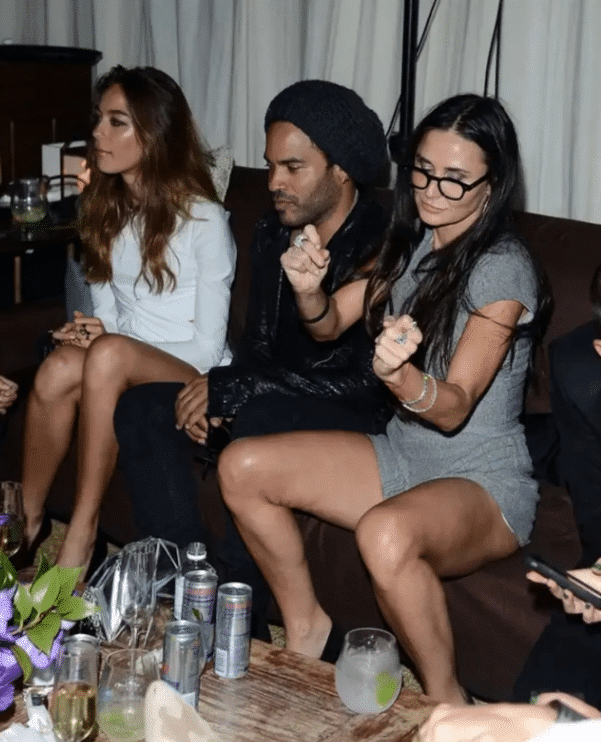
She sits on a crowded sofa at a Miami Beach party wearing a short gray outfit and large black-framed glasses. Her long dark hair falls loosely around her shoulders as she raises her hands and moves to the music.
Beside her, Lenny Kravitz appears remarkably composed.
On the other side sits Stacy Keibler, then widely known as a model, television personality, and former professional wrestler.
The scene is playful, crowded, and imperfect.
It looks less like a formal celebrity portrait than an old photograph from a lively gathering where one person has decided to enjoy the music more enthusiastically than everyone else.
A Miami Night From December 2012
The gathering took place on December 5, 2012, at Soho Beach House in Miami Beach.
Chanel presented the beachside barbecue in celebration of Art.sy during Art Basel, the annual art gathering that brings collectors, artists, designers, entertainers, and international visitors to Miami. Guests that evening included Lenny Kravitz, Stacy Keibler, Naomi Campbell, Pharrell Williams, Jeremy Piven, Russell Simmons, and others from the art and entertainment worlds.
Moore had celebrated her 50th birthday on November 11, only a few weeks earlier.
The event itself was not her birthday celebration, despite the way some later accounts connect the two occasions. She was attending a public Art Basel party during a year in which her private life had already received intense attention.

The photographs show her dancing while seated, posing with friends, adjusting her hair, and reacting animatedly to whatever was happening around the table.
They do not provide reliable information about her health, emotional state, or private motivations.
A photograph can show movement.
It cannot explain what the movement meant.
When a Party Photograph Lasted Longer Than the Party
In 2012, Instagram was still young, and entertainment photographs circulated differently.
A group of images might appear on several celebrity websites the next morning, move through weekly magazines, and then gradually disappear into an online archive.
There was no endless stream of short videos allowing viewers to inspect every second from several angles.
These particular pictures endured partly because of the contrast at their center.
Kravitz sits almost motionless in dark clothing and sunglasses.
Moore raises her arms and dances beside him.
The difference created an instantly memorable image—one that would continue circulating as a humorous reaction photograph long after most people had forgotten the event itself.
The party ended before sunrise.
The photograph remained available for more than a decade.
A Familiar Sofa Scene Beneath Unfamiliar Circumstances

The second photograph pulls back far enough to reveal the table in front of the group.
Glasses, flowers, bottles, and several cans of Red Bull occupy the crowded surface. Moore sits forward with both hands raised while Kravitz remains centered beside her. Contemporary reports noted the visible energy-drink cans, although photographs alone cannot establish who consumed each one or what effect anything had on the people present.
The arrangement may remind older readers of family parties photographed before everyone could review a picture immediately.
Someone was always looking away.
Another person had begun speaking.
A hand moved too quickly and became blurred.
No one asked for a second version because the roll of film had only a limited number of exposures.
Those imperfect photographs often became the most valuable ones.
They contained movement rather than performance.
The Brat Pack Years
During the 1980s, Moore became associated with the group of young actors the press called the Brat Pack.
Her performances in St. Elmo’s Fire and About Last Night… placed her among a generation of performers whose movies reflected young adulthood during the Reagan era—career uncertainty, changing relationships, urban independence, ambition, and the fear that friends might gradually grow apart.
For viewers who first saw those films in theaters, the actors seemed to belong to their own generation.
They wore familiar clothing.
They argued about recognizable problems.
Their apartments, jobs, friendships, and romantic mistakes felt closer to ordinary adulthood than the glamorous studio romances of an earlier Hollywood era.
Moore stood out because she could appear both strong and emotionally exposed.
She did not need to make a character entirely sympathetic to make her compelling.
When “Ghost” Became a Shared American Memory

Moore’s career reached another level with Ghost in 1990.
She played Molly Jensen opposite Patrick Swayze, with Whoopi Goldberg portraying the reluctant psychic who becomes involved in their extraordinary story.
The film combined romance, grief, comedy, suspense, and the supernatural. Its pottery-wheel scene, accompanied by “Unchained Melody,” became one of the most recognizable movie sequences of the period. Moore received a Golden Globe nomination for her performance.
Older readers may remember seeing Ghost before movie scenes could be replayed instantly online.
Theater audiences discovered the story together.
Later, families rented the videocassette, returned it to the store, and waited until it appeared on television to see it again.
Movies had time to settle into popular memory.
A particular song could bring back the entire theater experience years later.
A haircut could inspire women across the country to visit salons carrying a magazine photograph of Moore.
Hollywood’s Most Demanded Leading Woman
After Ghost, Moore appeared in a series of major studio productions.
She played Lieutenant Commander JoAnne Galloway in A Few Good Men, shared the screen with Robert Redford and Woody Harrelson in Indecent Proposal, and starred opposite Michael Douglas in Disclosure. Her success made her one of the most commercially important actresses of the early and mid-1990s.
Those films belonged to an era when adult dramas could become major theatrical events.
They were not built around established superheroes or decades-old franchises.
Audiences arrived because of the stars, the premise, and the promise of an emotionally provocative story.
Moore’s name could help open a movie.
That position brought negotiating power, but it also created intense scrutiny
The 2012 Photographs Came During a Complicated Chapter

By December 2012, Moore had separated from Ashton Kutcher, whom she had married in 2005. The divorce was finalized the following year. Her memoir later described the marriage, its ending, health struggles, and the effect those years had on her relationships with herself and her daughters.
Contemporary coverage therefore interpreted almost every gesture at the Miami party through that personal history.
Dancing became evidence of recovery to some observers.
To others, it became evidence that something was wrong.
The photographs could support either story only because viewers supplied the conclusion themselves.
That is the danger of attempting to diagnose a life from a party picture.
The Famous Lenny Kravitz Expression
In the fourth image, Kravitz sits with his hands folded while Moore has pulled part of her hair across her face.
The contrast is almost comic.
He appears still and unreadable.
She appears completely absorbed in the movement of the evening.
The photograph later circulated widely because viewers could attach their own meaning to Kravitz’s expression.
Was he amused?
Tired?
Waiting patiently?
Thinking about something unrelated?
The image cannot answer.
That uncertainty made it useful as an online reaction picture. It could represent anyone sitting quietly beside a much more energetic friend.
The Difference Between Confession and Understanding
Celebrity memoirs are frequently marketed through their most dramatic revelations.
The more lasting value may come from quieter recognition.
Why did a particular relationship feel necessary?
Why did professional success fail to create security?
Why did someone repeat a pattern she already knew was painful?
These questions do not produce easy villains or perfect endings.
They produce a more complicated adult understanding.
Moore’s memoir did not erase earlier mistakes.
It placed them within a longer attempt to understand how childhood experiences continued influencing decisions made decades later.
The Golden Globe Moment
In January 2025, Moore won the Golden Globe for Best Actress in a Motion Picture—Musical or Comedy for The Substance.
It was the first major acting award of her long career. During her acceptance speech, she recalled once being dismissed as a “popcorn actress,” a label that had encouraged her to question whether critical recognition was available to her.
The moment resonated beyond the film.
Here was an actress who had carried some of the largest movies of the 1990s yet had never received that kind of individual industry recognition.
Success and respect had not arrived on the same schedule.
The award did not make the earlier work valuable.
It finally acknowledged value that audiences had recognized for decades.
Aging Did Not End the Story
At 63, Moore remains professionally active and internationally recognized.
The Cannes Film Festival’s biography notes her Academy Award nomination and her Golden Globe, SAG, and Critics Choice victories for The Substance, along with her continuing television work.
Her later recognition does not erase the woman dancing in Miami.
It changes how viewers may understand her.
The 2012 photographs no longer look like images from the edge of a career.
They belong to the middle of a much longer story.
The Problem With Freezing Women at Their Most Famous Age
Demi Moore is frequently remembered as she appeared in Ghost, A Few Good Men, or Indecent Proposal.
Those images are permanently preserved.
The actress herself was not.
No human being can remain visually identical to a character photographed under professional lighting decades earlier.
Expecting otherwise would mean asking Moore to give up every year that produced her daughters’ adulthood, her granddaughter, her memoir, her renewed family relationships, and the performance that brought her first Oscar nomination.
Time changed her face because time expanded her life.