Act I
The room went silent only after Mia hit the floor.
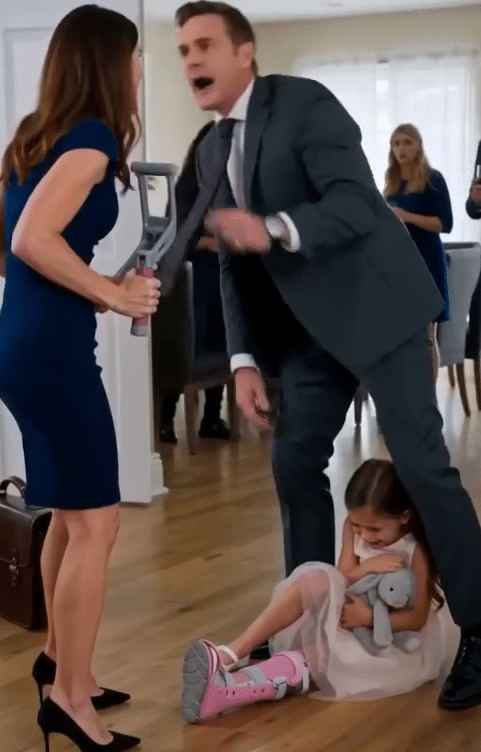
One second, my six-year-old daughter was standing beside me in her pink orthopedic brace, holding her stuffed gray rabbit against her chest. The next, my sister Caroline had ripped open the straps, pulled the metal hinge away from Mia’s healing knee, and shouted loudly enough for every relative in the house to hear.
“Stop pretending you’re disabled!”
Mia’s weakened leg folded beneath her.
Her rabbit flew across the hardwood floor. She landed on her side with a sound I would hear in my sleep for months, then curled around her knee and screamed.
“Daddy, my leg!”
I reached her before anyone else moved.
I dropped beside her, pulled her against me, and covered her body with mine. My hands were shaking so badly I could barely touch her without frightening her more.
Behind us, someone laughed nervously.
Not because it was funny.
Because families sometimes laugh when cruelty arrives wearing the face of someone they have known their entire lives.
“Do not touch my daughter again!” I shouted.
Caroline remained standing over us.
She still held the damaged brace in both hands.
One strap had been torn free. The side hinge hung at an angle, and a small piece of plastic had snapped near the locking mechanism.
Caroline looked annoyed rather than horrified.
“Oh, please,” she said. “She was walking five minutes ago. Children exaggerate when adults keep rewarding them for it.”
Mia’s fingers dug into my shirt.
“It hurts,” she sobbed. “Daddy, it really hurts.”
“I know, sweetheart. Don’t move.”
Then something heavy struck the floor behind Caroline.
A leather briefcase.
Everyone turned.
The man in the charcoal suit near the dining room doorway was already moving toward us. He knelt beside Mia, loosened his tie, and placed two fingers against the pulse in her foot.
Dr. Thomas Caldwell.
The orthopedic surgeon who had spent four hours rebuilding my daughter’s knee.
He had not come to the family gathering as a doctor. He had come because my uncle Robert served on the hospital foundation board and had invited him to discuss a charity program over dinner.
But the moment he saw Mia on the floor, every trace of the polite guest disappeared.
“Mia,” he said gently, “look at me.”
She recognized him through her tears.
“Dr. Tom?”
“That’s right. I need you to keep very still.”
He examined the angle of her leg, supported the joint, and asked her whether she could feel his hand against her toes.
Then he looked at the broken brace in Caroline’s hands.
His expression became terrifyingly calm.
“It was only tough love,” Caroline whispered.
I pulled out my phone and called emergency services.
Dr. Caldwell slowly rose between my daughter and my sister.
“I performed her surgery,” he said.
Caroline’s face changed.
Not much.
Just enough.
He pointed toward the brace.
“That device was protecting a reconstructed ligament and a healing growth plate. You removed it by force.”
“I didn’t know.”
“You didn’t ask.”
“She was running around earlier.”
“She was taking assisted steps,” he said. “Under strict instructions.”
Caroline glanced toward the rest of the family, searching for support.
No one spoke.
Dr. Caldwell took one step closer.
“If the repair has torn again, she may need another operation.”
The color drained from Caroline’s face.
The ambulance sirens were already approaching.
But before the paramedics reached the house, my wife picked up her phone from the dining table.
Her camera was still recording.
And it had captured everything.
Act II
Three months earlier, Mia had been the kind of child who never walked when she could skip.
She raced down hallways, climbed furniture she had been told not to climb, and treated every patch of grass like a stage built specifically for cartwheels.
Then one rainy afternoon, a delivery van lost control near her elementary school.
The van jumped the curb.
Mia’s teacher pulled two children out of the way, but Mia was struck at the edge of the crosswalk. The impact did not break her leg cleanly. It twisted her knee, damaged the ligament, and injured the growth plate in a way that could have affected the length of her leg permanently.
Dr. Caldwell had been the surgeon on call.
He never promised us a perfect recovery.
He promised only that he would do everything possible to give her a future without pain.
After the operation, Mia spent weeks afraid to move.
She woke crying in the night. She refused to look at the scar. She asked whether the doctors had put something “wrong” inside her knee.
The pink brace had been her choice.
The hospital offered black, gray, and blue. Mia pointed to the pink one and said it looked less scary.
We told her she was brave.
Caroline told everyone we were making her weak.
My sister had always believed suffering was useful.
When we were children, she mocked me whenever I cried. When our father lost his job, Caroline called his depression laziness. When our mother developed chronic pain, Caroline accused her of enjoying attention.
She was never cruel in obvious ways when outsiders were watching.
She wrapped cruelty in words like discipline, strength, honesty, and resilience.
At family dinners, she made small comments about Mia’s recovery.
“She still needs that thing?”
“Are you sure the doctors aren’t being overly cautious?”
“Children recover faster when parents stop hovering.”
I ignored her longer than I should have.
Part of me believed she would never cross a physical line.
Another part of me had spent forty years learning to avoid conflict with her.
That was my mistake.
The gathering at Uncle Robert’s house was supposed to be Mia’s first large family event since the accident. We had almost canceled, but she had begged to go after hearing there would be strawberry cake.
Before we arrived, I explained the rules to everyone in the family group chat.
Mia could walk short distances.
She could not run.
She could not use stairs without help.
No one was to touch the brace.
Caroline responded with a thumbs-up.
For the first hour, everything seemed fine.
Mia sat near the window and colored pictures with her cousins. She took six slow steps to the dessert table while I held her hand. Everyone applauded.
Everyone except Caroline.
I saw the way she watched Mia.
Not with concern.
With suspicion.
Later, while I was speaking to my uncle, Caroline approached Mia near the living room sofa. My wife had placed her phone on a shelf to record Mia taking a few steps for her physical therapist.
The camera captured Caroline bending down.
It captured her asking Mia why she was “still wearing that ridiculous thing.”
Mia answered exactly as we had taught her.
“My doctor says my knee isn’t ready.”
Caroline laughed.
“Your doctor isn’t here.”
Then she told Mia to walk without the brace.
Mia shook her head.
Caroline reached for the straps.
My daughter backed away.
“No.”
That single word should have stopped her.
It did not.
By the time I heard Caroline shouting, her hands were already on the brace.
The ambulance carried Mia to St. Catherine’s Hospital. Dr. Caldwell rode with us, still dressed in his charcoal suit, one hand stabilizing the knee while I held Mia’s trembling fingers.
Caroline followed in her car.
Not because she was worried.
Because Uncle Robert had told her the police were on their way.
At the hospital, officers met us outside the emergency entrance.
My wife handed them the video.
Caroline watched from across the parking lot.
For the first time in her life, my sister had no version of the story that could save her.
Then the X-ray revealed something no one expected.
Act III
The surgical repair had survived.
Barely.
There was inflammation around the joint and additional damage to the soft tissue, but the reconstructed ligament had not completely torn.
Dr. Caldwell called it fortunate.
I did not feel fortunate.
Mia would need to return to the brace full-time. Her physical therapy would be reduced. The progress she had fought for would be delayed by at least two months.
But the imaging showed something else.
A small abnormality near the original growth plate injury.
Dr. Caldwell had noticed it during surgery but believed it was trauma-related. Now, because of the new scans, he could compare the area more clearly.
He ordered additional tests.
“What are you looking for?” I asked.
He hesitated.
“A preexisting weakness in the bone.”
My wife stared at him.
“Preexisting?”
“Something that may have made the original injury worse.”
Two days later, the answer came back.
Mia had a rare inherited connective tissue disorder. Mild, manageable, but significant. It affected the stability of her joints and made certain injuries more dangerous.
The diagnosis explained things we had dismissed for years.
Her frequent ankle pain.
The bruises that appeared after minor falls.
The unusual flexibility in her fingers.
Dr. Caldwell recommended genetic testing for both parents.
My results were negative.
My wife’s were negative.
The doctor requested the tests again.
Same result.
Then he asked a question that changed the air in the room.
“Is Mia biologically related to both of you?”
My wife gripped the edge of the chair.
I felt as though the floor had tilted beneath me.
“Yes,” I said.
But even as the word left my mouth, I remembered the night Mia was born.
The emergency delivery.
The power failure in the old maternity wing.
The hospital transfer after a pipe burst.
The hours when newborns were temporarily moved between units.
And Caroline.
She had been there.
She had insisted on staying near the nursery while I remained with my wife after surgery.
At the time, I thought she was helping.
Now, for the first time, I wondered why she had refused to leave.
Dr. Caldwell did not speculate.
He simply recommended a parentage test.
The result arrived a week later.
Mia was not biologically related to my wife.
She was related to me.
The laboratory requested additional family samples to understand how that was possible.
My mother agreed.
So did Uncle Robert.
Caroline refused.
Her refusal lasted exactly twelve hours.
Then the police obtained a court order after investigators reviewed old hospital records and discovered that Caroline had given birth in the same hospital two days before Mia.
A child no one in our family knew existed.
According to official records, Caroline’s baby had died shortly after birth.
But there was no death certificate.
No burial record.
No neonatal medical file.
Only a handwritten transfer note signed by a nurse who had disappeared from hospital employment the following week.
The DNA result was undeniable.
Caroline was Mia’s biological mother.
I was not her biological father.
I was her biological uncle.
The test showed that Mia’s father had been someone closely related to my wife’s side of the family, but not my wife herself.
Then my wife remembered her younger brother Daniel.
Daniel had died in a car accident six months before Mia was born.
He and Caroline had briefly dated in secret.
A relationship both families would have fiercely opposed because of a long-standing inheritance dispute between our parents.
Caroline had hidden the pregnancy.
After Daniel died, she told no one.
She gave birth alone, then made a decision so calculated that even the detectives struggled to explain it without anger.
My wife had delivered a baby girl in the same hospital.
That baby developed severe respiratory failure during the power outage and died before she could be transferred.
Caroline learned what had happened.
She bribed a nurse.
Then she switched the records.
She placed her healthy newborn daughter into our care and allowed us to believe she was ours.
She did not do it out of love.
She did it because Daniel’s will left a trust for any surviving child.
A trust worth nearly three million dollars.
The money would become available when the child turned seven, controlled initially by the child’s legal parents.
By giving Mia to us, Caroline kept the baby hidden from Daniel’s family while preserving the option to reveal the truth later.
She planned to wait until the trust activated.
Then she would challenge custody, expose the parentage, and claim we had unknowingly raised her daughter.
Mia’s seventh birthday was four months away.
And Caroline’s attack on the brace had not been a sudden act of “tough love.”
She had been trying to create a record that we were medically overprotective.
The video changed everything.
Act IV
The family gathered again three weeks later.
Not for dinner.
For a legal conference.
Uncle Robert opened his home because he said the truth had entered there, and justice should begin there too.
Caroline arrived with two attorneys.
She wore a white coat, carried a leather folder, and looked almost offended to find police officers near the front door.
Mia was not present.
We had promised she would never be used as a prop in an adult battle.
She was home with my mother, eating pancakes and watching cartoons.
Dr. Caldwell attended voluntarily.
So did the hospital’s legal representative, a detective from the financial crimes unit, and the administrator responsible for archived maternity records.
Caroline’s lawyer began by claiming the brace incident had been misunderstood.
My wife played the video.
The room watched Caroline approach a six-year-old child, ignore her refusal, tear away prescribed medical equipment, and accuse her of pretending.
No one laughed this time.
Then Dr. Caldwell explained the injury.
He described the surgery, the rehabilitation plan, the risks of forced brace removal, and the additional trauma caused by the fall.
Caroline stared at the table.
Her attorney shifted beside her.
The detective placed the old hospital transfer note on the screen.
Then he displayed bank records.
Two payments had been made to the former nurse shortly after Mia’s birth.
Both came from an account controlled by Caroline.
A third payment had been made six months earlier.
The same nurse had recently returned to the country.
Caroline had paid her to remain silent until after Mia’s seventh birthday.
Caroline’s composure cracked.
“You don’t understand,” she said.
“No,” I replied. “We understand now.”
She looked at me for the first time.
“I gave you a child.”
The words landed like poison.
My wife stood so quickly her chair struck the wall.
“You stole our right to grieve our daughter.”
Caroline flinched.
“You were devastated. I had a baby I couldn’t raise. I thought—”
“You thought about the trust,” I said.
Her face hardened.
“That money belonged to Daniel’s child.”
“It belonged to Mia.”
“I am Mia’s mother.”
“No,” my wife said. “You gave birth to her.”
Caroline turned toward Dr. Caldwell.
“You made this worse.”
He did not react.
“I treated an injured child.”
“She wouldn’t even be injured if they didn’t encourage her to act fragile.”
That sentence destroyed what little sympathy remained in the room.
Dr. Caldwell opened the medical folder in front of him.
“Mia’s inherited condition came from you.”
Caroline blinked.
He continued.
“The genetic markers match your sample. Her joint instability is not imaginary, and it is not caused by overprotective parenting. She inherited it.”
Caroline looked down at her own hands.
For years, she had complained of shoulder pain, knee weakness, and frequent sprains. She had mocked anyone who suggested she see a specialist.
She had spent her life punishing vulnerability because she recognized it in herself.
But understanding the source of her cruelty did not excuse it.
The detective informed her that prosecutors were reviewing charges related to assault, child endangerment, fraud, falsification of medical records, conspiracy, and attempted financial exploitation of a minor.
Her attorney whispered for her to remain silent.
She ignored him.
“I never meant for her to get hurt.”
“You put your hands on her,” I said.
“I wanted her to stop acting weak.”
“She said no.”
Caroline’s eyes filled with tears.
For once, they did not move me.
“I’m her mother,” she repeated.
I leaned forward.
“Then why was the first thing you gave her pain?”
No one spoke.
Caroline looked around the room, waiting for someone to rescue her.
The family she had manipulated for decades remained still.
Then Uncle Robert slid a document across the table.
It was a revised trust petition.
He had asked the court to place Daniel’s inheritance under independent management, beyond the control of every adult involved.
The money would be used only for Mia’s medical care, education, and future needs.
Caroline would never touch it.
That was when she finally understood.
She had lost the money.
She had lost the story.
And she had lost the right to define herself as the victim.
But the hardest decision still belonged to us.
We had to tell Mia who she really was.
Act V
We waited until her knee was stronger.
Not because the truth was dangerous, but because she had already lost too much stability at once.
A child psychologist helped us choose the words.
We did not tell her everything.
Six-year-olds do not need court records, forged documents, or inheritance disputes.
They need truth shaped carefully enough that it does not become another wound.
We sat with her in the living room one Sunday morning.
Her stuffed rabbit rested in her lap. The repaired pink brace had been replaced with a new one, this time decorated with tiny silver stars.
I told her that families can begin in complicated ways.
My wife told her that another woman had carried her before she was born.
Mia listened quietly.
Then she asked, “Was it Aunt Caroline?”
My throat tightened.
“Yes.”
She looked down at the rabbit.
“Does that mean you’re not my mommy and daddy?”
My wife moved closer.
“It means we became your mommy and daddy in a different way than we thought.”
Mia’s eyes filled.
“Are you still keeping me?”
My wife broke before I did.
She pulled Mia into her arms and held her so tightly the rabbit was trapped between them.
“There is nothing in this world that could make us stop choosing you.”
I knelt beside them.
“You are our daughter. That is not changing.”
Mia cried for less than a minute.
Then she asked whether she could have waffles.
Children often survive truths that adults spend years trying to avoid.
The custody hearing took place two months later.
Caroline petitioned for parental recognition.
The judge denied it.
The court cited abandonment, fraud, deliberate concealment, financial motive, and the recorded physical attack.
Caroline was granted no custody.
No unsupervised contact.
After the criminal proceedings, she accepted a plea agreement that included probation, financial restitution, mandatory counseling, and a permanent protective order preventing her from approaching Mia.
Some relatives believed the punishment was too light.
Others believed losing access to the child she had treated as an asset was the harsher sentence.
I stopped measuring justice by Caroline’s suffering.
I measured it by Mia’s safety.
On the morning of her seventh birthday, we returned to Dr. Caldwell’s office.
Mia walked down the hallway without crutches.
The brace was gone.
Her steps were careful, but steady.
Dr. Caldwell watched her cross the examination room, turn, and walk back.
“Well,” he said, smiling, “I believe someone has officially graduated.”
Mia grinned.
“Can I run now?”
“Not yet.”
Her smile vanished.
He laughed softly.
“But soon.”
She considered this, then nodded with great seriousness.
Before we left, she handed him a drawing.
It showed Mia standing between me and my wife beneath a bright yellow sun. Dr. Caldwell stood nearby holding a giant pink brace like a shield.
In the corner, she had written four words in uneven purple letters.
Thank you for believing me.
Dr. Caldwell read it twice.
Then he turned away for a moment and cleared his throat.
Outside the hospital, Mia slipped her hand into mine.
“Daddy?”
“Yes?”
“Why didn’t Aunt Caroline believe my leg hurt?”
I looked down at her.
There were answers I could have given.
Because Caroline feared weakness.
Because she valued control more than love.
Because some adults only believe pain when it belongs to them.
Instead, I chose the answer Mia could carry without becoming bitter.
“Sometimes people decide what they want to believe before they listen.”
She thought about that.
“What should I do if someone does that again?”
I knelt beside her.
“You tell the truth once. Then you find someone safe.”
She squeezed my hand.
“Like you?”
“Always like me.”
She smiled and began walking toward the parking lot.
Slowly.
Carefully.
Confidently.
For months, Caroline had tried to convince everyone that Mia was pretending to be weak.
In the end, the truth revealed something very different.
Mia had never been weak.
She had survived an accident, surgery, betrayal, and a family secret built around her before she was old enough to understand any of it.
The weak one was the woman who needed to hurt a child in order to feel powerful.
Mia took another step.
Then another.
This time, no one laughed.
And no one dared tell her she was pretending.