Act I
The first thing I heard when I stepped through the side entrance of my Aspen mansion was music so loud it shook snow from the windows.
The second thing I heard was silence.
Not the peaceful silence of children sleeping on Christmas Eve. This silence was different. It settled into my chest before I even understood why.
I stood in the mudroom with snow melting from my coat and four silver gift bags hanging from my hands. For one foolish second, I smiled.
I imagined Emma, Lily, Sophie, and Grace racing around the corner in matching pajamas.
I imagined four sets of arms around my waist.
I imagined being forgiven for missing six months of their lives.
Instead, the mansion smelled like champagne, perfume, and something burned.
I opened the ballroom doors.
Vanessa, my new wife, was standing on the dining table in a silver dress, spraying champagne over thirty laughing strangers. Music thundered from enormous speakers. Caviar had been crushed into the marble floor, and lobster tails lay beneath designer heels.
“Merry Christmas, losers!” she screamed.
The room erupted.
I did not move.
A month earlier, I had wired enough money for a perfect family Christmas. Food. Gifts. New winter clothes. Two nannies. A private chef. Everything my daughters could need.
Everything except me.
Vanessa finally noticed me.
For half a second, panic crossed her face.
Then she smiled.
“Nathan,” she said, lifting the bottle. “You made it.”
I looked past her.
No stockings hung from the fireplace.
No children’s drawings covered the walls.
No handmade ornaments decorated the enormous tree.
The entire house had been transformed into a nightclub.
“Where are the girls?” I asked.
Vanessa took a drink.
“Sleeping, probably.”
It was barely seven.
I left without another word.
The west hallway was dark.
Too dark.
The farther I walked from the ballroom, the colder the mansion became. The music faded behind me, replaced by the sound of my own footsteps.
When I reached the family dining room, I could see my breath.
The door was closed.
I opened it.
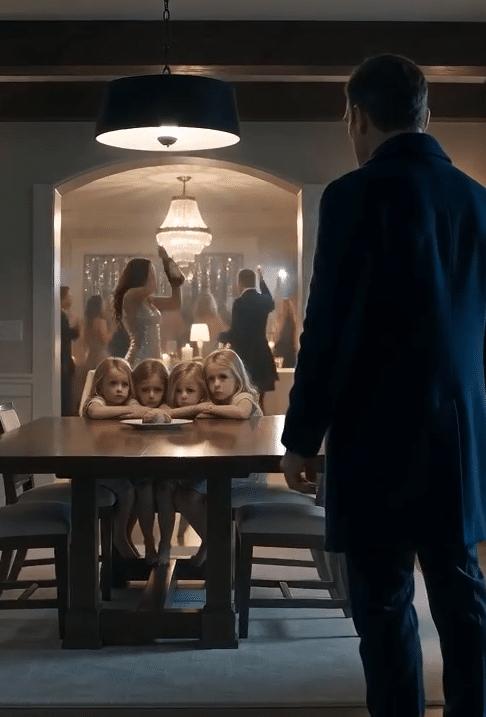
My four five-year-old daughters sat silently around a table built for twenty.
They wore thin, faded nightgowns.
Their bare feet were blue from the cold. Their faces looked smaller than I remembered. Their shoulders were sharp beneath the fabric.
There was no Christmas dinner.
No cookies.
No hot chocolate.
Just one plastic plate holding pieces of stale bread covered in green mold.
The gift bags slipped from my hands.
All four girls flinched.
Emma immediately covered the bread with her palms. Sophie crawled beneath the table. Grace stared down at her knees.
Then Lily whispered, “We’re sorry.”
I dropped to the floor.
“Baby,” I said, forcing my voice to remain steady. “What are you eating?”
Emma looked at me with the same gray eyes her mother had.
“Mama Vanessa says we’re getting chubby,” she whispered. “She says pretty girls don’t need big dinners.”
My hands curled into fists.
Lily pushed the plate toward me.
“Please don’t throw it away, Daddy. We’re still hungry. We’ll eat slowly. We promise.”
Something inside me broke.
Not loudly.
Not all at once.
It broke with the quiet finality of ice splitting beneath too much weight.
I wrapped my coat around Grace and lifted her into my arms. Then I carried all four girls toward the warmth of the ballroom.
Vanessa saw me too late.
I opened the electrical panel beside the entrance and slammed down the master switch.
The music died.
The lasers vanished.
The room went black except for the flames in the fireplace and the snow-reflected glow from the windows.
“Party’s over,” I said.
Vanessa laughed drunkenly.
“Well, look who finally came home. Nathan Caldwell, the Christmas ghost.”
“You left my daughters freezing in the dark.”
She rolled her eyes.
“Don’t be dramatic. They had dinner.”
“Moldy bread.”
Several guests stopped moving.
Vanessa’s expression changed—not with guilt, but irritation.
“You spoil them,” she snapped. “They need discipline.”
“They are five years old.”
“And already vain. Do you know how hard it is raising four girls while you play billionaire genius around the world?”
I stared at the diamonds around her neck.
Then I stared at my daughters, clinging to one another beneath my coat.
“What happened to the nannies?”
Vanessa shrugged.
“They quit.”
“Both of them?”
“They were incompetent.”
“And the chef?”
“Also incompetent.”
The answers came too quickly.
Practiced.
I looked toward the staircase.
Because before I had found my daughters, I had seen something upstairs.
Something worse than the moldy bread.
And Vanessa had no idea I had already opened the door.
Act II
Claire’s room had been locked since her funeral.
Vanessa told me she respected that.
She said some rooms should remain untouched because grief needed a place to breathe.
I believed her.
That had been my greatest mistake.
Vanessa entered our lives eighteen months after Claire died.
She was warm when I was numb. Patient when I could barely speak. She remembered the girls’ birthdays, sent me photographs when I traveled, and sat beside me through every night when guilt made sleep impossible.
She never asked me to remove Claire’s pictures.
She never complained when the girls called her Vanessa instead of Mom.
She said she wanted to earn their trust.
I confused patience with kindness.
I confused attention with love.
And because I was exhausted, lonely, and desperate to believe my daughters could have a family again, I married her after ten months.
Claire would have told me I was moving too fast.
She had always been better at seeing people.
That was why, before she died, she made me promise one thing.
“If anyone ever tries to make the girls feel like guests in their own home,” she whispered from her hospital bed, “you make sure they remember who they are.”
At the time, I thought she was speaking like a frightened mother.
Now I understood she had known something.
Upstairs, Claire’s room stood open.
The paintings were gone.
Her jewelry cabinet was empty.
Her wedding dress had disappeared from the wardrobe.
The cedar chest containing the girls’ baby blankets had been cleared out.
Even the old music box Emma loved—the one Claire wound every night—was missing.
At first, I thought Vanessa had moved everything into storage.
Then I saw the loose floorboard near the window.
Claire had shown it to me years ago.
She used to hide birthday gifts there because I was terrible at pretending not to know what she had bought me.
I lifted the board.
A wooden box sat beneath it.
Inside were bank statements, property records, copies of emails, and a sealed envelope with my name written across the front.
My hands began to shake.
Nathan,
If you are reading this, then someone has already tried to remove me from this house.
Do not let them remove our daughters too.
The letter was dated three weeks before Claire died.
She wrote that she had discovered unusual transfers from one of our family trusts. Small amounts at first. Then larger ones.
She had traced them through a charity foundation and two shell companies.
One company was registered to a woman named Vanessa Reed.
My wife’s maiden name.
The first transfer had occurred fourteen months before Claire’s death.
A full year before Vanessa claimed we had met for the first time.
Claire believed someone had been stealing from the trust established for our daughters.
She also believed that person had access to private family documents.
At the bottom of the box was a photograph.
Claire stood outside a hotel in Boston, pale and thin from treatment.
Beside her was Vanessa.
They knew each other.
On the back, Claire had written four words.
She is not my friend.
I heard footsteps behind me.
I hid the documents beneath my coat and turned.
Emma stood in the doorway.
She looked terrified to be there.
“Daddy,” she whispered, “we’re not allowed in Mama’s room.”
My throat tightened.
“This was your mother’s room.”
Emma shook her head quickly.
“No. Mama Vanessa said the sick lady was bad. She said she made you sad.”
I knelt.
“Did she tell you anything else?”
Emma looked toward the hallway before answering.
“She said we weren’t really yours.”
For a moment, the room tilted.
“What?”
“She said Mommy lied. She said one day you would find out and send us away.”
That was why they had not run into my arms.
That was why they apologized before speaking.
Vanessa had not only starved them.
She had spent months teaching them that my love could be taken away.
I carried Emma downstairs.
When the lights went out and the ballroom fell silent, I finally saw the fear Vanessa had hidden beneath her smile.
Not fear of losing me.
Fear of what I had found.
She moved toward the staircase.
I blocked her path.
“What were you doing in Claire’s room?”
Her face hardened.
“I live here.”
“Where are Claire’s belongings?”
“In storage.”
“Which storage facility?”
She opened her mouth.
Nothing came out.
One of her friends shifted nervously beside the bar.
Another reached for her coat.
Then a man near the fireplace spoke.
“I bought a music box from her.”
The room turned.
He was young, dressed in a tailored tuxedo, with the dazed expression of someone who had just realized the joke was on him.
Vanessa stared at him.
“Shut up, Derek.”
He swallowed.
“You said it belonged to your grandmother.”
Emma looked up.
“Was it blue?”
Derek’s face drained of color.
“Yes.”
Emma began to cry.
“That was Mommy’s.”
The room changed.
People who had been cheering minutes earlier now looked at Vanessa as if they had never seen her before.
I pulled out my phone.
“Security,” I said. “Seal the gates.”
Vanessa laughed, but her voice cracked.
“You can’t hold people here.”
“No,” I said. “But the sheriff can.”
Outside, snow continued to fall.
Inside, the truth had finally started to thaw.
And Claire had left me far more than a letter.
Act III
The sheriff arrived with two deputies, a child welfare investigator, and an ambulance.
The party guests lined the ballroom walls while paramedics examined my daughters near the fireplace.
Grace had a fever.
Sophie was dehydrated.
All four had lost enough weight to alarm the doctor.
When the paramedic asked how long they had been eating so little, none of them answered.
Then Lily whispered, “Since the birthday cake.”
Their birthday had been four months earlier.
I looked at Vanessa.
She looked away.
The child welfare investigator, a woman named Mara Lewis, crouched beside the girls.
“Did anyone else live here with you?”
Emma nodded.
“Miss Rosa and Miss Anne.”
The two nannies.
“Where did they go?”
“Mama Vanessa said they stole money.”
I turned to the head of security.
“Find them.”
He hesitated.
“Sir, Mrs. Caldwell instructed us to blacklist both women from the property.”
“Why?”
“She said they were dangerous.”
“Did anyone verify that?”
His silence was answer enough.
For years, I had built a company around systems that detected fraud within seconds.
Yet inside my own home, I had ignored every warning because I trusted the person standing beside me.
Thirty minutes later, my security team found Rosa Alvarez at a motel outside town.
She had never left Aspen.
She had been trying to reach me for months.
Vanessa had blocked her number on my phone.
Rosa arrived with a bruised wrist, a folder of printed emails, and tears already streaming down her face.
The moment my daughters saw her, they ran.
Not toward me.
Toward her.
Rosa dropped to her knees and held all four of them.
“I’m sorry,” she sobbed. “I’m so sorry I couldn’t come back.”
Vanessa backed toward the stairs.
The deputy stopped her.
Rosa explained everything.
She and Anne had noticed food disappearing from the children’s wing. Vanessa ordered the kitchen staff to serve the girls smaller portions. Then she fired the chef and replaced him with a private catering service used only for parties.
When Rosa objected, Vanessa threatened to report her immigration status, even though Rosa was a legal permanent resident.
When Anne tried to photograph the girls’ bruised knees after they had been forced to kneel for hours, Vanessa accused both nannies of theft.
She planted jewelry in Anne’s bag.
Security escorted them out.
Rosa had spent months emailing me.
I never saw a single message.
Vanessa had access to my accounts.
She deleted them before I could read them.
“What was she trying to do?” Mara asked.
Rosa looked at me.
“She wanted the girls gone.”
The words landed with terrible clarity.
Not dead.
Not injured.
Gone.
Vanessa wanted them weak, frightened, and convinced they did not belong to me.
She wanted me to return to children who feared me.
Children who might believe any document she placed in front of them.
I took Claire’s papers from my coat.
The sheriff studied them while one of my attorneys joined by video call.
The transfers from the girls’ trust totaled nearly eleven million dollars.
But money was only part of it.
Claire’s letter mentioned a second document.
A sealed addendum to her will.
It had never been filed.
According to Claire, the addendum transferred voting control of a major portion of Caldwell Systems into a protected trust for our daughters.
Until they turned thirty, I would serve as trustee.
But if I died or became incapacitated, control would not pass to my spouse.
It would pass to Claire’s sister, Margaret.
Vanessa could never inherit it.
Unless the girls were legally removed as beneficiaries.
My attorney went quiet.
“What?” I asked.
He adjusted his glasses.
“Three weeks ago, someone submitted a petition in Denver family court challenging the girls’ paternity.”
The ballroom disappeared around me.
“On what grounds?”
“Anonymous medical records. The petition claims Claire had an affair and that you are not the biological father.”
Emma had repeated Vanessa’s exact lie.
The petition was not random.
It was preparation.
If a court ruled the girls were not mine, they could be removed from the trust.
And if Vanessa later produced a will naming herself as my sole heir, she could take everything.
The sheriff turned toward her.
“Mrs. Caldwell, do you want to explain why your attorney filed that petition?”
Vanessa’s face went white.
“I don’t know what he’s talking about.”
“You signed the affidavit.”
“That is not my signature.”
Rosa opened her folder.
“I saw her practicing it.”
Everyone looked at her.
“Practicing what?”
“Claire’s signature.”
From the folder, Rosa pulled several sheets of paper.
The pages were covered with the same name written over and over again.
Claire Caldwell.
Some signatures were clumsy.
Others were nearly perfect.
Vanessa lunged forward.
A deputy caught her arm.
“You stole those!”
Rosa stepped back.
“I found them in the schoolroom after you made the girls copy their mother’s handwriting.”
I felt sick.
Mara looked sharply at the children.
“Why were you copying your mother’s name?”
Sophie spoke from behind Rosa’s shoulder.
“Mama Vanessa said it was a Christmas game.”
“What did she promise you?”
“Dinner.”
No one in the room moved.
The forged documents.
The stolen trust money.
The paternity petition.
The isolation.
The starvation.
It had all been building toward one final act.
Vanessa had planned to use my daughters’ hands to create the evidence that would erase them.
But she had made one mistake.
She believed Claire had left only papers behind.
Claire had left a witness.
Act IV
Margaret arrived just before midnight.
Claire’s older sister had not spoken to me in two years.
After the funeral, she accused me of burying my grief in work and leaving the girls with strangers.
I told myself she was angry.
The truth was harder.
She was right.
When Margaret entered the ballroom, she did not greet me.
She went straight to the girls.
They clung to her as if they had been waiting their entire lives for someone to open the door.
Then she stood and faced Vanessa.
“You.”
Vanessa’s eyes narrowed.
“You knew,” Margaret said.
“Knew what?”
“You knew Claire was documenting everything.”
Margaret opened her handbag and removed a small flash drive.
Claire had mailed it to her two days before she died.
Margaret never opened it because the envelope contained instructions: keep this safe until Nathan finally sees the truth.
“I thought she meant grief,” Margaret said. “I thought she was afraid he would remarry too quickly.”
She looked at me.
“I should have known she meant you.”
The flash drive contained recorded conversations.
In the first, Claire confronted Vanessa in a Boston hotel.
Vanessa’s voice came clearly through the ballroom speakers.
“You are confused, Claire. The medication is affecting you.”
“I know you moved money from the girls’ trust.”
“You cannot prove that.”
“I can.”
A pause followed.
Then Vanessa laughed.
“You are dying. By the time anyone listens to you, Nathan will believe whatever the living woman tells him.”
Vanessa closed her eyes.
The recording continued.
Claire accused Vanessa of befriending her during treatment, pretending to offer emotional support while collecting information about our marriage, our finances, and the girls.
Vanessa had worked for a private wealth management firm used by one of our subsidiaries.
That was how she gained access.
That was how she learned about the trust.
And that was how she positioned herself to meet me after Claire’s death.
Nothing about our marriage had been an accident.
The restaurant where we first spoke.
The charity gala where she comforted me.
The photograph she “accidentally” sent of herself reading to my daughters.
Every moment had been planned.
By the end of the recording, several guests had quietly begun giving statements to the deputies.
Derek admitted Vanessa had sold him Claire’s music box.
Another woman admitted buying a diamond bracelet Vanessa claimed was inherited.
A man near the bar handed over messages in which Vanessa had offered him access to confidential Caldwell Systems information.
Her entire world collapsed one witness at a time.
Still, she refused to surrender.
“You all used me,” she shouted. “Every person in this room came because of my husband’s money.”
She pointed at me.
“And where was he? Zurich? Dubai? Singapore? He left those girls with me and expected gratitude.”
Her words cut because they contained one piece of truth.
I had left them.
I had trusted wire transfers, staff reports, and scheduled calls.
Whenever the girls seemed quiet on video, Vanessa said they were tired.
Whenever one of them appeared thinner, she blamed a stomach virus.
Whenever they asked when I was coming home, I promised soon.
Soon became next week.
Next week became next month.
I had given them everything money could buy and denied them the one thing they needed most.
My presence.
“I failed them,” I said.
Vanessa stared at me, surprised.
The room went still.
“I failed my daughters every day I chose another meeting over their voices.”
I stepped closer.
“But my failure does not excuse your cruelty.”
She lifted her chin.
“You think they will forgive you?”
“I don’t know.”
That answer hurt more than any lie she could have told.
“But I will spend the rest of my life earning the chance.”
The sheriff placed Vanessa under arrest on suspicion of child abuse, fraud, forgery, theft, and evidence tampering.
As the deputy reached for her wrists, she screamed that the house belonged to her.
My attorney answered from the screen.
“No, Mrs. Caldwell. Under the prenuptial agreement you signed, any proven abuse against the children terminates all marital claims.”
For the first time that night, Vanessa stopped talking.
The diamonds around her neck no longer looked like armor.
They looked like evidence.
As the deputies led her away, she turned toward Emma.
“You little liar.”
I moved between them.
Emma gripped my hand.
Then, in a voice so quiet Vanessa almost missed it, she said, “I’m not hungry because I’m bad.”
Vanessa froze.
Emma looked up at me.
“I’m hungry because she didn’t feed us.”
It was the first time one of my daughters had spoken the truth without apologizing.
And it was the moment Vanessa lost the last piece of power she had over them.
But removing her from the house was only the beginning.
The harder question was whether my daughters would ever feel safe inside it again.
Act V
We did not spend Christmas in the mansion.
At three in the morning, after the statements were taken and the doctors cleared the girls to leave, I brought them to a small lodge Margaret owned near the edge of town.
There were no marble floors.
No chandeliers.
No ballroom.
Only a stone fireplace, four narrow beds, and a kitchen that smelled like cinnamon.
Margaret made oatmeal.
Rosa toasted bread.
When Lily saw the slices, she slipped one beneath her nightgown.
I pretended not to notice.
Later, I found three more pieces hidden beneath her pillow.
The next morning, I filled a basket with bread and placed it beside her bed.
“You never have to hide food again,” I told her.
She stared at the basket.
“Even if I’m bad?”
“Food is not a reward.”
She thought about that.
Then she tore one slice in half and gave part of it to me.
It was the first thing she had willingly shared that was not stolen from hunger.
The criminal case against Vanessa expanded over the following months.
Investigators recovered Claire’s jewelry from private buyers in three states. They found forged medical records, falsified trust documents, and messages between Vanessa and the attorney who filed the paternity petition.
The attorney claimed he believed the records were real.
A judge did not believe him.
DNA testing confirmed what I had never doubted.
The girls were mine.
But by then, I understood that biology was not the point.
Fatherhood was not something proven by a laboratory.
It was proven by who stayed when nightmares came.
Who sat outside the bathroom because Sophie was afraid of locked doors.
Who learned that Grace could not sleep without a lamp.
Who understood that Emma checked every plate before eating.
Who waited patiently while Lily learned not to hide bread.
I resigned as chief executive of Caldwell Systems three weeks after Christmas.
The board called it temporary.
I knew it was permanent.
For years, I had told myself I was building a future for my daughters.
I had never asked whether they wanted a future that required losing their father in the present.
We sold the Aspen mansion.
The girls did not ask to keep it.
Emma only wanted Claire’s music box back.
Derek returned it through his attorney.
It had a scratch across the lid, but it still played the same lullaby.
The first night Emma wound it, all four girls climbed into my bed.
No one spoke.
The melody filled the room.
For a moment, Claire felt close enough to touch.
A year later, we spent Christmas in a smaller house outside Boston.
Rosa lived nearby.
Margaret came for dinner.
The girls wore mismatched pajamas and decorated the tree with paper stars, crooked candy canes, and photographs of their mother.
There was too much food.
Lily still saved a roll in her pocket.
But this time, when I noticed, she smiled.
“For later,” she said.
“Good idea.”
After dinner, Emma handed me a box wrapped in newspaper.
Inside was a wooden frame with four painted handprints.
Beneath them, in uneven letters, they had written:
Daddy came home.
I could not speak.
Grace climbed into my lap.
“Are you crying?”
“Yes.”
“Because it’s bad?”
I shook my head.
“Because sometimes you get back something you thought you had lost.”
They did forgive me.
Not all at once.
Children do not heal in dramatic scenes.
They heal in ordinary mornings.
In full refrigerators.
In doors that stay unlocked.
In voices that no longer rise when they spill milk.
In fathers who keep their promises.
Vanessa believed money had made her untouchable.
She believed a mansion could hide cold rooms, that diamonds could distract from bruised hearts, and that frightened children would remain silent forever.
She was wrong.
The truth did not arrive with shouting.
It began with four little girls sitting around a table, protecting moldy bread with their hands.
And it ended with those same girls standing in a warm kitchen one year later, arguing over who got to place the star on top of the Christmas tree.
I lifted all four of them.
Together, they reached the highest branch.
And this time, when they looked down at me, there was no fear in their eyes.
Only trust.
The one inheritance no thief could ever take again.