Act I
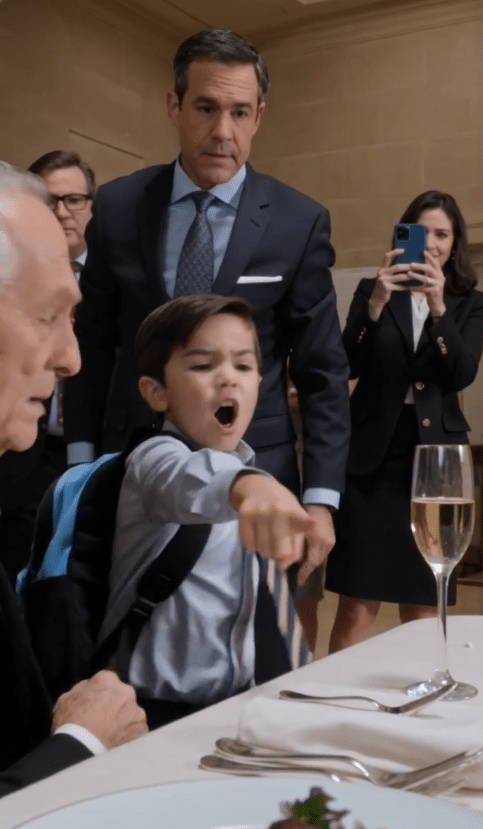
The museum trustee dug his manicured nails into the boy’s cheap backpack and dragged him away from the billionaire’s table in front of three hundred donors.
Crystal glasses stopped clinking.
Conversations collapsed into silence.
“Poor children do not touch donor tables,” Walter Hayes hissed, shoving ten-year-old Leo Bennett toward the exits.
Leo did not cry.
He planted his worn sneakers into the carpet and stared past the trustee at Richard Davis, the museum’s billionaire founder, who was lifting a silver spoonful of gold-leaf chocolate toward his mouth.
“Don’t eat that!” Leo shouted.
Then he lunged.
His palm struck the crystal dessert bowl just before the spoon reached Richard’s lips. The dish flew across the white tablecloth, shattered against the marble floor, and scattered dark chocolate beneath the chandeliers.
A woman in pearls screamed.
Several donors pulled out their phones.
Hayes spun toward Leo with a look of pure outrage.
“What the hell have you done?”
He seized the backpack strap and yanked so violently that Leo rose onto his toes. The cheap fabric tightened across the boy’s shoulder, cutting into the skin beneath his faded school polo.
Leo’s mother, Sarah, stood near the clinic doors at the far end of the grand hall. She had been speaking with a museum employee when she heard the crash.
By the time she turned around, Hayes was already shaking her son in front of the room.
“Let him go!” she shouted.
Hayes ignored her.
“You ungrateful little delinquent,” he said, loud enough for every donor to hear. “You destroy a founder’s plate, interrupt a private luncheon, and then expect us to keep funding your miserable little school?”
Whispers spread through the crowd.
“That’s the nurse’s son.”
“The scholarship child?”
“Maybe he wanted attention.”
Leo heard every word.
His cheeks burned, but he refused to lower his eyes.
Hayes leaned closer.
“I’ll have your mother fired before this room is cleared,” he whispered. “And your school’s outreach grant will disappear with her.”
Leo’s throat tightened.
Sarah had worked at the museum clinic for six years. She treated fainting visitors, injured staff, schoolchildren with asthma, and donors who drank too much champagne at private events.
Her paycheck covered the rent on their small apartment.
Her health insurance paid for Leo’s medication.
Hayes knew that.
He expected the boy to become frightened.
Instead, Leo twisted free enough to slam his palm against the red medical alarm mounted beside the head table.
A shrill siren ripped through the hall.
Hayes laughed.
“Calling security on yourself?”
But Leo was not looking at him.
He was pointing beneath the silver serving tray.
A small white packet was stuck to the metal by a smear of chocolate. It had been torn open and crushed flat.
Red warning letters were still visible across one side.
Sarah recognized the packaging immediately.
It came from the museum clinic’s emergency medication cabinet.
“There,” Leo said, breathing hard. “He emptied it into the dessert.”
The donors turned toward Hayes.
For the first time, his confidence cracked.
Only for a second.
Then he released Leo and reached for the tray.
“The boy planted it.”
He almost touched the packet.
Almost.
But the clinic doors buzzed open before his fingers reached it.
Two museum security officers rushed into the hall, followed by Sarah and Dr. Elena Marquez, the physician supervising the museum’s private medical unit.
Dr. Marquez saw the packet and stopped.
Her face changed.
“Do not touch that tray.”
Hayes froze.
Richard Davis slowly lowered the empty silver spoon in his hand.
“What is it?” he asked.
Dr. Marquez stepped closer without disturbing the table.
She read the partial label.
Then she looked at Richard.
“That packet contained a concentrated cardiac medication.”
A murmur rolled across the room.
Richard’s smile vanished.
Dr. Marquez continued, her voice controlled.
“In a normal dose, it can slow an unstable heartbeat.”
She looked directly at Hayes.
“In the amount contained in that packet, it could stop one.”
The museum founder stared at the shattered dessert on the floor.
Then he looked at the ten-year-old boy who had knocked it from his hand.
“What exactly did you see?” Richard asked.
Leo swallowed.
He pointed toward the towering Egyptian exhibit divider behind the head table.
“I saw Mr. Hayes standing back there before dessert.”
Hayes’s jaw tightened.
Leo continued.
“He took something from his jacket. Then he bent over the tray.”
“That is a lie,” Hayes snapped.
Leo reached slowly into his backpack.
Hayes moved toward him.
“Stop him.”
But one of the security officers stepped between them.
Leo pulled out a battered tablet with a cracked corner.
The screen was still recording.
And when he pressed play, the entire room heard Hayes’s voice coming from behind the Egyptian divider.
“You only need one bite, Richard.”
The silence that followed was worse than the alarm.
But the recording was not the most dangerous thing Leo had captured.
Act II
Leo had not come to the luncheon as a guest.
He had come because Sarah had no one else to watch him.
The public school had closed early after a heating failure, and their elderly neighbor, Mrs. Collins, had been taken to the hospital that morning.
Sarah had called everyone she trusted.
No one was available.
So she had brought Leo to work with strict instructions.
Stay near the clinic.
Do your homework.
Do not bother the donors.
Leo had promised.
He was usually good at promises.
He had learned to be.
After his father disappeared six years earlier, Sarah worked double shifts and spoke in careful half-truths whenever Leo asked questions.
His father had “made mistakes.”
His father had “gone away.”
His father was “not someone they could depend on.”
Leo stopped asking when he realized every question made his mother look tired.
He became the kind of child adults called mature.
He packed his own lunch.
He remembered Sarah’s work schedule better than she did.
He knew which bills could wait until Friday and which ones made her hands shake when the envelopes arrived.
He also noticed things.
That afternoon, he had been sitting behind the Egyptian exhibit divider because the clinic was too noisy. The museum’s education department had given him permission to use a small folding table near the closed archaeology gallery.
He was supposed to be finishing a science project.
Instead, he had been filming a short video about the exhibit.
His teacher had assigned a presentation on ancient preservation methods, and Leo thought the carved funerary panels would make the project look more impressive.
The tablet’s camera was pointed toward a narrow gap between the divider panels.
That was how he saw Hayes.
The trustee stepped behind the exhibit ten minutes before dessert was served.
He checked both directions.
Then he removed a white packet from inside his jacket.
Leo recognized it because Sarah had once shown him the clinic’s medication packaging after warning him never to touch anything from her work bag.
Hayes poured the packet into a small silver sauce container.
Then he stirred the contents with a dessert spoon.
Leo had not understood what he was seeing.
Not immediately.
Hayes was a trustee. His name appeared on museum walls. Staff members lowered their voices when he passed.
Children were taught that men like him helped keep the museum open.
Leo thought perhaps the powder was part of the dessert.
Then he heard Hayes speak into his phone.
“You only need one bite, Richard.”
A pause followed.
“The foundation transfers automatically once he is declared incapacitated.”
Leo stopped filming his school project.
He angled the tablet toward the gap.
Hayes continued.
“No, the daughter will not interfere. She has not spoken to him in years.”
Another pause.
“I control the board vote.”
At that moment, a catering cart rolled between Leo and the divider. By the time it passed, Hayes had already left.
Leo stared at the recording.
He did not know what “declared incapacitated” meant.
But he understood the way Hayes had said it.
He understood secrecy.
And he understood that Richard Davis was the man seated at the head table.
Leo ran toward the clinic to find Sarah, but a line of guests blocked the hallway. Museum staff were carrying floral arrangements, photographers were moving toward the founder’s table, and the dessert service had already begun.
He tried to tell an event coordinator.
She barely looked at him.
“Children’s activities are downstairs.”
He approached a security guard.
The guard pointed toward the staff corridor.
“Go find your mother.”
By the time Leo reached the head table, Richard had the spoon in his hand.
So Leo did the only thing left.
He knocked the dessert away.
Now, inside the grand hall, the damaged tablet played the recording through the luncheon speakers.
Sarah stood beside her son, one hand resting on his shoulder.
Hayes’s voice filled the room.
“The foundation transfers automatically once he is declared incapacitated.”
Several board members turned toward Richard.
Richard’s face had gone pale.
Not from poison.
From recognition.
Hayes recovered quickly.
“A manipulated recording,” he said. “Anyone can fabricate audio now.”
Leo lifted the tablet.
“You walked in front of the camera.”
He moved the video forward.
The image was grainy, but clear enough.
Hayes appeared behind the divider in his navy suit. He held the clinic packet in one hand and the silver sauce container in the other.
A donor near the front whispered, “My God.”
Hayes looked around the hall.
The room that had laughed with him minutes earlier was now watching him with horror.
He adjusted his cuffs.
Then he smiled.
It was not the smile of an innocent man.
It was the smile of someone who had survived scandals before.
“Even if that video is genuine,” he said, “there is no proof the substance was dangerous.”
Dr. Marquez looked at the packet.
“The medication inventory will prove where it came from.”
Hayes turned toward Sarah.
“And who controls that inventory?”
Every head shifted toward her.
Sarah stiffened.
Hayes stepped closer to the table.
“The clinic nurse.”
The accusation landed exactly where he intended.
Sarah’s employment badge.
Her access code.
Her missing medication.
Her son at the scene.
Hayes had not merely prepared to harm Richard.
He had prepared someone else to carry the blame.
And Sarah realized he had chosen her long before Leo entered the room.
Act III
The museum clinic’s medication cabinet required two forms of access.
A staff badge.
And a six-digit personal code.
Sarah’s badge had disappeared three days earlier.
She had reported it missing, but Hayes told administration not to issue a formal security alert.
He called it an unnecessary embarrassment.
That memory returned so sharply that Sarah felt sick.
“My badge,” she whispered.
Hayes heard her.
“Yes,” he said. “Your badge.”
He turned to the donors.
“Three days ago, Nurse Bennett claimed her access card vanished. Today, restricted medication disappears from her clinic and appears beneath a dessert her son deliberately destroyed.”
His voice softened with false regret.
“I did not want to say this publicly, Sarah.”
“You put it there,” Leo said.
Hayes ignored him.
“Perhaps financial pressure became overwhelming. Perhaps she believed the founder’s medical crisis would create confusion.”
Sarah stared at him.
“What would I gain?”
Hayes glanced toward Richard.
“The clinic’s budget was under review.”
A few trustees exchanged uneasy looks.
He had found a story that sounded plausible enough to create doubt.
That was all men like Hayes needed.
Not innocence.
Confusion.
Richard rose slowly from his chair.
He was seventy-two, silver-haired, and thinner than he appeared in photographs. The museum bore his family name, but over the years he had allowed trustees to control most daily decisions.
Hayes had become indispensable during that retreat.
He chaired the finance committee.
He handled donor relations.
He approved staff contracts.
He controlled which problems reached Richard and which disappeared.
“What did you mean about my foundation?” Richard asked.
Hayes remained composed.
“I said no such thing.”
“The recording says otherwise.”
“A fragment taken out of context.”
Leo touched the screen.
“There’s more.”
Hayes’s composure finally slipped.
He moved toward the boy.
Security blocked him again.
Leo opened another file.
The video showed Hayes turning his phone toward the narrow gap in the exhibit wall. For less than two seconds, the screen was visible to the camera.
A woman’s face appeared on the call.
Richard gripped the table.
“Elise.”
The name passed through the hall like a secret.
Elise Davis was Richard’s only daughter.
She had once served as the museum’s director of education and was expected to lead the foundation after him.
Then, seven years earlier, she disappeared from public life after a bitter dispute with the board.
Newspapers called it a family feud.
Hayes called her unstable.
Richard had not spoken to her since.
On the recording, Elise did not sound unstable.
She sounded terrified.
“You said no one would get hurt,” she told Hayes.
“No one is getting hurt,” he replied. “Your father will suffer a medical episode. Afterward, the board will activate the incapacity clause.”
“You promised he would recover.”
“He is an old man with a bad heart. Nothing is guaranteed.”
Richard lowered himself into his chair.
Hayes looked at the tablet as though he wanted to smash it.
Sarah understood before anyone explained.
Elise had been involved.
But not in the way Hayes had planned to portray her.
She had believed she was helping remove her father from control of the foundation, perhaps temporarily.
Hayes had intended to use her anger, then leave her carrying the blame.
Dr. Marquez examined Richard immediately. His blood pressure was elevated, but he had not consumed the dessert.
Leo’s intervention had saved him.
The museum’s legal counsel called the police.
Hayes still refused to panic.
He knew a partial recording and an empty packet might create scandal, but not necessarily conviction.
Then the head of museum security entered the hall carrying a black storage box.
“We reviewed the restricted corridor footage,” he said.
Hayes stared at the box.
The security chief placed it on the table.
“Someone disabled the camera outside the clinic at 2:14 p.m.”
Hayes smiled faintly.
“That proves nothing.”
“No,” the chief replied. “But the backup system does.”
Very few employees knew that the museum’s insurance company had required a secondary security archive after a sculpture theft the previous year.
Hayes was not one of them.
The backup footage showed him using Sarah’s missing badge to enter the clinic.
It showed him opening the locked medication cabinet.
It showed him wiping the badge before placing it inside a cleaning cart near Sarah’s office.
The room erupted.
Hayes stopped denying it.
Instead, he looked at Richard and spoke with quiet contempt.
“You were destroying everything.”
Richard stared at him.
Hayes pointed toward the museum walls.
“Free school programs. Public access days. Community clinics. Do you know what donors say when you spend millions on people who never contribute a cent?”
Leo felt Sarah’s hand tighten around his shoulder.
Hayes continued.
“You built an institution for people who cannot afford it, then expected the wealthy to pay without asking what they received in return.”
Richard’s voice was low.
“They received a museum.”
“They wanted influence.”
“And you sold it to them.”
Hayes laughed once.
“I protected this institution from your sentimentality.”
Richard looked toward Leo.
A child wearing a frayed backpack had risked everything to stop him from taking one bite.
A trustee wearing a suit worth thousands had tried to kill him for control.
The contrast needed no explanation.
But Hayes still had one final weapon.
He turned toward Sarah.
“Tell them who the boy’s father is.”
Sarah went completely still.
Leo looked up at her.
The room quieted again.
Hayes smiled.
“You never told him, did you?”
And for the first time that afternoon, Leo saw fear on his mother’s face.
Act IV
Sarah had spent six years preparing for Leo to ask the question again.
She had imagined answering in their kitchen.
Or during a quiet walk.
Or after he became old enough to understand that adults could love someone and still be wrong about them.
She never imagined telling him beneath crystal chandeliers while donors watched.
“Mom?” Leo whispered.
Sarah crouched in front of him.
Her face was pale.
“Your father worked here.”
Hayes folded his arms.
“Worked here is a generous description.”
Sarah ignored him.
“His name was Daniel Cross.”
Richard looked up sharply.
He knew the name.
So did several senior museum employees.
Daniel Cross had been a junior accountant in the foundation’s finance office. Seven years earlier, he was accused of stealing nearly two million dollars from a community education fund.
The money was never recovered.
Daniel disappeared before charges were filed.
His photograph appeared on local news for weeks.
Sarah was pregnant at the time.
“I thought he ran,” she told Leo. “Everyone did.”
Leo stared at her.
“You said he left us.”
“I believed he did.”
Hayes stepped closer.
“Your husband was a thief.”
“We weren’t married,” Sarah said. “And he was not a thief.”
Her voice changed on the final sentence.
Stronger.
Certain.
She looked toward Richard.
“Daniel contacted me once after he disappeared.”
Hayes’s expression hardened.
Sarah continued.
“He said he had discovered payments being moved through shell charities. He said someone inside the museum was using education grants to buy influence and hide private transfers.”
Richard turned toward Hayes.
Sarah reached beneath her uniform collar and pulled out a small brass key hanging from a chain.
“Daniel told me to keep this safe.”
Hayes moved before anyone else understood.
He lunged toward Sarah.
Security forced him to the floor.
The polished calm vanished completely.
He cursed, kicked, and shouted for the key.
That reaction told Richard more than any accusation could.
“What does it open?” he asked.
Sarah looked at the engraved number.
“A museum archive box.”
The key belonged to an old mechanical deposit system used before the archives were digitized. Boxes could only be removed in the presence of two authorized staff members.
Richard ordered the archive director to retrieve it.
Hayes struggled against the security officers.
“You have no idea what you’re doing.”
The archive box arrived twenty minutes later.
It was small, gray, and coated in dust.
Sarah inserted the key.
Inside were copies of financial ledgers, donor agreements, private board communications, and a handwritten letter addressed to Richard Davis.
Daniel had discovered that Hayes was diverting money from public programs into companies controlled by trustees and political donors.
When Daniel confronted him, Hayes transferred a final payment using Daniel’s credentials and arranged evidence that made him appear responsible.
Daniel fled because Hayes threatened Sarah.
He did not abandon them.
He disappeared to protect them.
The letter ended with a promise.
When I have enough evidence, I will come home.
Leo read that sentence twice.
“Did he?”
Sarah closed her eyes.
“No.”
A second envelope explained why.
Daniel had arranged to meet a federal investigator at a train station outside Albany.
He never arrived.
His car was found three days later near the Hudson River.
No body was recovered.
The case remained open.
Richard removed his glasses.
For seven years, he had believed Hayes’s version of the story. He had allowed Daniel’s name to be destroyed and Sarah to work quietly in the same institution that had framed the father of her child.
Hayes stopped struggling.
“You cannot connect me to what happened to Daniel.”
“No,” Richard said. “Not yet.”
The archive director lifted a small drive from the bottom of the box.
“But perhaps he can.”
The drive contained recorded meetings.
Daniel had worn a concealed microphone during his final weeks at the museum.
One file captured Hayes discussing the missing money.
Another recorded him threatening Daniel’s family.
The final audio was made inside a parking garage.
Hayes’s voice was unmistakable.
“You will leave tonight. Sarah will keep her job, and the child will never know your name. Come back, and neither of them will be safe.”
Daniel answered quietly.
“You’re going to destroy this museum.”
“No,” Hayes said. “I’m going to inherit it.”
The police arrived before the recording ended.
Hayes was handcuffed in the same grand hall where he had dragged Leo by his backpack.
As officers led him away, donors stepped aside.
No one defended him.
No one looked him in the eye.
Near the exit, Hayes stopped beside Leo.
His face was drained of color, but the hatred remained.
“You think you won because you broke a plate?”
Leo looked at the man who had humiliated him.
Then he looked at the crushed clinic packet sealed inside an evidence bag.
“No,” he said. “You lost because you thought nobody would believe me.”
Hayes was taken through the doors.
But Richard Davis was not finished.
He stood before the donors and asked Sarah and Leo to remain.
Then he requested a microphone.
What he said next changed the museum permanently.
Act V
Richard did not speak like a billionaire founder.
He spoke like an old man who had nearly died because he trusted the wrong person.
“For years,” he began, “this institution claimed to belong to the public.”
His voice carried through the silent hall.
“Today, a child from one of our public schools was dragged across this carpet, threatened, insulted, and dismissed because he did not look like the people seated at these tables.”
Several donors lowered their eyes.
Richard looked at Leo.
“He was the only person in this room brave enough to stop me.”
Leo shifted beneath the attention.
His backpack strap had torn almost completely through. A red mark remained across his shoulder where Hayes had pulled him.
Richard noticed it.
He stepped down from the head table.
Then he crouched so they were eye to eye.
“I owe you my life.”
Leo shook his head.
“I just saw what he did.”
“That is usually how courage begins,” Richard said. “Someone sees what everyone else finds convenient to ignore.”
He stood and faced the board.
Effective immediately, he suspended every trustee connected to Hayes’s financial committee.
He ordered a full independent audit.
He restored the missing money to the education fund from his personal assets.
Then he announced that the museum’s community programs would no longer depend on annual approval from donors who viewed poor children as intruders.
He created a permanent public access endowment.
Its first director would be Elise Davis, provided the investigation cleared her of criminal involvement.
Richard had already called his daughter.
She confessed that Hayes manipulated her anger and convinced her that a temporary medical crisis would allow the board to remove Richard before he sold part of the foundation.
She had not known the true dose.
When she realized Hayes intended to kill him, she tried to warn the museum.
Hayes had blocked her calls.
The recording on Leo’s tablet became the proof that she had tried to stop him.
Father and daughter spoke for the first time in seven years that evening.
Their reconciliation was not immediate.
Too much had happened.
But it began.
Sarah was not fired.
She was promoted to director of employee and visitor health services after the investigation revealed that Hayes had repeatedly cut clinic funding while using its restricted supplies for private events.
Daniel Cross’s name was formally cleared.
Federal investigators reopened his disappearance as a criminal case tied to Hayes’s financial network.
Months later, they found Daniel alive.
He had been living under another name in northern Canada after surviving an attack near the train station. He believed Sarah and Leo would be killed if he returned.
The arrest changed that.
The reunion took place in a private museum gallery before opening hours.
Leo stood beside Sarah beneath a suspended blue whale skeleton when a thin man with tired eyes entered through the far doors.
Daniel stopped when he saw the boy.
Leo had imagined that moment in hundreds of ways after learning the truth.
He thought he might run forward.
He thought he might shout.
Instead, he remained still.
“You said you would come home,” Leo said.
Daniel’s face broke.
“I know.”
“It took you a long time.”
“I know.”
Leo looked at his mother.
Sarah was crying silently.
Then he looked back at the father he barely remembered.
“You have to tell me everything.”
Daniel nodded.
“No more disappearing. No more half-truths.”
“I promise.”
Leo considered the word.
Promises still felt fragile.
But this time, he stepped forward.
Daniel wrapped his arms around him.
Sarah joined them a moment later.
Above them, the giant skeleton seemed to float through the morning light.
One year after the donor luncheon, the museum opened a new learning center for public-school students.
The walls displayed artifacts chosen by children from across the state.
The classrooms were free.
The meals were free.
Transportation was funded for schools that could not afford buses.
Near the entrance stood a glass display case.
Inside was Leo’s old backpack.
The torn strap had never been repaired.
Beside it sat the cracked tablet and a replica of the silver dessert spoon Richard had nearly lifted to his mouth.
The plaque beneath them did not mention wealth.
It did not mention donors.
It read:
Truth does not become less valuable because it comes from someone the room has chosen to ignore.
At the opening ceremony, Richard invited Leo to speak.
Leo was eleven then.
He walked onto the stage wearing a new jacket and clean sneakers, though he still carried himself with the same watchful seriousness.
The hall was once again filled with trustees, donors, teachers, museum staff, and reporters.
This time, no one told him he did not belong near the important tables.
Leo looked toward the front row.
Sarah sat beside Daniel.
Elise sat beside her father.
Dr. Marquez and the security officers were there too.
Leo unfolded his speech.
Then he set it aside.
“A year ago,” he said, “a man grabbed my backpack because he thought being poor meant I was powerless.”
The room went still.
“He was wrong.”
Leo looked at the display case near the entrance.
“My backpack was cheap. My tablet was cracked. My mother worked for people who barely noticed her unless they needed help.”
He paused.
“But none of that changed what I saw.”
Richard smiled.
Leo continued.
“People miss the truth when they decide who matters before anyone speaks.”
There was no dramatic applause at first.
Only silence.
The kind that comes when a room recognizes itself.
Then Sarah stood.
Daniel followed.
Soon, the entire hall was on its feet.
Leo looked toward the donor table where the shattered dessert had once fallen.
The table was gone.
In its place stood a row of workstations where children were learning to preserve old photographs, record family stories, and examine artifacts beneath microscopes.
The room had changed because one child refused to stay quiet.
And years later, visitors still stopped in front of the torn backpack and asked why it had been placed inside a museum.
The answer was simple.
It was not there because it belonged to a poor boy.
It was there because, on the day powerful adults failed to protect the truth, the boy carrying it did.