Act I
The scream came before anyone understood what they had done.
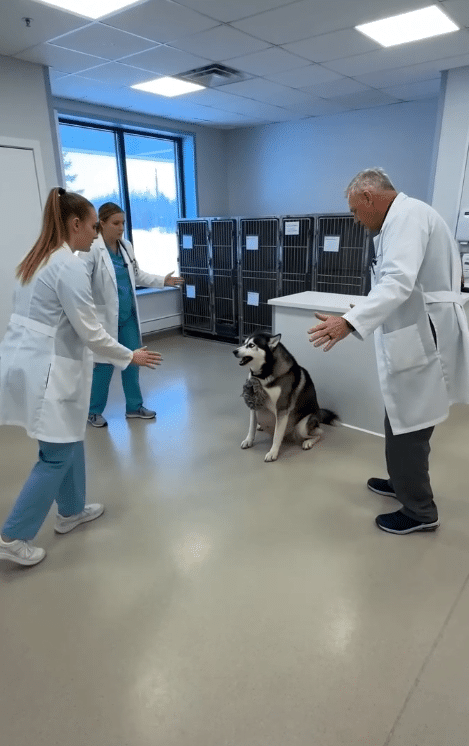
It ripped through the brightly lit lobby of the emergency veterinary clinic so violently that Sarah dropped the clipboard in her hands. Dr. Miller stumbled backward. I froze on my knees with one hand still reaching toward the husky’s chest.
The dog had not snapped at us.
She had not tried to bite.
She had screamed like something was being taken from her.
Outside, the November blizzard hurled snow against the glass doors. The parking lot had disappeared beneath a sheet of white, and the wind sounded almost human as it howled through the darkness.
It was 11:45 p.m. in upstate New York.
No one should have been on the road.
Yet somehow, the pregnant husky had walked into our clinic alone.
She stood near the entrance, soaked in mud and frozen slush, her gray-and-white coat pressed flat against her thin body. Her stomach hung low and heavy, swollen with puppies that looked ready to arrive at any moment.
She was shivering so hard that her teeth clicked.
But her eyes were sharp.
Ice blue. Terrified. Watchful.
At first, we thought she was afraid of us.
Then Dr. Miller reached toward the enormous clump of matted fur hanging beneath her throat, and the sound she made changed everything.
She threw herself backward, lost her footing, and crashed onto her side. Her pregnant belly struck the floor with a dull thud.
Before we could reach her, she scrambled beneath the waiting-room chairs and curled her body tightly around the dark mass on her chest.
Her chin pressed down over it.
Her front legs folded around it.
She guarded it like it was alive.
“Extreme matting can pull the skin,” I said, though even I did not believe that explained what we had just witnessed.
Dr. Miller stared beneath the chairs.
“I’ve treated neglected dogs for thirty years,” he said quietly. “That wasn’t just pain.”
The clump was almost four inches thick and hard as stone. It was coated in dried mud, something dark that looked like old blood, and a sticky chemical residue none of us could identify.
It dragged at the husky’s neck every time she moved.
It had to come off.
But when we tried to wrap her in a blanket, she fought with a desperation that made no sense. She thrashed until her claws tore through the fleece. She struck my jaw with her head so hard that I tasted blood.
Still, she did not try to injure us.
She only tried to keep us away from her chest.
Dr. Miller finally used a mild sedative.
Even as the medication spread through her exhausted body, the husky fought to remain upright. Her knees trembled. Her eyelids lowered.
Yet she kept forcing her chin down over the mat.
It was the last thing she surrendered.
When she finally collapsed, we lifted her onto a metal examination table and rolled her beneath the surgical lights.
The room became painfully quiet.
Dr. Miller raised the clippers.
I held the dog’s head back.
And then the hardened mass moved.
Not with the dog’s breathing.
Not from the vibration of the table.
It twitched from the inside.
“Stop,” I whispered.
Dr. Miller frowned. “It’s probably a muscle spasm.”
“No.”
I grabbed his wrist before the clippers touched the fur.
Then I found a narrow crack in the hardened mat and slowly pulled it open with my gloved fingers.
I expected infected skin.
I expected a wound.
Instead, from deep inside the darkness, a tiny eye opened and looked directly at me.
And then something inside the husky’s fur made the faintest sound imaginable.
A newborn puppy’s cry.
Act II
For several seconds, none of us moved.
Dr. Miller lowered the clippers.
Sarah covered her mouth with both hands.
I leaned closer to the gap in the fur, barely breathing. Behind the tiny eye was a trembling face no larger than the palm of my hand.
The puppy was alive.
Barely.
Its body had somehow become trapped inside the mass against the mother’s throat. Layers of wet undercoat, dried mud, blood, and melted synthetic fibers had hardened around it like a crude shell.
Only its nose and one eye had access to air.
“Oh my God,” Sarah whispered. “She was carrying it.”
Dr. Miller’s expression changed instantly.
The clippers went back onto the tray.
“We cut nothing until we understand how it’s attached.”
He brought over a magnifying lamp while I held the husky’s head steady. Under the stronger light, we began to see what had happened.
The puppy had not simply become tangled in her coat.
Someone had wrapped something around it.
Thin blue nylon cord ran through the matting, twisted beneath the mother’s fur and knotted near her collar line. Mixed into the mess were scraps of a torn plastic feed bag and a strip of dark green fabric.
The material had tightened as the dog moved through the storm.
Every step she took had pulled the puppy harder against her skin.
Every attempt to touch the mat had pressed the cord around the puppy’s tiny body.
That was why she screamed.
She had not been protecting the mat.
She had been protecting the life trapped inside it.
Dr. Miller worked with blunt-tipped surgical scissors, cutting one strand at a time. It took nearly forty minutes to free the puppy without injuring either animal.
When the last piece of hardened fur loosened, the puppy slid gently into my hands.
It was a male.
His fur was still damp beneath the crust. His body was cold, and his gums were dangerously pale.
But he was breathing.
The moment he was placed on a heated pad, the sedated husky’s front paw shifted toward him.
Even unconscious, she reached for her baby.
That single movement silenced the room.
We began warming the puppy and checking the mother. Her temperature was dangerously low. Her paws were cut from ice and road salt. A faded rope burn circled her neck beneath the filthy coat.
She had no collar.
No identification tag.
But when Sarah scanned her for a microchip, the machine beeped.
For the first time that night, we had a name.
Luna.
The chip listed an owner named Daniel Mercer and an address nearly twenty miles away in the town of Bellwood.
Sarah called the number.
Disconnected.
She searched the address.
The property had been sold eight months earlier.
Then she searched the owner’s name.
Daniel Mercer had died the previous spring.
The room felt colder after that.
We had assumed Luna was a stray.
She was not.
She had belonged to someone.
And according to the old registration file, she had once been one of two huskies living at a small family farm outside town.
The second dog was named Atlas.
No one knew where he was.
As we cleaned Luna’s wounds, Dr. Miller found more evidence that disturbed him.
The rope marks were recent.
So were bruises along her ribs.
One patch of fur near her hind leg had been cut unevenly, as though someone had tried to remove a tag or mark.
“This dog didn’t just get lost,” he said.
I looked at the tiny puppy under the warming lamp.
“Then how did he end up tied to her chest?”
Dr. Miller did not answer immediately.
He was staring at the dark green fabric we had cut from the mat.
There was yellow stitching along one edge.
A partial word remained visible beneath the mud.
County.
Sarah took a photo and enlarged it on her computer.
The fabric appeared to be part of a uniform.
Not police.
Not animal control.
A county correctional work jacket.
Before we could say anything else, Luna’s abdomen tightened.
Her entire body stiffened beneath the sedative.
Dr. Miller placed a hand against her belly.
Another contraction rolled through her.
Then another.
His face became grim.
“She’s going into labor.”
We thought the puppy trapped in her fur was the mystery.
We were wrong.
Because when the first contraction hit, Luna opened her eyes, looked directly at the clinic door, and began to growl at someone standing outside.
Act III
A man was visible through the snow.
He stood beneath the yellow parking-lot light with one hand raised against the glass.
He was tall, broad-shouldered, and dressed in a dark green work jacket.
The same color as the fabric tangled around the puppy.
Sarah locked the front doors before he reached them.
The man pulled on the handle.
Then he knocked.
Not urgently.
Calmly.
That made it worse.
Dr. Miller stepped into the lobby while I stayed beside Luna.
“Can I help you?” he called through the glass.
The man smiled.
“I’m looking for my dog.”
Luna’s growl deepened.
She was still weak from the sedative, but her eyes never left him.
“What’s the dog’s name?” Dr. Miller asked.
The man hesitated only a fraction of a second.
“Luna.”
Sarah and I exchanged a look.
Dr. Miller did not unlock the door.
“What’s your name?”
“Caleb Voss.”
The man leaned closer to the glass.
“She slipped out of my truck during the storm. I’ve been searching everywhere.”
Luna tried to rise.
The contraction forced her back down.
Her panic was immediate. She clawed at the towel beneath her, dragging herself toward the far side of the examination table.
I put both hands against her shoulders.
“You’re safe,” I whispered. “He’s not coming in.”
Caleb’s smile disappeared.
“I can prove she’s mine,” he said.
“The microchip belongs to Daniel Mercer,” Dr. Miller replied.
For the first time, the man looked surprised.
Then his face softened into practiced sadness.
“Daniel was my uncle.”
Sarah was already typing.
Daniel Mercer had no nephew named Caleb Voss.
He had only one known child, a daughter named Emily.
She had been nineteen when her father died.
There was no recent address listed for her.
Caleb knocked again.
Harder this time.
“You need to give me the dog.”
Dr. Miller crossed his arms.
“She arrived injured, hypothermic, and in active labor. No animal leaves this clinic tonight.”
Caleb stared at him.
Then his eyes shifted past the lobby and found me through the open hallway.
More specifically, he found the puppy under the warming lamp.
His expression changed.
It was quick, but unmistakable.
Fear.
Not concern.
Not relief.
Fear.
“He’s alive?” Caleb said.
The question slipped out before he could stop it.
Dr. Miller turned slowly toward the puppy.
“You knew about him.”
Caleb stepped back from the door.
Then he ran.
Sarah called the sheriff’s department while Dr. Miller rushed back into the exam room.
Luna’s contractions were becoming stronger, but the first unborn puppy was not moving correctly through the birth canal.
An ultrasound confirmed six more heartbeats.
One was dangerously slow.
“We may need an emergency cesarean,” Dr. Miller said.
As he prepared the surgical room, I stayed beside Luna and held the rescued puppy near her face.
She sniffed him weakly.
The puppy made a soft squeak.
For the first time since entering the clinic, Luna stopped trembling.
She began licking his head.
Slowly.
Carefully.
Then Sarah came into the room holding her phone.
“I found Emily Mercer.”
A local article from six months earlier showed a young woman standing outside a burned barn.
The headline said the Mercer family property had been investigated after a suspicious fire. Several animals had vanished. The owner’s daughter had accused a county-contracted kennel operator of illegally taking dogs from abandoned properties.
That operator was Caleb Voss.
The investigation had stalled due to insufficient evidence.
Emily had disappeared from public view soon afterward.
Sarah kept reading.
Daniel Mercer had bred working huskies for search-and-rescue programs. Luna and Atlas were not ordinary pets. They came from a rare bloodline, and trained dogs from that line sold for thousands of dollars.
After Daniel died, his will left the farm, the dogs, and all breeding rights to Emily.
But the signed will had gone missing after the barn fire.
A different document surfaced weeks later, transferring the remaining animals to Caleb’s kennel.
Emily claimed the signature was forged.
Nobody believed her.
Then Luna vanished.
So did Atlas.
Dr. Miller looked toward the puppy.
“This isn’t neglect,” he said.
“It’s evidence.”
The nylon cord, the uniform fabric, the bruises, the altered fur.
All of it pointed back to Caleb.
But there was still one detail we could not explain.
Why would anyone tie a newborn puppy beneath its mother’s neck?
The answer came from the object we found hidden beneath the last layer of matted fur.
It was not part of the dog.
It was a small waterproof pouch.
Inside was a folded letter covered in blood and mud.
And on the front, written in shaking black ink, were three words.
For whoever finds Luna.
Act IV
The letter was from Emily Mercer.
The first lines were almost unreadable.
My name is Emily. If Luna reaches someone, please do not return her to Caleb Voss. He killed my father’s dogs, and he will kill her too.
Sarah read the words aloud while Dr. Miller prepared Luna for surgery.
According to the letter, Emily had spent months trying to prove Caleb forged the transfer papers after her father’s death. She believed he had set the barn fire to destroy breeding records and ownership documents.
But Daniel had kept copies.
One was hidden inside the old farmhouse.
Emily recovered it two weeks earlier.
Caleb found out.
He followed her to the property and took Luna, who was already pregnant by Atlas. Emily managed to get Luna back, but not before Caleb discovered where the paperwork had been hidden.
Emily knew she could not outrun him in the storm.
So she placed the duplicate will, a memory card, and a handwritten statement inside the waterproof pouch.
Then she tied it beneath Luna’s neck.
The newborn puppy had come later.
Emily had been hiding with Luna in an abandoned storage shed when the dog unexpectedly delivered the first pup.
The temperature was below freezing.
There was no blanket.
No heat.
No time.
Emily wrapped the puppy in cloth and secured him against Luna’s chest, where the mother’s body warmth could keep him alive.
Then Caleb arrived.
The rest of the letter ended abruptly.
I heard his truck. I’m sending Luna toward the highway. She knows the clinic route from when Dad used to take her there. If she arrives alone, please believe me.
The final word trailed into a long streak of ink.
For several seconds, no one spoke.
Then the sheriff’s deputy arrived.
We gave him the letter, the pouch, and the memory card.
The card contained videos.
One showed Caleb loading dogs from the Mercer farm into an unmarked trailer days after Daniel’s death.
Another showed him burning documents behind his kennel.
The final video was recorded by Emily only hours earlier.
She was crouched inside a dark shed, whispering into the camera while Luna panted beside her.
“If anything happens to me,” Emily said, “Caleb has been selling the puppies under false registrations. He kept Atlas chained at the old county maintenance yard. Please find him.”
The video shook.
A loud noise came from outside.
Emily turned.
The recording ended.
The deputy immediately called for backup.
Meanwhile, Luna’s condition deteriorated.
One puppy’s heartbeat vanished from the monitor.
Dr. Miller had no choice.
We moved her into surgery.
The next hour became a blur of stainless steel, bright lamps, clipped instructions, and the steady mechanical sound of the oxygen machine.
One by one, Dr. Miller lifted the puppies free.
The first female was not breathing.
I rubbed her chest with a towel until she gasped.
The second began crying immediately.
The third was tiny but strong.
The fourth needed oxygen.
The fifth kicked in my hands.
The sixth came out completely still.
Dr. Miller worked on him for several minutes.
Nothing.
Then Luna, still half-conscious, lifted her head at the sound of the other puppies.
A weak howl escaped her throat.
The silent puppy twitched.
I pressed my fingers to his chest.
A heartbeat.
Faint.
But there.
By 3:20 a.m., Luna was resting beneath warm blankets with seven living puppies lined against her body.
The firstborn, the one she had carried beneath her neck, was placed closest to her face.
She curled her paw around him.
At 4:05 a.m., the deputy returned.
They had found Caleb’s truck abandoned near the old county maintenance yard.
Inside the building, they found Atlas chained in a locked room with three other stolen dogs.
They also found ledgers, forged registration certificates, sedatives, and sales records connecting Caleb to illegal breeding operations across three states.
But they had not found Emily.
Then the clinic phone rang.
A snowplow driver had spotted a young woman lying beside a rural access road less than four miles from the abandoned shed.
She was alive.
Barely conscious.
Severely hypothermic.
And when the paramedics asked her name, she said only one word before passing out.
“Luna.”
But the night still had one final truth left to reveal.
Act V
Emily arrived at the clinic two days later.
She had been released from the hospital that morning against medical advice.
Her face was bruised. One wrist was wrapped in a bandage, and she walked carefully, as though every step hurt.
But when she entered the recovery room and saw Luna, she stopped breathing.
The husky lifted her head.
For a long second, neither moved.
Then Luna let out a sound unlike the screams we had heard that night.
It was soft.
Broken.
Almost a sob.
Emily fell to her knees.
Luna pulled herself out of the recovery bed, dragging tubes and blankets with her until Dr. Miller quickly disconnected them.
She crossed the floor and pressed her entire body against Emily.
The puppies squeaked behind her.
Emily buried her face in Luna’s wet fur.
“I’m sorry,” she whispered. “I’m so sorry I sent you alone.”
Luna licked the tears from her cheek.
No one in the room looked away.
Emily later told us what happened after she tied the puppy to Luna’s chest.
Caleb had found the shed and tried to take the dog. Emily fought him long enough to open the back door and tell Luna to run.
Luna refused.
She kept circling back.
So Emily used the command her father had taught all his rescue dogs.
Find help.
Luna understood.
She ran into the blizzard carrying her newborn puppy, the missing will, and the evidence that could destroy Caleb’s operation.
She crossed nearly twelve miles of frozen roads.
She avoided traffic.
She survived the cold.
And somehow, through exhaustion and labor, she remembered the clinic Daniel had taken her to years before.
The place where strangers might believe what she could not say.
Caleb Voss was arrested that morning.
The recovered evidence led investigators to multiple stolen animals and several fraudulent breeding networks. The duplicate will proved Emily was the legal owner of the Mercer dogs and property.
Atlas was returned to her after treatment.
When he and Luna saw each other again, they pressed their foreheads together and stood silently for nearly a minute.
The firstborn puppy was named Daniel.
Not because he looked like Emily’s father.
Because, according to her, he had survived the same way Daniel Mercer had lived.
Quietly protecting the truth until someone was finally ready to see it.
The other puppies were eventually placed with carefully selected families, except for two that Emily kept.
She rebuilt the farm.
Not as a breeding business.
As a rescue and rehabilitation center for abandoned working dogs.
Dr. Miller donated medical services during its first year. Sarah organized a fundraiser. I visited whenever I could.
Luna never fully lost her fear of clippers.
Whenever she heard the low electric hum, she would tense and pull her puppies closer.
But she never screamed again.
Months later, Emily brought her back to the clinic for a routine examination.
Luna walked through the same glass doors where she had once arrived alone, frozen, pregnant, and terrified.
This time, sunlight followed her inside.
Her coat had grown back thick and bright. Her eyes were calm. Daniel trotted beside her, nearly half her size now, wearing a blue collar with a silver tag.
Emily stopped at the front desk.
“There’s something I wanted you to have,” she said.
She handed me a small framed photograph.
It showed Luna lying in a field beneath the summer sun, surrounded by her puppies.
Beneath the photograph, Emily had written one sentence.
You thought she was guarding her pain.
She was guarding the truth.
I hung it in Examination Room 1.
Years have passed since that night, but I still look at it whenever a frightened animal comes through our doors.
Because fear does not always mean aggression.
A wound is not always what it appears to be.
And sometimes, the creature fighting hardest to keep you away is not protecting itself at all.
Sometimes, it is protecting the one life it cannot bear to lose.