Act I
The room went silent before Sarah understood what her son was trying to say.
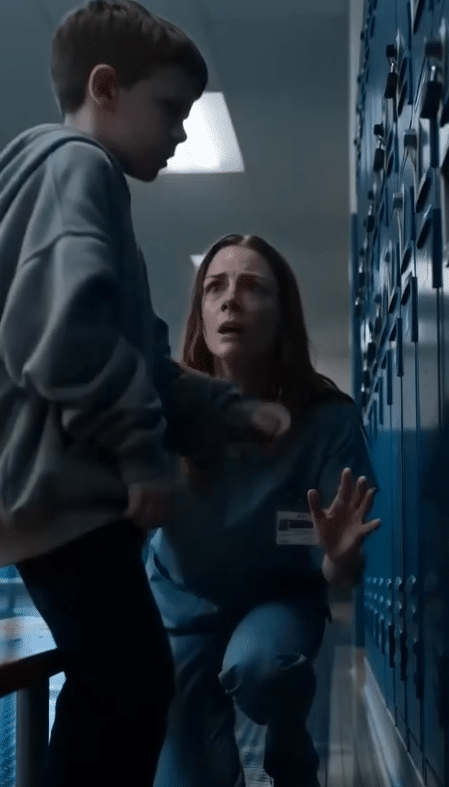
Leo stood beside locker number 42 with one trembling hand raised against the cold blue metal. His face was pale. His lips were pressed together so tightly they had lost their color.
Then he tapped again.
Three short knocks.
Three long ones.
Three short.
SOS.
Sarah felt the blood drain from her face.
Her ten-year-old son had not cried out. He had not screamed. He had not run into her arms.
He had asked for help in code.
For the past month, Coach Vance Miller had insisted Leo was becoming difficult. Lazy. Entitled. Uncooperative.
A spoiled brat, he had called him.
Sarah had believed him.
She had believed the celebrated coach with the framed medals in his office, the polished smile, and the list of scholarship athletes whose photographs covered the entrance hall of Oakridge Aquatic Center.
She had believed him instead of her own child.
Now Leo raised his arm to tap the final letter.
His oversized sleeve slipped down.
Sarah stopped breathing.
Dark bruises circled his forearm in the clear shape of an adult hand. They stretched from his wrist toward his elbow, layered in different shades of purple and yellow, as though some were new and others had been healing for days.
When Leo turned slightly, the hoodie pulled tight across his back.
Thin red marks showed through the fabric beneath it.
Sarah’s stomach twisted.
Suddenly, every strange moment from the last month came rushing back.
Leo refusing hugs.
Leo locking the bathroom door.
Leo sleeping in thick clothes.
Leo begging to skip practice on Tuesdays and Thursdays.
Leo standing in the kitchen at midnight, staring into the dark, whispering that he had forgotten how to be fast.
Sarah had thought he was grieving his father.
She had thought he was entering an awkward phase.
She had thought Coach Miller’s cruelty was discipline.
But her son had not been refusing to change because he was spoiled.
He had been hiding evidence.
“Leo,” she whispered.
He yanked his sleeve down and backed away.
His eyes filled with terror.
“Mom, please,” he said. “Don’t say anything here.”
Sarah stared at him.
“Did Coach Miller do this?”
Leo’s face collapsed.
He did not answer.
He did not need to.
From beyond the glass doors leading to the pool deck, a whistle shrieked.
Leo flinched so violently that his backpack slipped from his hands.
Something small and silver fell from an open side pocket and skidded beneath the bench.
Sarah reached for it.
Leo lunged forward.
“No!”
But she had already picked it up.
It was a digital voice recorder.
Old. Scratched. Wrapped in black electrical tape.
A tiny red light was blinking.
Sarah looked at her son.
Leo looked toward the pool doors.
Then he whispered the sentence that changed everything.
“He told me nobody would believe one poor kid over him.”
Before Sarah could respond, the locker-room door opened.
Coach Miller stood in the doorway.
His smile appeared instantly.
But his eyes went straight to the recorder in Sarah’s hand.
And for the first time, the famous coach looked afraid.
That was when Sarah realized the bruises were only the beginning.
Act II
“Mrs. Collins,” Miller said smoothly, stepping into the locker room. “Parents are not permitted in athlete-only areas.”
Sarah rose slowly.
She placed herself between him and Leo.
“Neither are locked doors.”
Miller’s smile tightened.
The transformation in his face was almost invisible, but Sarah saw it.
The public version of Vance Miller was still standing there: the respected coach, the mentor, the man who shook hands with donors and remembered every parent’s name.
But something colder had moved behind his eyes.
“This is a misunderstanding,” he said. “Leo has been struggling with authority. I was going to speak with you privately.”
“You’ve been speaking privately with him for weeks.”
Miller glanced at Leo.
It was only one look.
But Leo shrank behind Sarah as if struck.
Sarah’s hand closed around the recorder.
“What’s on this?”
Leo shook his head desperately.
Miller stepped forward.
“That belongs to the facility.”
“No,” Leo whispered. “It was Dad’s.”
Miller stopped.
Sarah looked down at the recorder.
Her husband, Daniel, had used it during his final months of cancer treatment. He had recorded messages for Leo—birthday wishes, advice for high school, stories about their first fishing trip.
Sarah had not seen it since the week after Daniel died.
Leo had been carrying his father’s voice into the locker room.
Not for comfort.
For evidence.
Sarah pressed the stop button and slipped the recorder into her scrub pocket.
“We’re leaving.”
Miller moved toward the door.
“You’re making a serious mistake.”
Sarah looked directly at him.
“My mistake was believing you.”
For a moment, neither of them moved.
Then Miller lowered his voice.
“You have no idea what’s at stake here.”
Sarah felt Leo grip the back of her shirt.
“Move.”
Miller’s jaw flexed.
Behind him, the pool deck was filled with splashing water, shouted lap times, and the laughter of parents watching through the glass observation wall.
A hundred people were only yards away.
Yet inside the locker room, Sarah understood how completely isolated her son had been.
Miller finally stepped aside.
As Sarah led Leo past him, he spoke softly enough that only she could hear.
“Be careful what you accuse people of when you can’t afford a lawyer.”
Sarah kept walking.
But the threat followed her all the way into the hallway.
Marcus was still standing beside his cleaning cart.
The elderly custodian looked at Leo’s lowered head, then at Sarah’s face.
He knew.
Sarah could see it immediately.
“How long?” she asked.
Marcus’s fingers tightened around the mop handle.
“I don’t know what you mean.”
“Yes, you do.”
He looked toward the lobby.
“Not here.”
Sarah pulled Leo closer.
“Then where?”
Marcus swallowed.
“Storage room B. Five minutes.”
Sarah should have left the building.
Every instinct told her to take Leo straight to the police, the hospital, anywhere far from Oakridge.
But Leo grabbed her hand.
“Mom,” he whispered, “there are other kids.”
The words stopped her.
“How many?”
He stared at the floor.
“I don’t know.”
Sarah felt something inside her harden.
This was no longer only about what had happened to her son.
Five minutes later, Marcus unlocked Storage Room B behind the maintenance corridor.
The space smelled of wet cardboard and industrial detergent. Broken lane dividers hung from hooks along the wall.
Marcus closed the door behind them.
Then he removed his glasses and began to cry.
“I told myself I wasn’t sure,” he said. “That’s how I lived with it.”
Sarah said nothing.
Marcus opened a dented filing cabinet and pulled out a thick envelope.
Inside were copies of incident reports.
Dozens of them.
Each report involved a young swimmer.
Each described bruising, anxiety, withdrawal, refusal to change, sudden departure from the team, or what the forms called behavioral instability.
Every complaint had been closed internally.
No police reports.
No outside investigations.
Most had the same handwritten note across the top.
Family withdrew allegation.
Sarah flipped through the pages.
“Who signed these?”
“Parents,” Marcus said. “Or that’s what management claimed.”
Several signatures looked nearly identical.
Sarah stared at them.
“Were these forged?”
Marcus lowered his head.
“I think so.”
Leo moved closer to the papers.
Then he pointed at one name.
Evan Price.
Sarah remembered him.
A gifted twelve-year-old swimmer who had disappeared from the team the previous winter. Parents had whispered that Evan suffered a breakdown before an important meet.
Coach Miller had called him mentally weak.
Sarah found the final note attached to his file.
Relocated out of state.
But Marcus shook his head.
“He didn’t relocate.”
“Where is he?”
“St. Augustine Children’s Recovery Center, forty miles north.”
Sarah felt sick.
“What happened to him?”
Marcus looked at Leo.
Then he looked away.
“He stopped speaking.”
The storage room seemed to shrink around them.
Sarah clutched the envelope against her chest.
Miller had not simply terrorized children.
Someone had protected him.
And just as Sarah reached for her phone, the light beneath the door disappeared.
A shadow had stopped outside.
Then the handle began to turn.
Act III
Marcus killed the light.
Leo’s hand found Sarah’s in the darkness.
The door opened.
A beam from a flashlight cut across the room.
Sarah held her breath.
A man stepped inside.
It was not Coach Miller.
It was Richard Hale, executive director of the Oakridge Athletic Foundation.
Sarah recognized him from fundraising brochures and local news interviews. Hale was always photographed beside politicians, hospital executives, and scholarship recipients.
He had personally awarded Leo his partial training grant.
Now he stood in the doorway wearing a charcoal suit, rainwater shining on his shoulders.
“Marcus,” he said quietly, “what are you doing?”
Marcus stepped in front of the filing cabinet.
“Inventory.”
Hale aimed the flashlight at Sarah.
His expression did not change.
“Mrs. Collins.”
Sarah’s heart pounded.
“You know who I am.”
“Of course. Your son is one of our scholarship athletes.”
The way he said scholarship made it sound like a debt.
Hale noticed the envelope in Sarah’s hands.
“Those are confidential records.”
“They’re evidence.”
“Of what?”
Sarah stared at him.
“Ask your coach.”
Hale sighed.
Not angrily.
Almost sadly.
“That’s what difficult parents always say when their children fail to meet expectations.”
Leo pressed closer to Sarah.
She felt him shaking.
Hale continued.
“Competitive sports are demanding. Children bruise. Children become anxious. They resent authority. Parents often search for someone to blame.”
Sarah pulled Leo’s sleeve back just enough to expose the marks around his arm.
Hale’s eyes flickered.
Only once.
But Sarah saw it.
“You knew,” she said.
“I know that allegations can destroy institutions before facts are established.”
“Institutions?”
“My son is ten years old.”
Hale’s face hardened.
“And this facility supports four hundred families. We fund scholarships, youth programs, rehabilitation clinics. One reckless accusation could jeopardize everything.”
Sarah stared at him in disbelief.
He was not denying it.
He was calculating the cost.
Hale extended his hand.
“Give me the files.”
Sarah stepped back.
“No.”
“You signed a participant agreement. These records are property of Oakridge.”
“My son is not your property.”
For the first time, irritation cracked through Hale’s calm expression.
He reached into his jacket.
Marcus moved quickly, shoving the cleaning cart between them.
A stack of plastic buckets crashed to the floor.
Leo screamed.
Hale froze.
The sound echoed down the corridor.
Voices rose in the distance.
Parents.
Staff.
Someone called out, asking what had happened.
Hale lowered his hand.
“Think carefully, Mrs. Collins,” he whispered. “You are a single parent with limited resources. Coach Miller has a spotless reputation. Your son has documented behavioral problems.”
“Documented by whom?”
Hale did not answer.
Sarah raised her phone and took a photograph of him standing in front of the open cabinet.
The flash filled the room.
Hale’s face changed.
Not fear.
Fury.
“You have no idea what you’ve just done.”
Sarah took Leo’s hand.
“Yes,” she said. “I finally do.”
They walked past him.
Hale did not stop them.
That frightened Sarah more than if he had.
At the hospital, a pediatric physician documented Leo’s injuries and quietly contacted child protective services. A police officer arrived an hour later.
Sarah gave him the recorder, the photographs, and copies of the files Marcus had slipped into her bag before they left.
But when the officer returned after speaking to his supervisor, his tone had changed.
He placed the recorder in an evidence bag.
“We’ll review it.”
“When?”
“As soon as possible.”
“Coach Miller is still at the facility.”
“We don’t have enough to arrest anyone tonight.”
Sarah stood.
“My son has bruises shaped like a hand.”
“And we are taking that seriously.”
“No. You’re speaking slowly so I’ll think you’re taking it seriously.”
The officer looked uncomfortable.
Leo sat silently on the hospital bed, wrapped in a white blanket.
Sarah lowered her voice.
“What aren’t you telling me?”
The officer hesitated.
Then he glanced toward the hallway.
“Coach Miller’s brother-in-law is Deputy Chief Raymond Hale.”
Sarah went still.
Hale.
The same last name as Oakridge’s executive director.
The foundation director, the deputy chief, and the coach were connected.
This was not an isolated monster protected by his reputation.
It was a system.
Sarah turned toward Leo.
He was staring at the evidence bag containing the recorder.
“Mom,” he said softly, “that isn’t the only recording.”
Sarah looked at him.
Leo reached into his backpack and pulled out a memory card wrapped in tissue.
“I copied everything.”
Her eyes filled with tears.
“When?”
“Every night.”
He looked ashamed.
“I thought if I disappeared like Evan, you’d need proof.”
Sarah’s knees nearly gave way.
She sat beside him and pulled him gently into her arms.
This time, he did not flinch.
She held him as tightly as she dared.
“You are not disappearing,” she whispered. “Do you hear me? You are not going anywhere.”
Leo began to cry against her shoulder.
For the first time in weeks, he cried like a child instead of hiding like a witness.
That night, Sarah listened to the recordings.
Coach Miller shouting.
Threatening.
Mocking children for their bodies, their families, their fear.
Ordering them to remain after practice.
Telling Leo that his mother needed the scholarship too badly to believe him.
Then came another voice.
Richard Hale.
“Keep the grant kids quiet,” he said. “Their parents won’t risk losing what we give them.”
Sarah replayed the sentence three times.
Then she heard the final recording.
A frightened child whispering from somewhere near Leo’s locker.
“Coach, please don’t make me go in the equipment room again.”
The child’s voice was familiar.
It belonged to Evan Price.
And behind his plea, another voice could be heard.
A woman’s voice.
Clear.
Controlled.
“Vance, the security camera is still running.”
Sarah sat upright.
The voice belonged to Claire Miller.
The coach’s wife.
And according to Oakridge’s website, Claire Miller was the facility’s head of security compliance.
She had known.
But the next morning, Claire Miller arrived at Sarah’s apartment carrying a key.
And what she unlocked would bring the entire Oakridge empire down.
Act IV
Claire stood beneath the flickering light outside Sarah’s apartment at six forty-two in the morning.
She looked nothing like the polished woman from the Oakridge website.
Her hair was unwashed. Her eyes were swollen. A dark wool coat hung loosely around her shoulders.
In one hand, she held a small brass key.
In the other, a sealed plastic folder.
Sarah did not open the door fully.
“What are you doing here?”
Claire looked past her.
“Is Leo safe?”
Sarah’s grip tightened on the door.
“You don’t get to ask me that.”
Claire closed her eyes.
“No,” she said. “I don’t.”
For several seconds, neither woman moved.
Then Claire held up the folder.
“Vance thinks he destroyed the security archive.”
Sarah stared at her.
“He didn’t?”
“He destroyed the official one.”
Claire’s voice cracked.
“I kept copies.”
Sarah let her inside.
Leo was asleep in the bedroom.
Claire sat at the kitchen table while Sarah remained standing.
The folder contained dates, camera numbers, internal emails, and access logs from Oakridge’s security system.
Claire pointed to a list of deleted recordings.
“The locker rooms don’t have cameras,” she said. “But the hallways, equipment rooms, maintenance entrances, and pool access corridors do.”
“Then you saw him taking children away from the group.”
Claire nodded.
“Not at first. I thought he was conducting private evaluations.”
Sarah slammed her hand onto the table.
“You heard Evan begging.”
Claire flinched.
“I did.”
“And you did nothing.”
“I confronted Vance that night. He told me Evan had panic attacks and needed controlled exposure therapy.”
“He’s a swim coach.”
“I know.”
Claire’s eyes filled with tears.
“I know what that sounds like now.”
“No,” Sarah said coldly. “You knew what it sounded like then.”
Claire looked down.
Sarah wanted to throw her out.
She wanted to scream until every window in the building shook.
But the folder was still on the table.
“What changed?”
Claire removed the brass key from her pocket.
“Three months ago, I found a locked cabinet in Vance’s private office. Inside were files on every scholarship child he had trained.”
“What kind of files?”
“Family income. Custody status. Medical history. Which parents were divorced. Which families had immigration concerns. Which children had lost a parent.”
Sarah felt cold.
“He selected vulnerable kids.”
“He selected children whose families he believed would be easy to control.”
Claire pushed the key across the table.
“This opens the cabinet.”
“Why haven’t you gone to the police?”
Claire laughed once, without humor.
“My brother is Deputy Chief Hale.”
Sarah stared at her.
Richard Hale was Claire’s father.
The deputy chief was her brother.
Coach Miller had not married into a family.
He had married into a shield.
Claire pressed both palms against her eyes.
“I went to Raymond after I found the files. He told me I was confused. He took my phone and erased the photographs.”
“But you kept copies.”
“I started hiding them everywhere.”
She slid a flash drive toward Sarah.
“Emails. Security footage. Financial records. Payments from the foundation to families who withdrew complaints.”
Sarah looked at the drive but did not touch it.
“Why now?”
Claire’s face crumpled.
“Because Evan was my nephew.”
Sarah froze.
Claire began to cry.
“His mother is my older sister. When Evan stopped speaking, Vance convinced us it was pressure from competition. Richard handled the report. My father paid for the recovery center.”
Sarah’s anger sharpened into disbelief.
“You protected the man who destroyed your own family.”
“I was afraid.”
“So was Leo.”
Claire nodded, tears falling freely now.
“I know.”
Sarah took the flash drive.
By noon, she had sent copies to a state investigator, a child advocacy attorney, two regional newspapers, and a television reporter whose clinic bills Sarah had once helped resolve.
She did not trust one institution.
So she gave the truth to all of them.
At three fifteen, Oakridge issued a statement.
It called the accusations false, malicious, and financially motivated.
At three twenty-eight, Coach Miller posted a video online.
He sat in his trophy-lined office wearing a navy polo shirt.
His voice was solemn.
His expression was wounded.
He spoke about cancel culture, unstable parents, and the dangers of judging coaches who demanded excellence.
He never mentioned Leo by name.
He did not need to.
By four o’clock, parents were posting photographs of Sarah’s apartment building.
By five, someone had leaked her salary.
By six, a local forum claimed Leo had a history of lying.
Sarah read every word.
Then she closed the laptop and sat beside her son.
“You don’t have to swim again,” she told him.
Leo looked toward the window.
“I know.”
“You don’t have to prove anything.”
“I know.”
“You did nothing wrong.”
His eyes filled.
“I know.”
But he said it like he was trying to believe her.
The next morning, Oakridge held an emergency press conference.
Richard Hale stood at the podium beside Coach Miller and Deputy Chief Raymond Hale.
Behind them hung the foundation’s blue-and-gold banner.
They expected to control the story.
They expected Sarah to remain home, frightened and ashamed.
Instead, she walked into the room holding Leo’s hand.
Claire Miller entered behind them.
Then Marcus.
Then three former swimmers and their parents.
Finally, two nurses pushed Evan Price into the room in a wheelchair.
He was thinner than Sarah remembered.
His eyes remained fixed on the floor.
The room erupted in camera flashes.
Coach Miller turned pale.
Richard Hale leaned toward his microphone.
“This is a private event.”
Sarah stepped forward.
“So was the locker room.”
The room fell silent.
A reporter called out a question.
Then another.
Claire walked to the front and placed the brass key on the podium.
“My husband kept files on vulnerable children,” she said. “My family helped him hide it.”
Deputy Chief Hale grabbed her arm.
Claire pulled away.
The cameras captured everything.
Coach Miller began shouting.
“These people are lying!”
Then Evan lifted his head.
For the first time in nearly a year, he spoke.
His voice was barely louder than a breath.
“Locker forty-two.”
Miller stopped.
Claire looked at Sarah.
Sarah understood.
Locker 42 had not been Leo’s locker originally.
It had been Evan’s.
The police opened it one hour later.
Behind the removable back panel, they found a sealed envelope containing memory cards, handwritten dates, and a letter in Evan’s uneven handwriting.
At the top, he had written one sentence.
If I forget how to talk, this is what happened.
The press conference was over.
The reckoning had begun.
Act V
By sunset, state police had taken control of the Oakridge investigation.
Coach Miller was removed from the facility in handcuffs beneath the same neon sign that had once displayed his championship record.
He kept his head down as reporters shouted questions.
Richard Hale resigned from the foundation before midnight.
Deputy Chief Raymond Hale was suspended pending investigation into evidence suppression and obstruction.
Oakridge’s board claimed it had known nothing.
The documents proved otherwise.
For years, the foundation had paid settlements disguised as emergency family grants. Complaints had been rerouted. Security footage had been deleted. Children had been labeled unstable before they were old enough to understand what the word meant.
Sarah watched the news from her living room.
Leo sat beside her under a blanket.
When Miller appeared on the screen, Leo reached for the remote and turned it off.
Sarah looked at him.
“Are you okay?”
He thought for a moment.
“No.”
It was the most honest answer he had given her in months.
Sarah nodded.
“You don’t have to be.”
The weeks that followed were not simple.
Justice did not erase fear.
Evidence did not restore sleep.
Some mornings, Leo woke before dawn and checked the front door three times. He avoided public locker rooms. The smell of chlorine made his stomach hurt.
Sarah stopped asking when he would feel normal again.
Instead, she sat with him in the difficult moments.
She apologized more than once.
Not because he demanded it.
Because he deserved to hear it.
“I should have listened,” she told him.
Leo stared at the floor.
“Coach said you wouldn’t.”
Sarah swallowed the pain in her throat.
“He was wrong.”
Leo looked up.
“You didn’t at first.”
The truth hurt.
Sarah did not defend herself.
“No,” she said. “I didn’t.”
That was the moment something shifted between them.
Not forgiveness.
Not yet.
But honesty.
Months later, the Oakridge Aquatic Center reopened under state supervision with an independent child-safety board. The old leadership was gone.
The trophy wall honoring Vance Miller had been removed.
In its place stood a plain white sign.
Children do not have to earn the right to feel safe.
Marcus became the facility’s official safety liaison.
Claire testified against her husband, her father, and her brother. Her choices did not erase her silence, but they helped expose the system that silence had protected.
Evan slowly began speaking again.
At first, only single words.
Then short sentences.
One afternoon, he asked to see Leo.
The two boys sat together on a bench outside the recovery center while Sarah and Evan’s mother watched from a distance.
For several minutes, neither child spoke.
Then Evan handed Leo a small silver locker key.
Number 42.
Leo held it in his palm.
“You kept everything there,” he said.
Evan nodded.
“I thought someone would find it.”
“I did.”
Evan looked at him.
“No,” he said quietly. “You finished it.”
That spring, Leo asked Sarah to drive him to a small community pool across town.
There were no scholarship banners.
No glass observation deck.
No famous coaches.
Just six lanes, faded tiles, and a patient instructor named Mr. Alvarez who never raised his voice.
Sarah sat in the bleachers while Leo stood at the edge of the water.
He wore his swim gear beneath an open robe.
For several minutes, he did not move.
Mr. Alvarez waited.
No whistle.
No command.
No threat.
Finally, Leo looked toward his mother.
Sarah did not tell him to be brave.
She did not tell him to try harder.
She simply nodded.
Leo removed the robe.
The bruises were gone.
Some scars remained.
He stepped onto the starting block.
For one terrifying second, Sarah saw his body tense.
Then he breathed.
Bent his knees.
And dove.
He did not break a record.
He did not win a medal.
He swam one slow length of the pool, stopped at the wall, and looked back at his mother.
Sarah was crying before he smiled.
It was small at first.
Uncertain.
Then it spread across his face—the same bright, fearless smile she remembered from before Oakridge, before the hoodies, before silence became the only language that felt safe.
Everyone had once believed Coach Miller’s version of Leo.
Spoiled.
Weak.
Difficult.
But the truth was written in every quiet act of courage the boy had carried alone.
In the hidden recorder.
In the copied files.
In the knocks against locker 42.
Three short.
Three long.
Three short.
A child asking for help.
And a mother finally listening.