Act I
“Get your pretty little hands off that rifle, sweetheart.”
The words landed harder than the briefing room door had.
Every conversation stopped.
At 7:55 that morning, the heat inside Forward Operating Base Kestrel had already turned the concrete walls into an oven. Diesel fumes seeped through the vents. Dust hung beneath the fluorescent lights, drifting slowly over rows of folding chairs packed with Rangers, SEALs, and exhausted intelligence officers.
I sat alone near the rear wall with a Barrett M107A1 resting across my thighs.
Bolt open.
Chamber clear.
Optics checked twice.
I had been wiping grit from the receiver when Vice Admiral Richard Brennan decided to make me the center of the room.
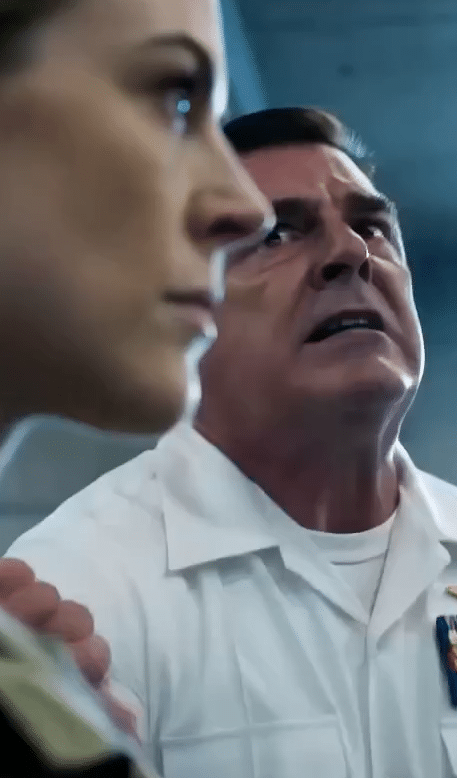
His uniform was immaculate. His ribbons covered half his chest. Two lieutenants walked behind him carrying folders as if they were following a parade float.
He looked at me, then at the rifle, and smiled.
It was not a friendly smile.
It was the expression of a man who had already decided what I was before asking my name.
I folded the cloth and placed it beside my boot.
“Sir,” I said calmly, “the weapon is assigned to me.”
A few operators shifted in their chairs.
Brennan glanced toward the staff officers behind him as though I had delivered a joke.
“To you?”
“Yes, sir.”
He stepped closer.
Up close, I could smell expensive aftershave fighting a losing battle against the heat.
“What unit?”
“Special Operations Command attachment.”
“That wasn’t my question.”
“It was the answer I was cleared to give.”
That changed the room.
Not much.
Just enough.
One of the Rangers in the front row looked over his shoulder. A SEAL leaning against the wall stopped chewing gum. Colonel Isaac Mercer, the ground commander for the mission, lowered the briefing folder in his hands.
Brennan’s smile disappeared.
He reached down and grabbed the Barrett by the fore-end.
“Then let me make this easier for you,” he said. “You are sitting in a classified mission briefing surrounded by combat operators. This is not a recruiting commercial.”
His grip tightened.
“Release the weapon.”
I looked at his hand.
Then I looked at him.
“No, sir.”
The silence became absolute.
Brennan pulled.
He expected the rifle to move.
It did not.
“Last warning,” he said.
I stood.
The Barrett came up with me.
He was larger than I expected, but size means very little once leverage takes over. His right hand was wrapped around the rifle. His elbow was locked. His weight was pitched forward.
He had given me everything.
I rotated the rifle inward, trapped his wrist against the receiver, stepped across his centerline, and dropped my weight.
It took less than a second.
His grip broke.
His knee struck the concrete.
A sharp gasp moved through the room.
I kept the muzzle pointed safely toward the floor and held his wrist just far enough to stop him from reaching again.
Nobody laughed.
That would have made things easier.
Instead, thirty trained men stared at a three-star officer on one knee in front of a woman he had called sweetheart.
Brennan’s face turned dark red.
“Let go of me.”
I released him immediately and stepped back.
“Weapon retention response, sir.”
He rose slowly.
The humiliation hit him before the pain did.
I saw it in his eyes.
He was not asking whether I had acted correctly.
He was deciding how to punish me.
Colonel Mercer stepped between us.
“Admiral, we are seven minutes from mission brief.”
Brennan brushed dust from his trousers.
“Who authorized her presence?”
“I did,” Mercer said.
“On whose recommendation?”
Mercer hesitated.
“General Holloway.”
That name carried weight.
Army General Nathan Holloway was commander of the joint task force and one of the few officers in theater whose authority rivaled Brennan’s.
The admiral looked back at me.
“What is your name?”
“Captain Mara Vance.”
A staff officer near the door went still.
He recognized it.
Brennan did not.
“Captain Vance,” he said, “you have just assaulted a superior officer.”
“You attempted to remove a controlled weapon from its assigned operator during preparation.”
His jaw flexed.
“That is not how this will be written.”
“No, sir,” I said. “I imagine it won’t be.”
Mercer quickly ordered everyone into their seats.
Maps appeared on the projector.
The mission concerned a valley forty-three miles east of the compound, a jagged corridor of cliffs and abandoned villages known as the Sable Cut. Intelligence believed a militia commander named Farid Al-Kazem was moving six mobile missile guidance packages through the valley before nightfall.
If those systems reached the northern border, they could threaten three allied airfields.
A Ranger platoon would move through the western pass.
SEAL Team 3 would intercept the convoy near the riverbed.
My job was to occupy an observation point above the valley and remove six designated targets before they could trigger demolition charges or call in support.
The longest confirmed firing solution was 1,810 meters.
Brennan studied the range card.
Then he gave a cold laugh.
“That is your plan?”
Mercer looked at him.
“That is the approved plan.”
“With one sniper?”
“With Captain Vance.”
Brennan turned toward me.
“Has she ever made a live-field shot at that distance?”
I did not answer.
Mercer did.
“She has made longer.”
Brennan leaned over the map.
“On a range?”
“No.”
The room changed again.
This time, several operators looked directly at me.
Brennan noticed.
He disliked not understanding something everyone else appeared to know.
“Captain,” he said, “what exactly are your qualifications?”
I closed the bolt on an empty chamber and locked the rifle into its case.
“My qualifications are why your convoy still has air cover.”
Brennan stared at me.
He had no idea what I meant.
But before the day ended, he would learn why my name had been erased from three official reports.
And why the six men waiting in that valley were not the real targets.
Act II
I did not grow up dreaming about rifles.
I grew up in a trailer outside Pueblo, Colorado, with a father who repaired transmission systems and a mother who worked overnight shifts at a nursing home.
We had no money for vacations.
So my father took me into the mountains.
He taught me wind by watching grass.
Distance by counting fence posts.
Patience by making me sit still long enough for frightened animals to forget I was there.
He never treated shooting like power.
He treated it like responsibility.
“Pulling a trigger is the easy part,” he once told me. “Living with why you pulled it is the test.”
I carried those words through basic training, sniper school, and eleven years of missions no one was supposed to discuss.
Most soldiers knew me only by a call sign.
Wraith.
Not because I was invisible.
Because when I was doing my job correctly, the men below never knew I had been there.
Three years before Sable Cut, I had been part of a classified overwatch team during an extraction in northern Syria. A transport helicopter carrying twenty-one personnel had been trapped by heavy fire.
The aircraft could not lift.
The rescue convoy could not advance.
Command had given the crew six minutes before abandoning the position.
I had been 2,040 meters away on a ruined communications tower with a damaged optic and a spotter bleeding beside me.
I fired nine rounds.
Seven struck armed targets.
One destroyed the trigger assembly on a recoilless rifle.
The final round severed a support cable holding a steel sign above the road. It dropped across the alley and blocked the pursuing vehicles long enough for the helicopter to escape.
That mission had saved the life of General Nathan Holloway.
It had also embarrassed Vice Admiral Brennan.
Brennan had been responsible for the aerial surveillance plan.
His drones had been pulled from the sector thirty minutes before the ambush because he wanted them reassigned to protect a visiting delegation.
When the after-action review began, Brennan’s staff altered the timeline.
The drone withdrawal disappeared.
The rescue was credited to “combined suppression and favorable atmospheric conditions.”
My name was removed entirely.
General Holloway knew the truth.
So did Colonel Mercer.
Brennan apparently never bothered to learn who had fired the shots.
Now, three years later, I was assigned to another operation carrying his fingerprints.
As the briefing continued, I studied the valley images.
Something was wrong.
The six targets were positioned too neatly.
One near the western ridge.
Two by the riverbed.
Three around the convoy.
All visible from the same elevated observation point.
Militia fighters did not organize themselves for the convenience of an enemy sniper.
I raised my hand.
Mercer stopped.
“What is it?”
“Where did we get the target coordinates?”
A civilian intelligence analyst answered.
“Signals intercepts and drone confirmation.”
“When was the drone confirmation?”
“Forty-two minutes ago.”
“Who controls the drone feed?”
Brennan looked toward me.
“What are you suggesting?”
“I’m asking a question.”
“The feed is Navy ISR,” the analyst said.
Brennan folded his arms.
“And it is reliable.”
I looked again at the target images.
Each figure wore heat-concealment cloth around the torso. Their faces were obscured. Their weapons were visible, but none appeared to be moving.
“Zoom in on Target Four.”
The analyst enlarged the image.
A man stood beside a truck.
His left arm was bent.
His right hand rested near his waist.
There was no shadow beneath the rifle slung across his chest.
Because the rifle was not resting naturally.
It had been tied in place.
“That man is dead,” I said.
The analyst stared at the screen.
Brennan laughed once.
“You can determine that from a drone image?”
“He hasn’t changed position in forty-two minutes.”
“They are waiting.”
“In direct sun?”
No one answered.
I pointed at the truck.
“No tire compression on the front axle. The engine block is missing.”
Mercer stepped closer to the screen.
The vehicle was a shell.
The convoy was staged.
Brennan’s voice hardened.
“Captain, this mission has been planned for six weeks.”
“That does not make the image real.”
“It makes your theory reckless.”
I studied the coordinates again.
The proposed sniper position sat on a ridge known as Point Echo.
It offered a perfect view of all six targets.
It also sat inside a narrow rock shelf with only one exit.
A kill box.
I looked at Mercer.
“Change the insertion point.”
“We do not have time.”
“Then delay the assault.”
Brennan stepped forward.
“The guidance systems move tonight.”
“If they exist.”
The admiral slammed his palm onto the table.
“This operation is not being redesigned because one captain saw a strange shadow.”
Mercer remained silent.
That worried me.
He was a good officer.
But Brennan outranked him and had the authority to remove him from command before the first helicopter lifted.
I closed the rifle case.
“Then I will not use Point Echo.”
Brennan’s eyes narrowed.
“You will follow the mission plan.”
“I will complete the mission.”
“That is not the same thing.”
“No, sir.”
He stepped close enough that only I could hear him.
“You embarrassed me in front of this room.”
“You grabbed my weapon.”
“You think General Holloway protects you?”
I held his stare.
“I think results protect me.”
His expression went flat.
“That confidence is going to get someone killed.”
Then he walked away.
At 8:32, the helicopters lifted from Kestrel.
From the open door, I watched the compound shrink beneath a cloud of dust.
Brennan stood outside the briefing building with his hands behind his back.
As we banked east, sunlight flashed against the window of his command vehicle.
A signal.
Small.
Brief.
Directed toward someone beyond the outer fence.
That was when I understood.
The mission had not been compromised by bad intelligence.
It had been designed to fail.
And Brennan expected me to die where no one could question him afterward.
Act III
I jumped from the helicopter three kilometers south of Point Echo.
My spotter, Sergeant Eli Torres, landed behind me.
Torres had served with me for four years. He was quiet, methodical, and could calculate wind shifts faster than most men could read a watch.
He did not ask why I had changed the landing zone.
He trusted that there was a reason.
We moved through a dry ravine beneath a sun so bright it erased color from the landscape.
The Barrett weighed more than thirty pounds.
Ammunition, water, optics, and communications gear added another fifty.
By 10:00, sweat had soaked through my uniform.
At 10:17, Point Echo came into view.
Torres raised his binoculars.
Then he stopped.
“Trip sensors.”
I saw them a moment later.
Thin infrared emitters stretched across the southern entrance.
Fresh boot marks covered the rock shelf.
A concealed firing position had been built directly above the planned sniper nest.
Had we followed the briefing, we would have crawled beneath an enemy team waiting less than twenty meters away.
Torres looked at me.
“Someone had the insertion plan.”
“Yes.”
We backed away and climbed toward an older ridge known as Widow’s Spine.
It was a terrible position.
Exposed.
Steep.
Nearly five hundred meters farther from the valley.
But it offered a line of sight into Point Echo.
At 11:03, I saw the men waiting there.
Eight fighters.
Two machine guns.
One camera mounted on a tripod.
They had not simply planned to kill us.
They planned to record it.
Torres contacted Mercer using an encrypted channel.
“Echo is compromised. Repeat, Echo is compromised.”
Static answered.
Then a voice came through.
It was not Mercer.
“Captain Vance, return to your assigned position.”
Brennan.
I looked at Torres.
“How is he on this channel?”
“He shouldn’t be.”
Brennan repeated the order.
I ignored him.
Through the scope, I scanned the valley.
The six original targets were exactly where the drone feed had shown them.
None moved.
Dead bodies.
Decoys.
Then I saw flashes beneath the northern cliffs.
Glass.
Optics.
A second ambush force was watching the Ranger route.
Another team waited near the riverbed for the SEALs.
The entire assault element was moving into a trap.
I opened the command channel.
“Mercer, abort western advance. Enemy teams north and east. Original targets are decoys.”
Brennan answered.
“Maintain radio discipline.”
“Get off my channel.”
“You are ordered to engage designated targets.”
“They are corpses.”
“That is not your determination.”
“It is exactly my determination.”
Torres touched my shoulder.
Movement near Point Echo.
The enemy team had realized the sniper nest was empty.
Two men began descending toward our ravine.
At the same time, the Rangers were less than eight minutes from the western pass.
I had six useful rounds loaded.
Six visible threats.
And more than a dozen hidden fighters preparing to close the valley.
Torres began calling distances.
“North ridge machine gun, 1,642.”
I adjusted elevation.
Wind pushed hard from the southwest, bending heat waves above the rock.
The gunner was lying behind a stone wall with only part of his shoulder exposed.
I waited for his head to rise.
It did.
I fired.
The Barrett cracked across the ridge.
The gunner dropped.
“Hit.”
Every fighter in the valley moved at once.
“East river observer, 1,511.”
The second man grabbed a radio.
I fired.
His hand never reached the transmitter.
“Hit.”
Brennan’s voice exploded over the channel.
“Cease fire! You are engaging unauthorized personnel.”
Torres looked at me.
“He knows who they are.”
I already understood.
The third target carried a shaped charge near the Ranger approach.
Distance: 1,709 meters.
The wind shifted.
I held left.
Fired.
The charge fell from his hand.
The Rangers below changed formation and took cover.
They had finally seen the threat.
The fourth target ran from Point Echo carrying the camera.
Not a fighter.
An evidence courier.
I tracked him across the slope.
“Distance?” I asked.
“1,810.”
The longest shot on the card.
Except this man had never been part of the card.
He reached a motorcycle hidden behind the rocks.
I aimed at the engine block.
Fired.
The round tore through the casing.
The motorcycle collapsed beneath him.
He survived.
The evidence did too.
Brennan’s breathing filled the radio.
“Captain Vance, you are relieved.”
“By whom?”
“By me.”
“You are not in my operational chain.”
“I am now.”
That was a confession disguised as an order.
I switched frequencies.
“Mercer, confirm Brennan has assumed ground command.”
A pause.
Then Mercer’s voice arrived, strained.
“Negative. He attempted to. Request denied.”
In the background, I heard shouting.
Brennan was no longer directing the mission from a secure room.
He was trying to seize it.
The fifth target appeared near the riverbed with an anti-armor launcher aimed at the SEAL convoy.
Distance: 1,376.
I fired.
The launcher exploded against the ground.
The sixth target was harder.
He stood on the northern cliff holding a remote detonator.
Below him, the Rangers were pinned between rocks.
Torres calculated.
“1,788. Wind nine left. Mirage heavy.”
I slowed my breathing.
Through the scope, the man was no longer a man.
He was movement.
Angle.
Distance.
Pressure.
I squeezed.
The round crossed the valley.
The detonator flew from his hand.
He folded behind the cliff.
Six shots.
Six threats stopped.
But then Torres saw a seventh figure.
A man in a gray combat shirt emerged from a cave above the valley.
He carried no rifle.
Only a satellite phone.
When he turned, sunlight struck his face.
Torres went silent.
I recognized him too.
Commander Paul Reddick.
Brennan’s senior intelligence liaison.
The same officer who had certified the drone feed.
The same officer who had disappeared from Kestrel the night before.
He was not being held hostage.
He was standing beside the militia commander, giving orders.
The operation was not merely compromised.
It had been sold.
And Brennan had just heard us identify the man who could prove it.
Act IV
Reddick ran for the cave.
I could have fired.
The distance was possible.
The shot was clean.
But dead men do not testify.
“Rangers need to take him alive,” I said.
Mercer answered immediately.
“Copy.”
For the first time that day, the mission began operating on truth.
The Rangers reversed through the western pass and climbed toward the northern cliff. The SEALs abandoned the staged convoy site and cut off the river exit.
The enemy force, expecting two units to walk blindly into fixed kill zones, now found itself trapped between them.
Brennan kept shouting orders.
No one followed them.
Then our communications died.
Not static.
Not interference.
A complete shutdown.
Torres checked the system.
“Command encryption keys were revoked.”
“Can we reach Mercer?”
“Not through military channels.”
I looked toward the valley.
Reddick had disappeared inside the cave.
The fighters at Point Echo were moving toward us.
Four remained.
Maybe five.
We relocated down the western face of Widow’s Spine as rounds struck the rocks behind us.
A fragment cut Torres across the cheek.
He barely reacted.
We reached a narrow ledge overlooking the cave entrance.
Below, Ranger elements moved uphill while the SEAL team advanced from the opposite side.
Without communications, each unit risked mistaking the other for enemy movement.
I took a small signaling mirror from my kit and flashed a coded pattern toward the Ranger lead.
Three short.
Two long.
Three short.
The Ranger stopped.
He answered with an infrared strobe.
They knew our position.
The SEALs did not.
Torres pulled a civilian satellite communicator from an emergency pouch.
It had one preloaded number.
General Holloway.
The device connected after twenty-three seconds.
I gave him everything.
The compromised coordinates.
The ambush teams.
Reddick.
Brennan’s unauthorized access to command channels.
Holloway did not interrupt.
When I finished, he said, “Is Brennan aware Reddick is alive?”
“Yes.”
“Then he will try to erase him.”
“How?”
“The extraction aircraft.”
Two helicopters were scheduled to enter the valley once the guidance systems were secured.
If Brennan controlled the pilots, he could strike the cave and call it enemy resistance.
Holloway ordered us to mark Reddick’s location and keep him alive.
Four minutes later, we heard rotors.
Too early.
The helicopters came low from the west.
One transport.
One attack aircraft.
The attack helicopter turned its nose toward the northern cliff.
“Missile rail is hot,” Torres said.
I raised the Barrett.
A helicopter moving at distance is not a reasonable rifle target.
But I was not aiming at the pilot.
I found the forward targeting sensor beneath the aircraft’s nose.
Range: 1,230 meters.
Movement fast.
Crosswind severe.
The sensor began rotating toward the cave.
I fired.
The round struck the housing.
The targeting pod shattered.
The helicopter banked violently and pulled away.
The pilot shouted over an open emergency frequency.
“We are taking fire from friendly position!”
Holloway’s voice answered from another aircraft entering behind them.
“Break west and land immediately. This is General Holloway. You are under direct order.”
Brennan’s plan collapsed in the air.
The transport helicopter landed near the valley entrance under Holloway’s authority.
The Rangers reached the cave.
Reddick surrendered after less than three minutes.
He had a laptop containing bank transfers, operational schedules, and encrypted messages exchanged with militia intermediaries.
One message came from a secure account registered to Admiral Brennan’s office.
The motive was larger than money.
Brennan had spent years building a private network of contractors, intelligence officers, and foreign brokers. He created threats, redirected missions, and used the resulting instability to justify weapons contracts awarded to companies controlled by his associates.
The six missile guidance packages were real.
But they had never been in the convoy.
They were already hidden at a warehouse connected to one of Brennan’s contractors.
The Sable Cut mission had been constructed to kill the assault teams, destroy the false evidence, and blame the disaster on militia forces.
My death was supposed to prove that even the task force’s best sniper could not overcome the enemy position.
Brennan had not mocked me because he thought I was weak.
He had mocked me because he needed everyone else to believe I was.
By the time we returned to Kestrel, military police had surrounded the command building.
Brennan stood outside beneath the same brutal sun, still wearing his perfect uniform.
General Holloway approached him with two investigators.
Brennan did not resist.
He looked past them and found me stepping down from the helicopter with the Barrett across my chest.
For the first time, he knew who I was.
“Wraith,” he said.
I stopped.
The name barely left his mouth.
He stared at me as memory rearranged itself inside his head.
The Syrian extraction.
The altered report.
The shooter whose identity had been classified above his access.
“You were on the tower,” he whispered.
“Yes, sir.”
His face changed.
He finally understood that the woman he had humiliated in the briefing room was the same operator who had once saved his command from catastrophe.
The same operator whose record he had buried.
And now the same operator who had destroyed the mission meant to protect him.
But there was still one truth he had not prepared for.
I had recorded every word he said.
Act V
The recorder was built into my tactical communications unit.
Every order.
Every interruption.
Every demand that I fire on dead targets.
Every attempt to remove Mercer.
Every response after Reddick appeared.
Brennan’s attorneys later argued that his statements were taken out of context.
The context was played in full.
A military tribunal heard his voice order me back into a compromised sniper nest.
They heard him call living enemy fighters “unauthorized personnel.”
They heard him revoke encrypted access while American units were under fire.
They heard him try to authorize an airstrike on the cave holding the witness who could expose him.
Reddick testified for three days.
The financial records took two weeks to explain.
The list of compromised operations stretched across five countries and nearly seven years.
Men had died in missions Brennan designed to fail.
Families had received folded flags while contractors tied to his network collected emergency defense payments.
Colonel Mercer testified that Brennan pressured him to use Point Echo despite repeated warnings.
The drone analysts admitted they had been ordered to certify manipulated imagery.
The attack helicopter pilot confirmed Brennan’s office had transmitted the target authorization before the assault team entered the valley.
General Holloway gave the final testimony.
He described the extraction in Syria.
He described the missing drone support.
He described the sniper whose actions saved twenty-one lives while Brennan’s staff rewrote the record.
Then he said my name.
Not Wraith.
Not Captain Vance.
Mara Vance.
For the first time in my career, the truth was attached to it publicly.
Brennan was stripped of rank and convicted on charges including conspiracy, obstruction, unlawful command interference, fraud, and actions that contributed to the deaths of American service members.
Commander Reddick received a reduced sentence in exchange for revealing the contractor network.
Twelve officers were removed from command.
Four private companies lost federal contracts.
The guidance systems were recovered before they could leave the warehouse.
None of that brought back the people who had died.
Justice rarely repairs what corruption destroys.
It only prevents the lie from becoming permanent.
Months later, I was summoned to a ceremony at Fort Bragg.
I almost refused.
Ceremonies make me uncomfortable.
They turn private moments into public performances, and most of the work worth doing happens far from microphones.
But Torres insisted.
So did Mercer.
The auditorium was full of operators, commanders, and families.
General Holloway stood at the podium.
He spoke about Sable Cut.
Not as a victory.
As a warning.
He said institutions fail when rank becomes more important than truth. He said experience means nothing when arrogance silences the person who sees what others missed.
Then he called me forward.
A citation was read.
Six precision engagements.
Two assault forces saved.
A compromised command structure exposed.
A witness preserved.
I stood under bright lights while people applauded.
All I could think about was the briefing room.
The diesel smell.
The dust.
The folding chair beneath me.
The way Brennan’s hand closed around my rifle because he assumed he had the right.
After the ceremony, a young lieutenant approached me.
She looked nervous.
She had recently graduated near the top of her class and had already been told by a senior instructor that she was “too small” for the assignment she wanted.
She asked how I kept my composure when Brennan mocked me.
I considered giving her the polished answer.
Discipline.
Training.
Confidence.
Instead, I told her the truth.
“I was angry.”
She seemed surprised.
“Then how did you stay calm?”
“Being calm does not mean you feel nothing,” I said. “It means your feelings do not get to choose your next move.”
She nodded slowly.
I looked at the qualification badge above her pocket.
“You do not need every person in the room to believe in you.”
“What do I need?”
“To know your job when the room goes silent.”
Years have passed since Sable Cut.
The Barrett from that mission is no longer assigned to me.
Its receiver sits inside a military museum behind glass, though the public plaque reveals only part of the story.
Visitors see the distance of the shots.
They see the heat.
The wind.
The number of targets.
They tend to focus on the impossible range.
But the longest shot I made that day was not 1,810 meters.
It was the distance between what everyone had been ordered to believe and what was actually in front of them.
Six men across the valley threatened the mission.
One man inside the command structure threatened everyone.
The rifle helped stop the first six.
The truth stopped the last.
And whenever I remember Brennan reaching for that weapon, I do not remember the insult.
I remember his surprise.
He thought authority lived in his stars.
He thought power belonged to the loudest voice in the room.
He thought a woman sitting quietly in the corner was the easiest person to humiliate.
He learned otherwise in one second.
The valley took a little longer.