Act I
The sharp crack of splintering wood echoed all the way into the driveway.
David Mercer was still halfway out of his truck when he heard it.
For one suspended second, he stood frozen with his hand on the door, listening. The house should have been quiet. His six-year-old daughter, Lily, was supposed to be watching cartoons while Margaret, his stepmother, read one of the glossy lifestyle magazines she kept stacked beside the sofa.
Then came the sound of breaking glass.
David ran.
He didn’t bother taking out his keys. The front door was already unlocked, and he shoved it open so hard the brass knob punched a dent into the drywall.
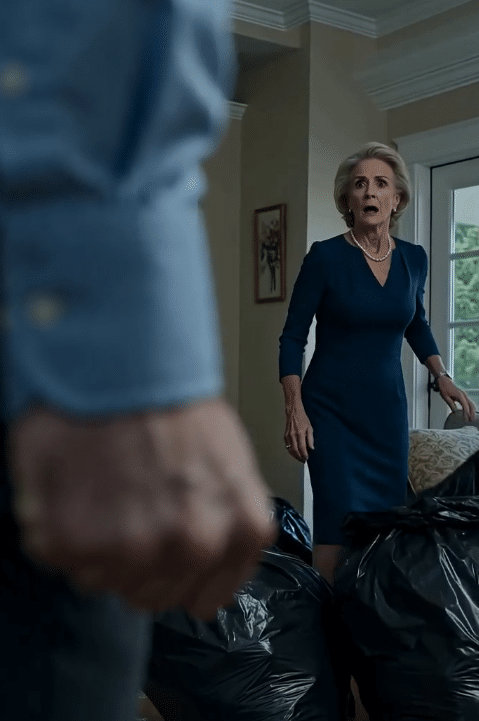
The living room looked like someone had tried to erase a life.
Three enormous black contractor bags sat in the middle of the vintage Persian rug. One was filled with Sarah’s clothes. Another held old cards, dried flowers, framed notes, and the white scarf she had worn during her final winter.
Margaret stood over the third bag.
She was dressed impeccably, as always, in a pressed beige blouse and tailored slacks. Her silver hair was pinned neatly at the back of her head. There wasn’t a trace of guilt on her face.
In her hands was a stack of framed wedding photographs.
David recognized every one of them.
Sarah laughing beneath a canopy of string lights.
Sarah pressing cake against his cheek.
Sarah dancing barefoot with Lily, who had been only three years old then.
Before David could speak, Margaret dropped the frames into the open bag.
Glass shattered.
“What are you doing?”
His voice came out low and rough.
Margaret turned her head as casually as if he had caught her throwing away expired groceries.
“David. You’re home early.”
“Step away from the bags.”
“I was cleaning.”
“You were destroying my wife’s things.”
Margaret sighed.
“It has been two years. This house is suffocating under all of this grief. Someone had to make a decision.”
David took one step toward her.
“That decision wasn’t yours.”
A quiet whimper came from the far corner of the room.
David turned.
Lily was wedged between the oak bookcase and the wall, curled into a tiny ball. Her knees were pulled tightly against her chest. Her face was red from crying, and her shoulders shook with every breath.
“Lily?”
The rage vanished from David’s voice.
He crossed the room and dropped to his knees beside her.
“Sweetheart, Daddy’s here. Look at me.”
She wouldn’t.
Her eyes were fixed on the object pressed against her chest.
David reached toward her carefully.
“Are you hurt?”
“She broke it,” Lily whispered.
“What did she break?”
“Mommy’s box.”
Lily slowly opened her arms.
David’s stomach dropped.
She was holding the ruined remains of a hand-carved mahogany music box.
Sarah had owned it since she was sixteen. It had sat on her nightstand throughout their marriage, its delicate melody filling the bedroom on quiet Sunday mornings.
When Sarah’s illness became serious, she had made David promise one thing.
“Save it for Lily.”
Now the lid had been torn from its hinges. The brass winding key was bent. A jagged crack split the carved wooden base from one side to the other.
Margaret’s voice cut through the room.
“The child knocked it down while I was packing.”
Lily shook her head violently.
“No, I didn’t.”
Margaret’s eyes hardened.
“Don’t lie.”
“She threw it!” Lily cried. “I tried to take it back, and she threw it!”
David looked over his shoulder.
Margaret folded her arms.
“The girl has become obsessed with dead things. You encourage it.”
David turned back to Lily and covered her trembling fingers with his hands.
“It’s okay, baby. Let me see it.”
“I promised Mommy I’d keep it safe.”
“You didn’t break it.”
“But it’s ruined.”
“I’ll fix it.”
He didn’t know whether that was possible, but Lily needed to hear it.
She slowly released her grip.
David took the broken pieces and examined the damage. Fine sawdust clung to his palms. The crack was deeper than he had first realized, running through the base and separating a thin wooden panel underneath.
As he turned the box over, something shifted inside.
David frowned.
The bottom panel slid outward.
It wasn’t solid.
It was a false floor.
Beneath the velvet lining was a narrow hidden compartment.
David had dusted the box hundreds of times. Sarah had kept it within arm’s reach for more than a decade. He had never known there was anything hidden inside.
Tucked into the hollow space was a folded sheet of yellowed paper and a small silver key.
Margaret went silent.
David unfolded the document.
It was a bank transfer record dated three days before Sarah had collapsed for the final time.
Fifty thousand dollars had been withdrawn from Sarah’s private account.
The destination account belonged to Margaret Mercer.
David stared at the name until the letters blurred.
Behind him, Margaret shifted.
“What is that?” she asked.
Her voice had changed.
The calm authority was gone. In its place was panic.
David looked down at the silver key. He recognized its narrow shape from the safety deposit boxes at First National Bank downtown.
Margaret took one careful step toward the door.
“David, give me that paper.”
He rose slowly.
“What did you do to my wife?”
Margaret’s face turned white.
And in that moment, David understood that the broken music box had not revealed an old family secret.
It had exposed a crime someone had spent two years trying to bury.
Act II
Margaret had entered David’s life when he was twelve.
His biological mother had died suddenly, leaving his father to raise a frightened boy while trying to manage a construction company that was beginning to expand across the state.
Margaret had seemed like salvation.
She cooked. She remembered birthdays. She sat beside David at school plays when his father worked late. She never tried to make him call her Mom, which somehow made him trust her more.
After David’s father died, Margaret remained part of the family.
Sarah had never trusted her.
Not openly. Sarah was too gracious for that. But there had been moments—small, uncomfortable pauses whenever Margaret discussed money, inheritance, or the future of the Mercer family business.
“She watches people when they sign things,” Sarah once told him.
David had laughed.
“What does that even mean?”
“It means she cares more about the signature than the person.”
At the time, he had kissed Sarah’s forehead and told her she was imagining things.
Now he wished he had listened.
“Lily, go upstairs,” David said.
His daughter clutched the broken lid of the music box.
“Take your tablet. Call Aunt Emily. Stay in your room until I come for you.”
Lily looked at Margaret.
For the first time, David noticed that his daughter wasn’t merely upset.
She was afraid.
“What did she do to you?” he asked.
Lily’s lips trembled.
Margaret answered first.
“Don’t be ridiculous.”
David’s eyes remained on Lily.
“Tell me.”
“She said Mommy was making me weak,” Lily whispered. “She said after today, we weren’t going to talk about her anymore.”
David felt something cold spread through his chest.
“What else?”
“She took Mommy’s picture from my room.”
Margaret lifted her chin.
“The child needs to move forward.”
“She’s six.”
“She’s old enough to learn that the dead don’t come back.”
David stood.
“Go upstairs, Lily.”
This time, she ran.
The moment she disappeared, Margaret moved toward the front door.
David stepped in front of her.
“Where are you going?”
“I won’t stand here while you threaten me.”
“I haven’t threatened you.”
“You’re blocking the door.”
“You recognized this record.”
“I recognized Sarah’s handwriting.”
“There’s no handwriting on it.”
Margaret stopped breathing.
It was brief, but David saw it.
He held up the document.
“Why did Sarah send you fifty thousand dollars?”
Margaret looked toward the staircase.
Then toward the black bags.
Finally, she lowered her voice.
“She was helping me.”
“With what?”
“A private matter.”
“What matter?”
“You wouldn’t understand.”
“Try me.”
Margaret’s expression tightened.
“Your father left financial complications.”
“My father left a profitable company and a paid-off house.”
“He left debts you knew nothing about.”
“Then why did Sarah pay you?”
Margaret looked at the paper in his hand as if calculating how quickly she could tear it away.
“She discovered something in the estate records,” she said at last.
“What?”
“A mistake.”
David waited.
Margaret did not continue.
“What kind of mistake?”
“The kind that could have embarrassed this family.”
“Whose mistake?”
Her silence was an answer.
David glanced toward Sarah’s photographs lying beneath broken glass.
“You stole from my father.”
Margaret’s face hardened.
“Be careful.”
“You forged something.”
“I kept that company alive after he died.”
“You had no role in the company.”
“I had a role in everything. I protected your father when he was too sick to think. I protected you when you were too young to understand.”
“And Sarah found out.”
Margaret’s eyes flickered.
David stepped closer.
“She found out you had taken money. She confronted you. You asked her for fifty thousand dollars.”
“It was a loan.”
“Why hide the record?”
“I didn’t hide it.”
“Then why did you try to destroy the box?”
Margaret looked toward the broken mahogany pieces on the floor.
Her composure finally cracked.
“I didn’t know it was in there.”
David believed her.
That frightened him even more.
Because if Margaret had not known about the document, then Sarah had hidden it from her deliberately.
David opened his palm and showed her the silver key.
Margaret stared at it.
Her knees seemed to weaken.
“What does this open?” David asked.
“I don’t know.”
“You’re lying.”
“David—”
“What does it open?”
Margaret’s voice dropped to a whisper.
“Whatever Sarah put in that box, she did it because she wanted to turn you against me.”
“Sarah was dying.”
“She was vindictive.”
“She could barely stand.”
“She hated me.”
“No,” David said. “She was afraid of you.”
Margaret’s face went still.
That was the first moment David truly wondered whether Sarah’s death had been more than an illness.
And the answer was waiting in a locked steel box across town.
Act III
First National Bank was less than fifteen minutes away.
David called the police before he left the house, but he did not accuse Margaret of murder. Not yet. He told them his stepmother had destroyed personal property, frightened his child, and possibly attempted to remove financial evidence.
By the time officers arrived, Margaret had regained her calm.
She claimed David was overwhelmed by grief.
She claimed the music box had broken accidentally.
She claimed the black bags contained items David had already agreed to donate.
Then Lily came downstairs holding the wedding photograph Margaret had removed from her bedroom.
“She told me Daddy wanted Mommy gone,” Lily said.
The officer looked at David.
David looked at Margaret.
Margaret said nothing.
She was escorted from the house while the incident was documented. Because the home belonged to David, he formally revoked her permission to enter.
As she passed him on the porch, Margaret leaned close.
“You’re going to regret opening that box.”
David met her eyes.
“You already regret it.”
At the bank, the manager initially refused to grant him access.
The safety deposit box was registered under Sarah’s maiden name, Sarah Bennett, and had not been listed during probate.
Then David showed him Sarah’s death certificate, their marriage license, the silver key, and the transfer record.
The manager disappeared into a private office.
Twenty minutes later, he returned with the bank’s legal counsel.
“There are special instructions attached to this box,” the attorney said. “Mrs. Mercer requested that access be transferred to you upon proof of her death.”
“Why wasn’t I notified?”
“She instructed the bank not to contact you.”
David stared at him.
“Why?”
“She wrote that she feared correspondence might be intercepted.”
The steel box was brought into a private room.
Inside were no jewels.
No cash.
No treasured family heirlooms.
There was a sealed letter, a flash drive, a medical folder, and an old photograph of Margaret standing beside a man David did not recognize.
On the envelope, Sarah had written:
For David, if Margaret ever tries to erase me.
His hands began to shake.
He opened the letter.
Sarah’s words were careful and direct.
She had discovered irregular withdrawals from the trust created after David’s father died. At first, the amounts were small enough to look like administrative fees.
Then she found property documents carrying David’s signature.
He had never signed them.
Several parcels of land had been quietly transferred into shell companies. Those companies were connected to a man named Victor Hale, the stranger in the photograph.
Sarah confronted Margaret.
Margaret admitted to moving money but insisted she had done it to cover business losses that would otherwise destroy the Mercer family’s reputation.
She begged Sarah not to tell David.
Then she demanded fifty thousand dollars.
Not as a loan.
As payment for silence.
Margaret claimed she possessed evidence that David’s father had committed tax fraud. If Sarah exposed the stolen inheritance, Margaret would release the files, destroy the company, and leave David responsible for millions in penalties.
Sarah paid her.
But she did not trust her.
She hired a forensic accountant.
She copied the estate records.
She began building a case.
Then Sarah’s health declined with terrifying speed.
David stopped reading.
The room felt airless.
Sarah had suffered from an autoimmune disorder, but her doctors had expected treatment to stabilize her. Instead, her condition had worsened after a series of missed appointments, prescription errors, and unexplained medication changes.
At the time, Margaret had been “helping.”
She picked up prescriptions.
She drove Sarah to appointments when David was working.
She spoke privately with nurses and claimed Sarah was too tired to answer calls.
David opened the medical folder.
Inside were copies of canceled appointments Sarah said she had never canceled.
There were pharmacy receipts carrying Margaret’s signature.
There was a typed timeline of medication that had gone missing from the house.
And there was a letter from Sarah’s physician.
The doctor had not accused anyone of harming her. But he had written that repeated disruptions in Sarah’s treatment had likely accelerated her decline.
The final item was a printed email from Sarah to the forensic accountant.
If anything happens to me, send everything to David. Do not send it to the house. Margaret has begun searching my room.
The email had never been sent.
It remained in Sarah’s drafts.
David covered his mouth.
For two years, he had blamed himself for Sarah’s final months. He had believed he worked too much, noticed too little, and trusted Margaret because grief made trust easier than suspicion.
Now he understood why Sarah had kept the music box close.
It had not merely played a melody.
It had guarded the truth.
Then David inserted the flash drive.
One video file appeared on the screen.
Sarah’s face filled the frame.
She looked pale and exhausted, but her eyes were clear.
“David,” she said, “if you are watching this, Margaret found a way back into our home.”
Act IV
Sarah’s recorded voice broke him.
Not because she sounded frightened.
Because she sounded calm.
She told him she had uncovered evidence that Margaret and Victor Hale had been stealing from the Mercer estate for more than a decade. Victor had once worked as an accountant for David’s father.
He had also been Margaret’s secret partner.
Together, they created false debts, forged signatures, sold assets, and moved the proceeds through private companies.
Sarah believed Margaret’s marriage to David’s father had never been about love.
It had been access.
But the financial crimes were not the reason Sarah made the recording.
Three weeks before her collapse, Sarah caught Margaret replacing labels on two prescription bottles.
Margaret claimed the pharmacy had made an error.
Sarah secretly sent the pills to a private laboratory.
The results were inside the flash drive.
The medication did not match the label.
It was not poison. It would not have killed a healthy person.
But for someone with Sarah’s condition, it could weaken treatment, worsen fatigue, and make her increasingly dependent on others.
Dependent on Margaret.
Sarah had not gone to the police because she was afraid the evidence would be dismissed as a pharmacy mistake. She also feared Margaret would retaliate against David or Lily.
So she waited.
She gathered records.
And she hid copies where Margaret would never think to look.
“I know you’ll blame yourself,” Sarah said into the camera. “Don’t.”
David lowered his head.
“You loved me. You trusted someone who taught you to trust her when you were a child. That is not the same as choosing this.”
He pressed both hands against the table.
Sarah’s image blurred through his tears.
“Protect Lily. And when Margaret tells you she did everything for the family, remember this: people who love a family do not need to erase the dead to control the living.”
The recording ended.
David immediately contacted the detective who had taken the report at his house.
The investigation moved quickly after that.
The forensic accountant named in Sarah’s files was located in another state. He had believed Sarah abandoned the case because she stopped responding. He still possessed copies of the documents she had sent him.
The pharmacy had archived security footage.
One recording showed Margaret collecting Sarah’s prescription.
Another showed her returning to the counter days later and insisting that the dosage had been changed by the doctor.
It had not.
Victor Hale was arrested while attempting to leave the country.
Faced with decades in prison, he agreed to cooperate.
He revealed that Margaret had planned to take full control of David’s remaining inheritance by having him declared emotionally unstable.
Her return to the house had never been an act of kindness.
She had been collecting evidence.
Photographs of unopened bills.
Recordings of David crying.
Notes from teachers describing Lily’s grief.
Margaret intended to portray the home as unhealthy and David as incapable of raising his daughter.
The black bags were part of that plan.
She wanted Sarah’s belongings gone before social workers could see how deeply Lily remained connected to her mother.
She also wanted to find any evidence Sarah might have hidden.
Margaret had searched drawers, closets, old books, and photo albums.
She had overlooked the music box.
Until that afternoon.
In police custody, Margaret denied tampering with the medication.
Then Victor gave investigators the final piece.
Margaret had not intended to kill Sarah, he claimed.
She had intended to keep her weak.
A sick, confused woman would be easier to discredit. Easier to frighten. Easier to silence.
But Sarah’s body had been more fragile than Margaret understood.
The treatment disruptions hastened a decline that could not be reversed.
Margaret had spent two years telling everyone that Sarah’s death was tragic.
Now prosecutors argued it was the foreseeable result of deliberate cruelty.
The woman who had entered David’s life as a protector was finally exposed as the architect of his family’s destruction.
But before the trial ended, Margaret demanded one last chance to speak to Lily.
Act V
David refused.
Margaret’s attorney called it heartless.
David called it protection.
The trial lasted six weeks.
Margaret appeared each morning in conservative clothing, her silver hair perfectly arranged. She looked less like a criminal than a respected grandmother attending church.
That image began to collapse when the evidence was presented.
Bank records showed years of theft.
Handwriting experts confirmed forged signatures.
Doctors testified that interference with Sarah’s treatment had worsened her condition.
The laboratory report proved the pills in Sarah’s bottle were not what she had been prescribed.
Then the prosecution played Sarah’s video.
The courtroom became completely still.
Margaret watched Sarah’s face appear on the screen.
For the first time, her composure broke.
Not when Sarah described the theft.
Not when she mentioned the altered medication.
It broke when Sarah said Lily’s name.
Margaret looked toward David as if expecting sympathy.
She found none.
The jury convicted her of fraud, forgery, identity theft, evidence tampering, child endangerment, and criminal interference with medical care. The most serious charge connected to Sarah’s death remained legally complicated, but the judge made his view clear during sentencing.
“You may not have administered a fatal substance,” he said, “but you knowingly weakened a vulnerable woman for financial gain. You turned care into control and trust into a weapon.”
Margaret received a sentence that ensured she would be an old woman before she could ever petition for release.
Victor received a reduced sentence for cooperating.
The stolen assets were recovered where possible. Several properties were returned to David. Most of the money meant little to him.
Sarah was still gone.
No verdict could change that.
But the truth changed the house.
David removed every lock Margaret had installed. He repainted the living room. He repaired the dent behind the front door but left one small mark visible.
Not as a reminder of rage.
As a reminder of the day silence ended.
The wedding photographs were restored by a specialist. Tiny fractures remained in the glass of one frame, but David chose not to replace it.
Lily said the cracks looked like silver branches.
The music box took longer.
A craftsman repaired the mahogany and replaced the hinges. He could not hide the split completely, so he filled it with a thin line of pale resin that caught the light.
When the winding key turned, the melody played unevenly.
Three clear notes.
A pause.
Then the rest of the song.
On the first evening it returned home, David placed it on Lily’s bedside table.
She touched the repaired lid.
“Is Mommy’s secret still inside?”
“No,” David said. “We don’t need to hide it anymore.”
Lily thought about that.
“Did Grandma Margaret hate Mommy?”
David sat beside her.
He had wondered how to answer that question for months.
“I think Margaret hated anyone she couldn’t control.”
“Did Mommy know she was bad?”
“Yes.”
“Why didn’t she tell us?”
“She tried.”
Lily looked at the music box.
“And we found it.”
David smiled sadly.
“You found it.”
“No,” Lily said. “Margaret broke it.”
The words settled between them.
It was the simplest version of the truth.
Margaret had tried to destroy Sarah’s memory.
Instead, she had broken open the one object holding the evidence that destroyed her.
Lily wound the brass key.
The melody began.
When it reached the damaged note, the mechanism hesitated.
Lily leaned closer.
For a fraction of a second, the room was silent.
Then the music continued.
David closed his eyes.
He could almost see Sarah standing in the doorway, one shoulder against the frame, smiling the way she had on quiet mornings before illness and secrets took over their lives.
The sound was imperfect now.
So was their family.
But it was still beautiful.
And for the first time in two years, the memories inside that house no longer felt like something David had to survive.
They felt like proof that Sarah had never truly been erased.