Act I
“Stop—it hurts!”
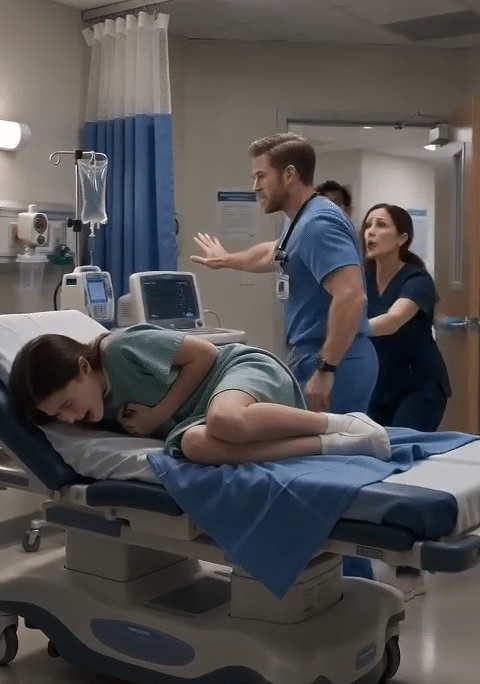
Valeria’s body jerked so violently that the ultrasound probe slipped from Dr. Ryan Cole’s gloved hand.
The fifteen-year-old curled tighter on the emergency-room bed, one hand locked over her lower abdomen and the other gripping her phone against her chest. The blue sheet twisted beneath her legs as another wave of pain stole her breath.
Dr. Cole caught the probe cable before it struck the floor.
Then he stepped between the bed and the open doorway, thrusting one arm outward.
“Nobody comes closer.”
Hector Santos stopped mid-step.
He had arrived at Columbus General demanding to see his daughter, furious that his wife had taken her to the hospital without his permission. His navy shirt was half-buttoned, his hair uncombed, but his voice still carried the same authority that had controlled their home for fifteen years.
“She’s always dramatic,” he said. “Ask her mother.”
Marisol stood beside him, still wearing the jeans and beige sweater she had thrown on before sneaking Valeria out of the house at four in the morning.
For years, Hector had trained her to doubt her own instincts.
If she questioned a bill, she was paranoid.
If she defended Valeria, she was making the girl weak.
If she cried, she was manipulating him.
That night, Marisol had finally ignored him.
Valeria had been vomiting for three days. Her fever had climbed. She could no longer stand upright.
When she fainted beside the shower and whispered, “Don’t tell Dad,” Marisol carried her out the back door while Hector slept.
Now Hector pointed toward the bed.
“I’m her father. Move.”
Dr. Cole planted both feet.
“Your daughter is in severe distress. You will remain outside until I understand what is happening.”
Hector laughed once.
Not because anything was funny.
Because he was not accustomed to being told no.
“Do you have children, Doctor?”
“That is not relevant.”
“It is relevant when you’re lecturing me about mine.”
Valeria made a small sound behind him.
Dr. Cole turned.
Her face had gone gray. Sweat clung to her forehead. Her fingers were shaking around the phone.
“Valeria,” he said carefully, “I need you to tell me where the pain started.”
Her eyes moved toward the doorway.
Toward Hector.
“It’s okay,” Marisol whispered. “Tell him.”
Valeria looked at her mother.
Then she looked at her father.
Hector’s face had changed.
The irritation was gone.
In its place was something tighter.
Something afraid.
Valeria’s breathing became shallow.
“He knows,” she whispered.
Dr. Cole leaned closer.
“What did you say?”
Her voice broke as another spasm seized her.
“He knows why it hurts.”
The room stopped.
Marisol did not blink.
Hector did not move.
Even the monitor beside the bed seemed suddenly too loud.
Dr. Cole looked from Valeria to Hector.
Then he pressed the emergency-call button.
A nurse appeared almost immediately.
“Call security,” he said. “And page pediatrics, surgery, and the hospital social worker.”
Hector’s face hardened.
“This is ridiculous.”
Dr. Cole did not look away from him.
“No,” he said. “It is now a safeguarding matter.”
Two security officers entered the corridor.
Hector stepped backward.
“You’re going to believe a sick child over her own father?”
Marisol finally looked at him.
Really looked at him.
There was no confusion in his face.
No shock.
Only calculation.
And that frightened her more than Valeria’s words.
Because an innocent man would have asked what she meant.
Hector had only asked who would believe her.
The security officers escorted him toward the waiting area.
He turned once.
His eyes found Valeria.
She flinched.
Marisol saw it.
A movement so small she might have missed it on any other day.
But not now.
Not after those five words.
Dr. Cole closed the door.
Then he lowered his voice.
“Valeria, you are safe in this room.”
She began to cry.
Marisol reached for her.
Valeria recoiled.
Not from her mother.
From the sound of footsteps fading outside.
“He’ll come back,” she whispered.
“No,” Dr. Cole said. “Not without permission.”
Valeria shook her head.
“You don’t understand.”
She unlocked her phone with trembling fingers.
There were dozens of unread messages from a contact saved as Dad.
Most were short.
Where are you?
Answer me.
Do not embarrass this family.
The final message had arrived seven minutes earlier.
Delete the video.
Marisol stared at the screen.
“What video?”
Valeria pressed the phone against her chest again.
Her entire body tightened.
Then the ultrasound monitor made a sharp, unfamiliar sound.
Dr. Cole looked at the image.
His expression changed.
He called for a stretcher.
“Her appendix may have ruptured,” he said. “We need surgery now.”
Marisol followed as they rushed Valeria toward the operating room.
Behind them, security held Hector at the end of the corridor.
He was no longer shouting.
He was watching the phone in Valeria’s hand.
And for the first time in fifteen years, Marisol understood that her husband was not afraid his daughter might die.
He was afraid she might survive long enough to speak.
That realization would soon lead Marisol to the one locked room Hector had forbidden them to enter.
Act II
The surgery lasted two hours.
Valeria had a perforated appendix and a severe abdominal infection. Another day without treatment, Dr. Cole later said, and the infection could have spread beyond control.
Marisol sat alone beneath the white lights of the surgical waiting room, replaying every moment she had ignored.
Valeria missing school.
Valeria refusing to eat dinner when Hector was home.
Valeria locking the bathroom door.
Valeria flinching whenever his truck entered the driveway.
Marisol had seen all of it.
She had simply accepted Hector’s explanations.
Teenagers are moody.
Teenagers lie.
Teenagers turn mothers against fathers.
He had repeated those sentences until they no longer sounded like accusations.
They sounded like facts.
A hospital social worker named Elaine Park sat beside her.
She did not speak at first.
She simply waited.
Eventually, Marisol asked, “What do you think she meant?”
Elaine answered gently.
“I think Valeria should be allowed to explain that in her own words when she is stable.”
“You think Hector hurt her.”
“I think your daughter is afraid of him.”
Marisol looked down at her hands.
“He has never hit her.”
Elaine did not react.
She had heard that sentence before.
“Fear does not always begin with hitting.”
Marisol’s eyes filled.
“He controls everything,” she whispered. “Money. Phones. Doors. Where we go. Who we talk to.”
Elaine nodded.
“Does he monitor Valeria’s devices?”
“Yes.”
“Does he enter her room without knocking?”
“Yes.”
“Has he isolated her from friends?”
Marisol thought of the birthday party Hector had canceled because the girls were “a bad influence.” She thought of the soccer team he forced Valeria to leave after a coach questioned bruising on her wrist.
“Yes.”
Elaine’s voice remained calm.
“Has he ever made her keep secrets from you?”
Marisol could not answer.
A surgeon appeared before she had to.
Valeria was alive.
The infection had been controlled.
She would remain in intensive observation overnight.
Marisol nearly collapsed with relief.
When she was finally allowed into recovery, Valeria lay pale beneath the blankets. Her phone had been placed in a plastic property bag beside the bed.
Elaine stood near the window.
A uniformed police officer waited outside the door.
Hector had been barred from entering.
Valeria opened her eyes.
“Mom?”
“I’m here.”
“Is he gone?”
“Yes.”
“Did he get my phone?”
“No.”
Valeria closed her eyes again.
“Good.”
Marisol sat beside her.
“What is on it?”
Valeria’s lips trembled.
For several seconds, she seemed unable to speak.
Then she looked toward Elaine.
“Will you stay?”
“Of course.”
Valeria turned back to her mother.
“Dad has been giving me pills.”
Marisol felt the room tilt.
“What pills?”
“He said they were vitamins. Then he said they were for anxiety. Sometimes they made me sleep.”
“How long?”
“A few months.”
Marisol stood so quickly the chair scraped the floor.
“No.”
Valeria began crying.
“I didn’t know at first.”
“No, baby, I’m not saying no to you.”
Marisol reached for her hand, stopping before touching it.
“I’m saying no because I should have known.”
Valeria stared at the ceiling.
“The video is from last week.”
Elaine moved closer.
“What does it show?”
“I put my phone behind the books in Dad’s office.”
Hector’s office.
The locked room at the end of the upstairs hallway.
He told them it contained business documents.
He kept the only key.
“I heard him talking to Mr. Calder,” Valeria said.
Marisol knew the name.
Samuel Calder was Hector’s employer, a contractor who ran several assisted-living facilities across Ohio.
“They were talking about medicine,” Valeria continued. “Boxes that weren’t supposed to be there.”
“What kind of medicine?” Elaine asked.
“I don’t know. Dad said they were replacing labels before an inspection.”
Marisol remembered Hector bringing sealed cartons home late at night. He always said they contained electrical supplies.
Valeria swallowed painfully.
“I recorded them.”
“Did they see you?” Elaine asked.
“Not then.”
“Then what happened?”
Valeria’s voice dropped.
“Dad checked the router log. He saw my phone had connected near the office after midnight.”
Marisol closed her eyes.
Hector monitored everything.
Of course he did.
“He came into my room,” Valeria said. “He asked what I heard. I said nothing.”
“What did he do?” Marisol whispered.
“He took my phone, but I had already hidden the video in a private account.”
Her breathing quickened.
“He said I was confused. He said the pills were making me imagine things. Then he said if I told anyone, you would go to prison because some of the accounts were in your name.”
Marisol froze.
“What accounts?”
“I don’t know.”
Elaine looked at her.
“Does your husband manage the family finances?”
“All of them.”
“Does he have access to your identification?”
“Yes.”
The answer came out like a confession.
Hector had built the perfect threat.
He had used Marisol’s name for whatever he was hiding, then warned Valeria that telling the truth would destroy her mother.
Valeria had stayed silent.
Not because she trusted him.
Because she was trying to protect Marisol.
“The vomiting started after he gave me another pill,” Valeria said. “I didn’t take it. I hid it under my tongue and spit it out later.”
“Where is it now?” Elaine asked.
“In my backpack.”
The backpack was still at home.
Inside the house Hector controlled.
Then Valeria remembered something else.
Her eyes opened wider.
“There’s a notebook under the lining.”
“What notebook?”
“I wrote down every date he gave me something. Every time he brought boxes home. Every license plate that came to the garage.”
Marisol stared at her daughter.
While she had been trying to survive Hector one day at a time, Valeria had been building a case against him.
But the evidence was still inside the house.
And Hector had already been released from the hospital because the police said Valeria’s statement was not yet complete.
He was going home.
To the backpack.
To the notebook.
And to the locked office where the truth had been hidden for years.
Act III
Marisol did not tell the police she was leaving the hospital.
She told Elaine.
That was different.
Elaine tried to stop her.
“The police can retrieve the evidence.”
“They will take too long.”
“They need a warrant.”
“Hector does not need one.”
Marisol knew her husband.
By the time officers arrived, the backpack would be gone.
So would the boxes.
So would every document bearing her name.
Elaine looked at her for a long moment.
Then she called Detective Naomi Briggs from the county’s special-victims unit.
Unlike the first responding officers, Briggs listened without interrupting.
“You cannot enter if he is there,” she said.
“It is my house.”
“That does not make it safe.”
“It also means I know something you don’t.”
“What?”
Marisol looked through the recovery-room window at Valeria.
“There is a second entrance.”
The Santos home had once belonged to Hector’s grandfather. Behind a shelving unit in the basement was an old service passage leading to the detached garage.
Hector believed Marisol had forgotten it existed.
She had not.
Forty minutes later, Detective Briggs parked two streets away with three officers.
Marisol entered through the garage passage alone, carrying a small body camera the detective had clipped beneath her sweater.
The house was silent.
Too silent.
Hector’s truck sat in the driveway, but no lights were on.
Marisol moved through the basement and reached the interior stairs.
A floorboard creaked above her.
She stopped.
Then Hector’s voice drifted from the kitchen.
“You always were terrible at doing what you were told.”
Marisol looked up.
He stood at the top of the basement stairs.
Valeria’s backpack hung from one hand.
In the other was the notebook.
“You should be at the hospital,” he said.
“So should you.”
He smiled.
“After what she accused me of?”
“You know what she meant.”
His smile disappeared.
“No. I know what you are trying to make it mean.”
Marisol climbed one step.
Hector lifted the notebook.
“This?”
He shook his head.
“A sick child’s fantasy.”
“She documented dates.”
“She copied numbers she did not understand.”
“She recorded you.”
That stopped him.
Only for a second.
But the camera beneath Marisol’s sweater caught it.
“What recording?” he asked.
Marisol continued upward.
“The one you told her to delete.”
His jaw tightened.
“You have no idea what your daughter has done.”
“She tried to protect me.”
“She is destroying us.”
“No.”
Marisol reached the top step.
“She is exposing you.”
Hector grabbed her wrist.
The movement was fast, practiced, and familiar.
He had held her that way before.
Never hard enough to leave marks where others could see.
Always hard enough to remind her who controlled the room.
This time, Marisol did not lower her eyes.
“You used my name,” she said.
His fingers tightened.
“You signed what I told you to sign.”
“I signed tax forms.”
“You signed whatever was in front of you.”
The words escaped before he realized what he had admitted.
Outside, Detective Briggs heard every syllable.
Marisol did too.
“What did you put in my name?”
Hector pulled her closer.
“Accounts. Deliveries. A company.”
“For stolen medication?”
His face changed again.
Not fear.
Contempt.
“You think those places care what happens to a few boxes? They overorder. They lose inventory. Nobody checks.”
“People need that medicine.”
“People die in those facilities every week.”
Marisol stared at him.
He said it as if death were an accounting error.
Then she noticed black smoke drifting from beneath the office door.
“You’re burning it.”
Hector released her.
He moved toward the office.
Marisol grabbed the backpack.
He turned and shoved her against the wall.
The body camera struck her ribs.
Outside, Detective Briggs gave the command.
The front door crashed open.
Officers flooded the house.
Hector ran into the office and slammed the door.
By the time they forced it open, flames had climbed the curtains.
A metal waste bin burned beside the desk.
Two officers pulled Hector out while another used an extinguisher.
Marisol stood in the hallway clutching Valeria’s backpack.
Hector looked at her through the smoke.
“You did this,” he said.
For years, those words would have broken her.
This time, they set her free.
“No,” Marisol replied. “Valeria did.”
Inside the backpack, police found the pill, the notebook, and a second phone Hector did not know existed.
The phone contained the video.
But it also contained something Valeria had never mentioned.
A folder labeled Mom.
Inside were photographs of documents from Hector’s office.
Bank statements.
Shipping records.
Employee schedules.
Insurance forms.
And a death certificate bearing the name Elena Ruiz.
Marisol recognized it immediately.
Elena had been Hector’s younger sister.
She had died twelve years earlier from what the family called an accidental overdose.
The death certificate listed the place of death as one of Samuel Calder’s facilities.
At the bottom was the signature of the medical administrator on duty.
Hector Santos.
The medication scheme had not begun months ago.
It had begun more than a decade earlier.
And Elena may have discovered it before Valeria did.
Act IV
The fire destroyed part of Hector’s office.
It did not destroy enough.
Investigators recovered a metal lockbox from beneath the floorboards.
Inside were handwritten inventory lists, forged prescriptions, prepaid debit cards, and copies of patient records from three care facilities.
The scheme was simple.
Calder’s facilities ordered expensive medication for residents whose insurance covered it. Hector diverted part of the shipment before it reached the patients. Cheaper substitutes were placed in the original containers, while the stolen medication was sold through a network of private buyers.
The money moved through shell companies.
One was registered to Marisol.
Another was registered to Elena Ruiz.
Even after her death.
Detective Briggs reopened Elena’s case.
The original investigation had lasted less than a day.
No autopsy had been ordered.
Hector had identified the body.
Calder had signed the internal report.
A local physician declared the death accidental.
Then the facility cremated Elena before her mother could ask questions.
Marisol remembered the funeral.
A closed urn.
Hector standing beside it, telling everyone Elena had always been troubled.
The same word he now used for Valeria.
Dramatic.
Unstable.
Confused.
The language had never been random.
It was part of the method.
Destroy the witness before the witness could speak.
Valeria remained in the hospital for nine days.
Her physical recovery came faster than her trust.
She slept with the lights on. She asked nurses to announce themselves before entering. Every time a man raised his voice in the corridor, her pulse monitor accelerated.
Marisol stayed beside her.
Not because she knew how to repair what had happened.
Because she finally understood that leaving was no longer an option.
On the fifth night, Valeria asked, “Did he hurt Aunt Elena?”
Marisol’s breath caught.
“You remember her?”
“Only pictures.”
“Then why did you ask?”
Valeria looked toward the dark window.
“I heard Dad talking to Mr. Calder.”
“When?”
“The night I recorded them.”
She swallowed.
“Mr. Calder said, ‘We should have handled this the way we handled Elena.’”
Marisol covered her mouth.
Valeria continued.
“Dad told him not to say her name.”
That sentence became the center of the new investigation.
Federal agents joined the case.
Calder was arrested at an airport two days later carrying a passport, cash, and a list of employee names.
Hector remained in county custody.
Through his attorney, he denied everything.
He claimed Marisol had created the companies.
He claimed Valeria had stolen medication herself.
He claimed the video had been edited.
But investigators found the sedative he had been giving Valeria.
It came from a diverted hospital shipment.
Toxicology tests showed traces of the same substance in her blood.
It had not caused the appendicitis.
But it had dulled her symptoms, confused her, and made it easier for Hector to dismiss her pain.
For three days, he watched his daughter vomit.
He watched her fever rise.
He told Marisol she was dramatic because taking Valeria to a doctor risked exposing the drug in her system.
He had not merely ignored her suffering.
He had needed it to remain hidden.
The most damaging evidence came from an audio file recovered from Valeria’s private account.
The recording was only forty-eight seconds long.
Hector’s voice was clear.
“You are going to delete what you saw.”
Valeria answered, “People could die.”
“People die every day.”
“I’m telling Mom.”
“No, you’re not.”
“Why?”
“Because her name is on everything.”
Then came a pause.
And Hector’s final sentence.
“You want to save your mother? Learn to be quiet.”
The prosecution played the recording during the preliminary hearing.
Hector sat at the defense table without moving.
Marisol sat behind the prosecutor.
Valeria listened from a protected room by video.
When the recording ended, the courtroom remained silent.
Hector’s attorney requested bail.
The judge denied it.
For the first time in his life, Hector Santos could not leave simply because he had decided the conversation was over.
Yet Valeria’s hardest battle was still ahead.
The defense planned to put her on the stand and prove that a frightened girl could be made to doubt her own memory.
Act V
The trial began eleven months later.
By then, the case had expanded far beyond the Santos home.
Nine former employees testified against Samuel Calder.
Three facilities lost their licenses.
Families learned that relatives had gone without necessary medication while insurance companies continued to pay full price.
Elena Ruiz’s death was officially reclassified as suspicious.
There was not enough physical evidence to prove murder after twelve years, but investigators established that she had discovered missing medication days before she died.
Her notes had been hidden in an archived employee file.
One page contained a single name.
Hector.
Marisol testified first.
The defense attorney asked why she had stayed with a controlling husband for fifteen years.
It was meant as an accusation.
Marisol answered quietly.
“Because every year he convinced me I was weaker than I had been the year before.”
The attorney asked why the jury should believe her now.
“Because my daughter was stronger than both of us.”
Then Valeria testified.
She wore a plain gray dress and sat with both hands folded in front of her. The scar from surgery was hidden, but the memory of that night was not.
The prosecutor guided her through the pills, the office, the recording, and the threat against her mother.
Valeria spoke clearly.
Then the defense stood.
He was polished, patient, and careful.
He never raised his voice.
“You were ill when you made the accusation in the emergency room, correct?”
“Yes.”
“You had a high fever?”
“Yes.”
“You were in extreme pain?”
“Yes.”
“You had medication in your system?”
“Yes.”
“So it is possible you were confused.”
Valeria looked toward Hector.
He stared back with the same expression he had used across the dinner table for years.
The look that said he knew her better than she knew herself.
She turned to the attorney.
“I was confused about a lot of things.”
He smiled slightly.
“Exactly.”
“But not that.”
His smile faded.
Valeria continued.
“I was confused about why my mother was afraid all the time. I was confused about why my father needed every password. I was confused about why Aunt Elena’s name was on a company after she died.”
The courtroom grew still.
“I was confused about why he called me dramatic when I could barely stand.”
She looked at the jury.
“Then I realized he needed everyone to think I was unreliable before I told them the truth.”
The attorney tried to interrupt.
The judge told him to let her finish.
Valeria’s voice shook.
But it did not break.
“My father did not lose control that night.”
She looked directly at Hector.
“He was using control.”
That sentence followed the jury into deliberation.
They returned with guilty verdicts on conspiracy, fraud, unlawful distribution, child endangerment, witness intimidation, identity theft, and evidence destruction.
Hector received forty-two years in prison.
Samuel Calder received fifty-one.
Marisol was cleared of involvement after investigators confirmed her signatures had been copied or obtained under false pretenses.
She sold the house.
Valeria never asked to return.
They moved into a small apartment on the other side of Columbus, above a bakery that started work before sunrise. The pipes rattled. The kitchen was narrow. The windows faced a brick wall.
It was the first place either of them had ever lived where nobody checked the router log.
Recovery did not arrive like a victory.
It arrived in pieces.
Valeria eating a full breakfast.
Marisol opening a bank account in her own name.
A door closing without either of them flinching.
A night passing without Valeria waking from a nightmare.
On the anniversary of the emergency-room visit, Marisol found her daughter sitting at the kitchen table with the old notebook.
For a moment, fear returned.
Then Valeria closed it.
“I don’t need this anymore,” she said.
Marisol sat across from her.
“We can keep it somewhere safe.”
“No.”
Valeria looked toward the window.
“Evidence is for when people don’t believe you.”
She placed the notebook in a cardboard box containing court documents, hospital bracelets, and the second phone.
“People believe me now.”
Marisol reached across the table.
This time, Valeria let her take her hand.
“I believed you too late,” Marisol whispered.
Valeria’s eyes filled.
“But you believed me when it mattered.”
Outside, morning traffic moved through the city.
Below them, trays clattered in the bakery kitchen.
Ordinary sounds.
Safe sounds.
Marisol thought of the emergency room and the moment her daughter had screamed the sentence that froze her in place.
He knows why it hurts.
At the time, it had sounded like the end of their family.
It was not.
It was the first honest sentence spoken inside that family in years.
And once the truth entered the room, Hector never controlled the silence again.