Act I
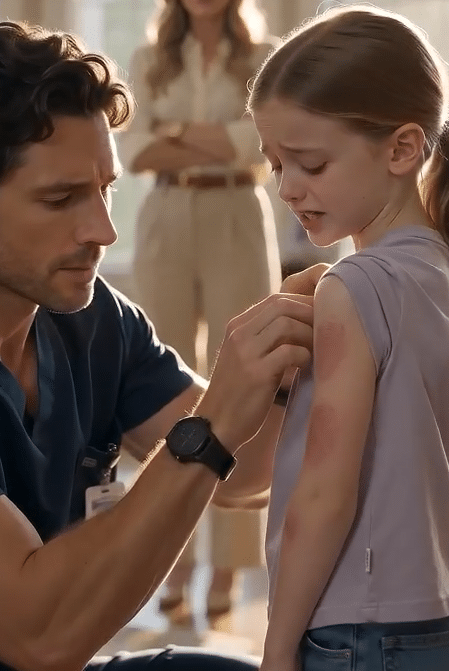
The bruises on Harper’s arm were not from a fall.
I knew that before I even touched her.
Four dark oval marks pressed into the inside of her upper arm, perfectly spaced. A fifth bruise sat opposite them, wider and deeper.
Four fingers.
One thumb.
An adult hand had grabbed that seven-year-old girl hard enough to leave a complete impression.
For a few seconds, neither of us moved.
Harper stared at the floor while I stood beside her in the front hallway, still holding the sleeve of her school sweater.
“Harper,” I said carefully, “who did this?”
She yanked the fabric down.
Her face changed instantly.
The shy little girl vanished. In her place was someone older, someone trained to survive questions without answering them.
“I bumped into the door.”
“No, you didn’t.”
Her eyes snapped toward the staircase.
My wife, Clara, was upstairs getting ready for work.
Harper lowered her voice.
“You’re not supposed to notice.”
A chill moved through me.
I had been an ER nurse in the trauma unit at University of Colorado Hospital for nearly eleven years. I had seen children with broken bones, internal injuries, and excuses rehearsed by frightened adults standing just outside the curtain.
I knew what fear looked like.
But Harper’s fear was different.
She was not afraid of being hurt again.
She was afraid of what would happen if I understood.
“Did your mother grab you?” I whispered.
Harper’s eyes filled with tears.
Then she said something I would never forget.
“If you ask her, she’ll make you go away.”
Before I could respond, Clara appeared at the top of the stairs.
She looked flawless.
Cream blouse. Pearl earrings. Hair pinned neatly behind one ear.
Her smile was warm enough to fool anyone who had not seen the marks beneath Harper’s sleeve.
“Everything all right?” she asked.
Harper stepped away from me.
“I fell into the door.”
Clara’s gaze moved to mine.
For the briefest moment, her smile disappeared.
Then it returned.
“She’s clumsy when she’s tired,” Clara said lightly. “Always has been.”
She walked down the stairs and kissed my cheek.
The kiss felt cold.
Harper picked up her backpack and moved toward the front door.
Clara reached out and placed one hand on her daughter’s shoulder.
Harper froze.
It was not a comforting gesture.
It was a reminder.
“Tell Ethan you’re okay,” Clara said.
Harper looked at me.
“I’m okay.”
The words were perfect.
Too perfect.
Clara smiled again.
“See?”
Then she led Harper outside as though nothing had happened.
I stood alone in the hallway, listening to the sound of their car leaving the driveway.
That was the moment I understood something terrible.
Harper had not been distant because she disliked me.
She had been waiting to see whether I would notice.
And now that I had, someone inside that house was going to make sure I regretted it.
Act II
I met Clara Monroe nine months earlier at a hospital fundraiser.
She was the kind of woman people noticed without understanding why. She did not need to be loud. She moved through a room as though every conversation had been waiting for her to arrive.
She worked as a corporate compliance consultant and spent much of the year traveling between Denver, Phoenix, and Salt Lake City.
She was intelligent, composed, and impossibly attentive.
When I told her about my work in trauma medicine, she listened like every word mattered.
When she told me she was raising a daughter alone, I admired her.
Her previous marriage, she said, had been a mistake.
“Harper’s father was unstable,” she told me one evening. “He disappeared when she was three.”
She never used his name.
Whenever I asked, Clara would look wounded.
Eventually, I stopped asking.
We married after seven months.
Fast, perhaps.
But after years of twelve-hour shifts, failed relationships, and coming home to an empty apartment, Clara’s certainty felt like safety.
The Victorian house on Hawthorne Avenue belonged to her family. Tall windows. Dark wood. White lace curtains. Every room arranged with almost unnatural precision.
Harper was the only thing in it that never seemed to fit.
She carried an old stuffed fox named Scout everywhere.
She spoke softly.
She flinched at sudden sounds.
And whenever Clara left us alone, she cried.
At first, it happened silently.
A tear during breakfast.
Wet eyes in the rearview mirror.
A face turned toward the window so I would not notice.
Every time I asked what was wrong, she shook her head.
Clara always laughed.
“She just doesn’t like you.”
The first time she said it, I believed she was joking.
The fifth time, I realized she wanted me to believe it.
After I saw the bruises, I began watching more carefully.
Harper never accepted food until Clara took the first bite.
She asked permission before using the bathroom.
She slept with her shoes beside the bed.
And every night, before climbing under the blankets, she checked the smoke detector above her door.
When I asked why, she whispered, “To make sure the red light is still there.”
I thought she meant she was afraid of fire.
I was wrong.
Two weeks later, Clara left for a three-day business conference in Salt Lake City.
The change in Harper was immediate.
She still seemed nervous, but the silence around her loosened.
That first evening, we sat on the couch watching an animated movie. Halfway through, I noticed tears running down her face.
“Harper?”
She kept her eyes on the screen.
“Mommy says you’ll leave.”
My chest tightened.
“Why would she say that?”
“She says all men leave because I’m too much trouble.”
I muted the television.
“Look at me.”
She hesitated.
“She says when you see what I’m really like, you’ll hate me.”
“Harper, you are seven years old.”
“That’s not what she means.”
“What does she mean?”
Her fingers tightened around Scout.
“She says I make things happen.”
“What things?”
“Bad things.”
That night, after midnight, I woke to the sound of sobbing.
I found Harper curled beneath her blanket, shaking so hard the mattress moved.
I sat on the floor beside her bed.
“You’re safe,” I said.
She stared at the smoke detector.
“No, I’m not.”
“Tell me what you’re afraid of.”
Her voice dropped to a whisper.
“Mommy says if I tell, the fire will come back.”
“What fire?”
She covered her mouth with both hands.
I stayed there until she fell asleep.
The next morning, she barely spoke.
By afternoon, she seemed to have decided something.
She stood at the bottom of the staircase with her old pink backpack pressed against her chest.
“Ethan?”
It was the first time she had said my name without Clara in the room.
“Yes?”
She looked toward the windows.
Then toward the smoke detector.
Finally, she walked over and sat beside me.
Her hands trembled as she unzipped the backpack.
She reached inside.
“Daddy,” she whispered.
It was the first time she had ever called me that.
“Look at this.”
She pulled out a small silver key.
Then she placed a burned photograph in my hand.
The edges were black.
The middle showed a younger Clara standing beside a man I had never seen before.
Between them was a little girl.
Not Harper.
An older child.
Maybe ten.
On the back, written in blue ink, were six words.
For Lily. In case I disappear.
I looked at Harper.
“Who is Lily?”
She began to cry.
“My sister.”
I stared at her.
Clara had never mentioned another child.
“Where is she now?”
Harper pointed toward the ceiling.
“No,” she whispered. “Not upstairs.”
Then she pointed lower.
Toward the floor.
“The room under the house.”
And suddenly, the bruises were no longer the worst secret inside 219 Hawthorne Avenue.
Act III
The basement door was hidden behind a cabinet in the pantry.
I had lived in the house for nearly three months and never noticed it.
The cabinet was bolted to the wall, but fresh scratches marked the floor beneath it. Someone had moved it recently.
Harper handed me the silver key.
“Mommy keeps the other one in her necklace.”
I pulled the cabinet aside.
Behind it stood a narrow wooden door.
The lock opened with one turn.
Cold air rose from below.
The staircase led into darkness.
I wanted to call the police immediately, but Harper grabbed my sleeve.
“She’ll know.”
“How?”
“The eyes.”
She pointed toward the kitchen clock.
I removed it from the wall.
A tiny camera lens stared back at me.
I checked the smoke detector.
Another camera.
Then the framed photograph in the hallway.
A third.
Clara had not installed a security system.
She had built a surveillance network.
I unplugged the router, knowing she might receive an alert but no longer caring.
Then I took a flashlight and walked downstairs.
The basement had been divided into two sections.
The front half looked ordinary. Storage boxes. Holiday decorations. Old furniture covered in sheets.
At the far end stood a steel door.
The silver key opened that too.
Inside was a room no child should ever have known existed.
There was a narrow bed.
A desk.
A shelf of books.
A wall covered in drawings.
Every picture showed the same house surrounded by flames.
On the desk sat a cassette recorder, several notebooks, and a wooden box.
The notebooks belonged to Lily Monroe.
The earliest entries were written in large, uneven handwriting.
The later ones were precise.
Careful.
Terrified.
Lily wrote that Clara blamed her for everything.
A failed marriage.
A lost promotion.
A broken vase.
A neighbor’s complaint.
Whenever Lily tried to tell someone, Clara said she was confused.
Unstable.
Dangerous.
Lily wrote about being locked in the basement for hours.
Sometimes overnight.
She wrote that Clara made her repeat the same sentence until she believed it.
I ruin families.
The final entries were different.
Lily had discovered documents in Clara’s office.
Insurance policies.
Property transfers.
A death certificate belonging to a man named Michael Foster.
The same name Harper had once called “Daddy Number One.”
I felt sick.
According to Clara, Harper’s biological father had abandoned them.
According to the document in my hand, Michael Foster had died in a house fire four years earlier.
The cause was listed as accidental.
The beneficiary of his life insurance policy was Clara Monroe.
I opened the wooden box.
Inside were newspaper clippings about the fire.
One photograph showed firefighters standing outside a burned home in Aurora.
Another showed Clara wrapped in a blanket, crying for cameras.
The article said her husband had died inside.
It also said her eldest daughter, Lily Monroe, had disappeared the same night.
Clara told police the girl had run away before the fire.
She was never found.
Harper stood in the doorway behind me.
“She didn’t run away,” she said.
I turned.
“How do you know?”
“Lily told me.”
My skin went cold.
“When?”
Harper walked to the wall and removed one of the drawings.
Behind it was a vent.
“She used to talk through there.”
I looked at the bed.
The dust.
The room.
“How long ago?”
“When I was little.”
“Harper, where did Lily go?”
“I don’t know.”
She reached inside the vent and pulled out a folded envelope.
“Mommy never found this.”
The envelope was addressed to whoever found it.
Inside was a letter written by Lily.
She said Clara had started the fire after Michael discovered she had been stealing money from clients.
Michael planned to report her.
Clara drugged him.
Lily saw everything.
Before Clara could lock her downstairs again, Lily escaped through a basement window and ran.
She wrote that she would return for Harper one day.
But she also wrote something else.
Clara had forged records claiming Lily suffered from hallucinations and violent behavior.
If Lily went to the police without proof, Clara would have her committed.
The letter ended with one sentence.
The proof is where Mommy keeps the faces of the men she erased.
I did not understand what it meant.
Then Harper pointed toward the wall.
A row of framed photographs hung near the bed.
Clara with Michael.
Clara with another man.
Clara with me.
I removed the frames one by one.
Behind each photograph was a memory card.
The first contained audio recordings of Michael confronting Clara about missing money.
The second showed another husband, Ben, accusing her of abusing Harper.
The final card was labeled with my name.
It contained videos from inside the house.
Clips of me helping Harper dress.
Clips of me entering her bedroom at night when she cried.
Clips filmed from angles designed to look secretive.
Taken out of context, they could destroy me.
Clara had already begun building a case.
Not against herself.
Against me.
The moment I understood that, the lights came back on.
The router upstairs had restarted.
A red dot blinked on the basement camera.
Clara was watching.
Then my phone rang.
Her name appeared on the screen.
I answered.
For the first time since I met her, Clara did not sound warm.
“Ethan,” she said, “step away from my daughter.”
Act IV
I put the call on speaker.
Harper moved behind me.
“You went into a private room,” Clara said.
“You mean the room where you imprisoned Lily?”
Silence.
Then a small laugh.
Not nervous.
Not surprised.
Almost relieved.
“You have no idea what you found.”
“I found Michael’s death certificate. I found Lily’s letter. I found recordings.”
“You found the fantasies of a disturbed child.”
“You had another daughter.”
“I had a daughter who was dangerous.”
“Where is she?”
“She ran away.”
“After witnessing you start a fire?”
Clara’s voice sharpened.
“Do you understand how easily I can end your career?”
I looked at the camera.
“That’s why you recorded me.”
“I recorded a grown man entering a little girl’s bedroom after midnight.”
“She was crying.”
“You touched her clothes.”
“I found bruises.”
“Bruises you caused.”
Harper made a small sound behind me.
Clara heard it.
“Harper,” she said sweetly, “tell Ethan what happens when people lie.”
Harper began trembling.
I turned toward her.
“No,” I said. “She doesn’t have to say anything.”
Clara’s voice changed.
The sweetness vanished.
“She says exactly what I tell her to say.”
Harper covered her ears.
I ended the call.
Then I dialed Detective Laura Martinez, a police investigator I had worked with on several trauma cases.
I gave her the address.
I told her there was evidence of child abuse, unlawful confinement, fraud, and possible homicide.
She told me to leave the house immediately.
We were halfway up the basement stairs when I heard the front door slam.
Clara had not been in Salt Lake City.
She had been less than twenty minutes away.
Her heels struck the kitchen floor above us.
Slow.
Controlled.
“Harper,” she called, “come upstairs.”
Harper clutched my hand.
Clara appeared at the top of the basement steps.
She was still wearing the navy suit from the conference photograph she had texted me that morning.
Only now I could see the conference badge was fake.
Her expression was calm.
Too calm.
“You’re confused,” she told me.
“No.”
“You’re emotionally involved.”
“No.”
“You have a history of burnout.”
I stared at her.
She smiled.
“I read your hospital records.”
My stomach dropped.
Two years earlier, after a brutal series of pediatric trauma cases, I had taken medical leave for anxiety and insomnia.
Clara knew.
She had always known.
“That’s why you chose me,” I said.
“I chose you because people trust nurses.”
She descended one step.
“And because exhausted men are easy to discredit.”
Sirens sounded in the distance.
For the first time, Clara’s composure cracked.
She looked at Harper.
“This is your fault.”
Harper flinched.
I stepped between them.
“No. It isn’t.”
Clara reached into her handbag.
I moved before I saw what she was holding.
It was not a weapon.
It was a lighter.
She flicked it once.
A small flame appeared.
Harper screamed.
“The fire comes when people tell,” Clara whispered.
Then she dropped the lighter onto a stack of papers near the stairs.
I kicked it away before the flame could catch.
Clara lunged for Harper.
I blocked her.
She struck me across the face, then tried to climb past me.
By the time officers entered the kitchen, she was screaming that I had abducted her daughter.
That I had broken into the basement.
That I was unstable.
For a moment, it almost worked.
Then Harper stepped forward.
Her whole body shook.
But her voice did not.
“She hurts me.”
Clara stopped moving.
Harper lifted her sleeve.
“She locked Lily downstairs.”
Clara stared at her daughter with something colder than rage.
Betrayal.
Then a voice came from the doorway behind the officers.
“She locked me there too.”
A woman stood in the kitchen.
Thin.
Pale.
Barely thirty.
A burn scar ran from her jaw to the edge of her collar.
She looked at Harper and began to cry.
Harper dropped Scout.
“Lily?”
The woman nodded.
And the little girl who had been told everyone would leave ran straight into her sister’s arms.
Act V
Lily had not disappeared.
She had survived.
The night of the fire, she escaped through the basement window and hid in a neighbor’s shed until morning.
But Clara had already prepared for that possibility.
Police records described Lily as unstable, delusional, and potentially violent. Clara produced psychiatric assessments signed by a doctor who later admitted he had falsified them for money.
When Lily tried to report what happened, she was placed in emergency psychiatric care.
By the time she was released, Clara had moved.
Harper was gone.
For four years, Lily searched.
She followed property records, school enrollments, marriage licenses, and insurance filings.
She stayed hidden because Clara had threatened to frame her for Michael’s death.
Three days before I found the basement, Lily contacted Detective Martinez with copies of the records she had gathered.
Laura had already begun investigating Clara when I called.
My report gave them what they needed to move.
The evidence from the basement unraveled everything.
Michael had discovered Clara was stealing from corporate accounts and using forged identities to move money.
The fire had destroyed most of the original paperwork.
Most, but not all.
Lily had hidden copies inside the wall behind the photographs.
Ben, Clara’s second husband, was found living in Oregon under a different name.
He had not abandoned Harper.
Clara had threatened to accuse him of abuse unless he disappeared.
She had used the recordings to force him into signing away every legal right.
When he learned Harper was safe, he agreed to testify.
So did Lily.
So did I.
Clara was charged with child abuse, unlawful imprisonment, fraud, evidence tampering, arson, and Michael Foster’s murder.
In court, she wore the same expression she had worn at our wedding.
Calm.
Elegant.
Certain everyone else would believe her.
Then Harper entered the courtroom holding Scout in one hand and Lily’s hand in the other.
She did not look at Clara.
She looked at me.
I had worried she might never trust an adult again.
I had worried that every promise would sound like another lie.
But when she reached the witness room door, she turned back.
“Daddy?”
The hallway went quiet.
“Yes?”
“You’re still here.”
I swallowed hard.
“I told you I would be.”
Clara was convicted on every major charge.
The house on Hawthorne Avenue was sold.
Harper never went back.
Lily became her legal guardian, and I remained part of their lives through a custody arrangement the court approved after months of evaluation.
I was not her biological father.
I was not the man who gave her his name first.
But I was the one who stayed after the truth became dangerous.
A year later, on Harper’s eighth birthday, she handed me a drawing.
It showed three people standing outside a small yellow house.
Lily.
Harper.
Me.
There were no flames.
No locked doors.
No cameras.
In the corner, she had drawn Scout the fox beneath a blue sky.
At the top of the page, in careful purple letters, she had written:
My family is the people who came back.
I kept that drawing in my locker at the hospital.
Whenever a frightened child refused to speak, I remembered Harper.
I remembered the bruises.
The backpack.
The silver key.
And the woman who believed fear could erase the truth forever.
She was wrong.
Because silence can hide pain for years.
But sometimes all it takes is one person who notices.
One person who believes.
One person who refuses to leave.