Act I
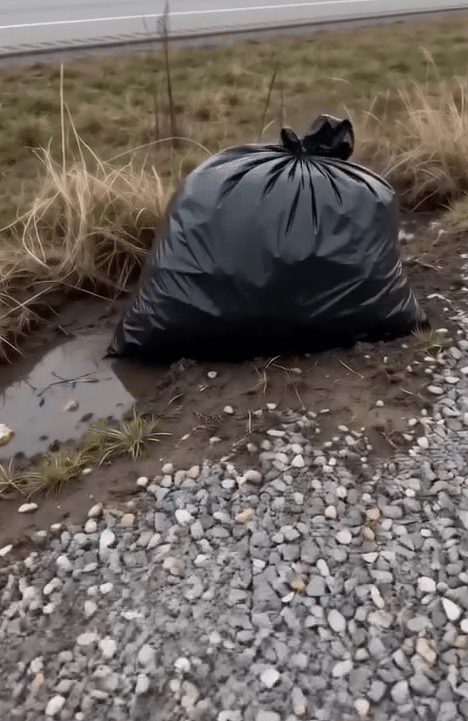
The garbage bag moved just as Deputy David Mercer reached for it.
Not fluttered. Not shifted in the wind.
It lunged.
The heavy black plastic scraped across the gravel shoulder of Interstate 95, inches from traffic moving at seventy miles an hour. A tractor-trailer thundered past, shaking the pavement beneath David’s boots and swallowing every sound for half a second.
Then the highway went quiet enough for him to hear it.
A scream.
Thin. Muffled. Human.
David dropped to his knees.
“County Sheriff!” he shouted, though he had no idea who was trapped inside. “Hold still. I’m getting you out.”
The top of the contractor bag had been twisted tight and wrapped in layer after layer of silver duct tape. Whoever had sealed it had not done so carelessly. They had taken their time.
David pulled out his tactical knife.
His hands had remained steady during armed standoffs, fatal crashes, and one terrifying night when a suspect fired through the windshield of his cruiser.
Now they shook.
He pinched the plastic away from whatever was inside and cut downward.
The smell escaped first.
Sweat. Urine. Infection. Fear.
Then he pulled the bag open.
A little boy was curled inside.
He looked six, perhaps seven, though starvation had reduced him to angles and bones. He wore oversized basketball shorts and nothing else. His ribs pressed sharply beneath pale, dirt-streaked skin.
His wrists were tied with rope.
Bruises darkened his face.
Circular burns covered his arms, shoulders, and chest—some old, some recent, all telling the same unbearable story.
When sunlight reached him, the child screamed again and threw his hands over his face.
David tossed the knife aside.
“Hey,” he said, forcing his voice to soften. “You’re safe. I’m a police officer. I’m not going to hurt you.”
The boy folded tighter, as if trying to disappear inside himself.
David pressed the emergency button on his radio.
“Unit Four to dispatch. Emergency traffic. I need fire and rescue at mile marker 145 northbound. Pediatric victim, severe trauma. Step it up.”
The dispatcher’s voice returned instantly.
“Copy, Unit Four. Rescue is rolling.”
David removed his uniform jacket and draped it over the boy’s shoulders.
The child recoiled so violently that David froze.
“I’m sorry,” he whispered. “I’m only trying to keep you warm.”
Using medical shears, he cut through the rope around the boy’s wrists. Bloody grooves circled the skin beneath it.
David had seen cruelty before. He had arrested husbands who beat their wives, parents who abandoned newborns, men who treated violence like a language only they were entitled to speak.
But this was different.
Someone had placed a living child into a trash bag, sealed it shut, and thrown him beside an interstate.
Not in panic.
Not by accident.
With intention.
The boy lowered one hand.
One eye was swollen shut. The other fixed on David with an expression so terrified it made him feel ashamed to be wearing the same human face as whoever had done this.
“What’s your name, buddy?” David asked.
The child tried to answer, but no sound came out.
His lips were cracked from dehydration.
“You don’t have to talk,” David said. “Help is coming.”
Sirens rose in the distance.
Paramedics rushed toward them moments later. Their movements were quick and practiced, but David saw the lead medic’s expression change when the jacket slipped aside and revealed the burns.
They wrapped the boy in a thermal blanket and lifted him onto a stretcher.
He did not resist.
That frightened David almost as much as the wounds.
As the medics pushed the stretcher toward the ambulance, a small hand reached out from beneath the blanket and caught David’s sleeve.
David leaned closer.
The child’s voice was barely more than breath.
“Don’t let them take me back.”
David placed his hand over the boy’s.
“I won’t.”
The child stared at him.
David tightened his grip.
“I swear.”
The ambulance doors closed.
David remained on the shoulder as it sped away, staring at the torn plastic, the blood-marked rope, and the strips of duct tape lying in the dust.
Behind him, his sergeant called his name.
David did not answer.
Because near the bottom of the bag, partially hidden beneath the folded plastic, he had just noticed something else.
A white mailing label.
And printed across it was the address of a house only twelve miles away.
That address would lead them somewhere no child should ever have survived.
Act II
The house stood at the end of a narrow county road lined with pine trees and rusting mailboxes.
From the outside, it looked forgettable.
A faded one-story rental. Plastic toys scattered across the yard. A cracked birdbath near the porch. Curtains drawn even though it was barely noon.
David arrived with Detective Lena Ortiz, a child-crimes investigator with fifteen years on the job and a reputation for never raising her voice.
The mailing label had come from a box of industrial trash bags purchased online. The delivery address belonged to Eric and Melissa Vance.
According to county records, Melissa had one biological son.
His name was Noah.
Seven years old.
He had not been enrolled in school for nearly eight months.
Melissa had told the district she planned to homeschool him.
No curriculum had ever been registered.
No medical records had been filed.
No one had followed up.
Lena knocked.
A man in work boots opened the door.
Eric Vance was broad-shouldered, clean-shaven, and calm in the way guilty men sometimes became when they believed calmness looked like innocence.
“Yes?”
“County Sheriff’s Office,” Lena said. “We need to ask you about Noah Vance.”
Eric’s eyes flickered.
Only once.
Then his face hardened.
“Noah ran away.”
“When?”
“Last night.”
“You report him missing?”
“I was about to.”
David looked past him.
The living room was spotless.
Too spotless.
No schoolbooks. No photographs of Noah. No shoes near the door small enough for a child.
But there was a faint chemical smell beneath the air freshener.
Bleach.
“Where’s Melissa?” David asked.
“At work.”
“Where?”
Eric named a diner.
Lena had already checked.
Melissa had been fired three months earlier.
Eric began closing the door.
Lena stopped it with her hand.
“We have reason to believe Noah was seriously injured.”
For the first time, Eric showed emotion.
Not concern.
Irritation.
“That kid hurts himself,” he said. “He’s disturbed.”
David felt something cold settle inside him.
“That kid?” he repeated.
Eric’s mouth tightened.
Lena stepped forward.
“We’re coming in.”
“You don’t have a warrant.”
She held his gaze.
“No. But the screams coming from your back room are giving me probable cause.”
Eric turned his head.
That was all the confirmation David needed.
He pushed past him.
The hallway was dark. The bedroom doors stood open except for one at the far end, secured from the outside with a sliding metal latch.
David reached it first.
Inside were two children.
A girl of about nine sat on the floor beside a toddler. Both were dressed. Both appeared fed.
But the girl’s face had gone blank with fear.
“Where is Noah?” she asked.
“He’s safe,” David said.
Her shoulders collapsed.
Not with surprise.
With relief.
She began to cry without making a sound.
The room beside theirs had no bed.
Only a stained mattress on the floor, a plastic bucket in the corner, and a chain bolted into the wall.
A strip of duct tape hung from a shelf.
Beside it sat a glass jar filled with cigarette butts.
David turned away before rage took control of him.
Eric tried to run through the kitchen.
Lena caught him at the back door.
By the time they placed him in handcuffs, Melissa had been found at her sister’s apartment across town.
She denied everything.
She said Noah had behavioral problems.
She said he stole food.
She said he lied.
She said Eric was strict, but only because Noah needed discipline.
At the hospital, doctors gave Noah a different history.
He had suffered chronic malnutrition, untreated infections, old fractures, repeated burns, and injuries consistent with long-term restraint.
The abuse had not lasted weeks.
It had lasted years.
When Lena asked the girl from the back bedroom what had happened, she stared at the floor.
“Eric said Noah was bad,” she whispered.
“Was he?”
The girl shook her head.
“Noah took the punishments for us.”
Her name was Sophie. She was Melissa’s daughter from a previous relationship.
The toddler was Eric’s biological son.
Noah, she explained, had become the family’s target after Eric moved in.
Whenever the toddler cried, Noah was punished.
Whenever Sophie broke something, Noah confessed.
Whenever food went missing, Noah said he took it.
“He told me not to tell,” Sophie said. “He said Eric would start hurting me again.”
Lena asked about the garbage bag.
Sophie squeezed her eyes shut.
The previous night, Noah had collapsed after Eric beat him for taking bread from the kitchen.
Eric believed he was dead.
Melissa checked for a pulse.
Then she told Eric they could not call an ambulance because “people would ask questions.”
They wrapped Noah in plastic.
They drove north before sunrise.
They left him beside the highway.
But Noah had not died.
He had woken up inside the bag.
And he had fought hard enough for passing motorists to notice.
That should have been the worst revelation of the day.
It was not.
At four-thirty that afternoon, Lena walked into David’s office carrying a thick county file.
Her face had lost all color.
“You need to see this.”
Inside were complaints involving Noah Vance.
Not one.
Not two.
Eleven.
Teachers, neighbors, an emergency-room nurse, a grocery clerk, and Sophie’s biological father had all raised concerns over three years.
Every report had been sent to Child Protective Services.
Every case had been closed.
And one name appeared on nearly all of them.
Caseworker Patricia Cole.
The same woman who had signed the most recent closure only six weeks earlier.
She had written that Noah appeared “healthy, safe, and appropriately supervised.”
But Noah had not been seen by anyone outside the home in eight months.
Which meant Patricia Cole had either made a catastrophic mistake—
or she had never entered the house at all.
Act III
Patricia Cole arrived at the sheriff’s office with an attorney.
She was fifty-two, neatly dressed, and visibly offended by the accusation that she had failed a child.
“I followed procedure,” she said.
Lena placed the file between them.
“You documented an in-person visit on May seventeenth.”
“Yes.”
“You wrote that Noah answered questions appropriately.”
“He did.”
“You described him as wearing a blue school shirt.”
Patricia hesitated.
“That sounds right.”
Lena slid a photograph across the table.
It showed the Vance house on May seventeenth.
The image had been captured by a utility company’s pole-mounted camera during a maintenance project.
The front yard was visible from sunrise to sunset.
No county vehicle arrived.
No caseworker entered.
No child stepped outside.
Patricia stared at the photograph.
Her attorney leaned toward her.
The interview ended minutes later.
But the investigation was only beginning.
Detectives obtained warrants for Patricia’s work phone, email account, and financial records.
What they found transformed the case.
Over three years, Patricia had received regular cash transfers from a small construction company owned by Eric’s older brother, Randall Vance.
The payments were disguised as consulting fees.
Patricia was not a consultant.
She had never worked in construction.
The transfers often appeared within days of new abuse complaints.
Each time money arrived, a report was closed.
Eric had not simply manipulated an overworked system.
He had purchased its silence.
And Patricia had not acted alone.
Her supervisor, Martin Hale, had approved every closure.
Hale insisted he trusted Patricia’s judgment. Then investigators discovered that Randall Vance’s company had renovated Hale’s lake house at a fraction of the normal price.
The pattern widened.
David and Lena reviewed other cases assigned to Patricia.
They found missing photographs, copied interview notes, falsified home visits, and children listed as “safe” despite medical records showing otherwise.
Noah was not the only child failed by the scheme.
He was simply the one who nearly died because of it.
Still, one mystery remained.
Why had Eric hated Noah so much?
The answer came from Melissa.
After two days in custody, she asked to speak without Eric present.
Her hands trembled throughout the interview.
“Noah wasn’t Eric’s son,” she said.
That much was already known.
But then she revealed the part she had hidden for seven years.
Noah’s biological father was Daniel Cross, a local firefighter who had died during a warehouse fire before Noah was born.
Daniel’s death had been ruled accidental.
He left behind a life insurance policy and a survivor’s benefit for his child.
The payments totaled more than two hundred thousand dollars.
Melissa received them as Noah’s guardian.
By the time Eric learned about the account, much of the money had already been spent.
He demanded access to the remainder.
But the final portion—nearly eighty thousand dollars—was locked in a protected trust until Noah turned eighteen.
Eric could not touch it legally.
So he began pressuring Melissa to surrender control through forged medical and disability claims.
If Noah were declared permanently impaired, they believed they could petition for expanded guardianship and gain access to the funds.
When that failed, Eric’s resentment turned vicious.
“He said Noah was standing between us and a new life,” Melissa whispered.
David stared at her.
“And you let him torture your son?”
Melissa began crying.
“He said he would take Sophie and the baby.”
“You watched him burn Noah.”
“I was scared.”
“You helped put him in the bag.”
Her crying stopped.
David leaned forward.
“You felt his pulse.”
Melissa looked away.
“You knew he was alive.”
Silence filled the room.
That silence told them everything.
The attempted murder had not been Eric’s decision alone.
Melissa had chosen the highway because she believed the passing traffic would destroy the evidence.
The bag was placed inches from the lane for a reason.
She expected a truck to strike it.
Instead, a gust from a passing vehicle pushed it deeper onto the shoulder.
Noah survived because chance moved him a few feet.
But chance had not been the only thing protecting him.
At the hospital, Noah finally began speaking to a trauma specialist.
His first full statement was not about Eric.
It was about Daniel.
Noah had never met his father, but Sophie had once found an old photograph hidden in Melissa’s closet.
Daniel stood beside a fire engine, smiling into the sun.
Noah kept the photograph under his mattress.
On the worst nights, he looked at it and imagined his father telling him to stay awake.
To breathe.
To endure.
The night they placed him in the garbage bag, Noah felt the photograph still tucked inside the waistband of his shorts.
He focused on it in the darkness.
He kicked.
He screamed.
He refused to disappear.
Investigators later recovered the photograph from the torn bag.
It was creased, stained, and nearly split down the middle.
On the back, written in faded ink, were five words from Daniel to Melissa.
Take care of our boy.
She had failed that promise.
But the investigation was about to reveal someone who had tried desperately to keep it.
Act IV
Daniel Cross’s older sister, Rebecca, arrived from Ohio three days after Noah was found.
She walked into the hospital carrying a cardboard box.
Inside were birthday cards.
Seven of them.
One for every year of Noah’s life.
None had ever been opened.
Rebecca had mailed them every summer. She had included photographs of Daniel, letters about his childhood, and requests to visit Noah.
Melissa had returned every package.
Later, she stopped responding entirely.
Rebecca contacted Child Protective Services twice after a brief video call in which Noah appeared frightened and unusually thin.
Patricia Cole handled both complaints.
Each was closed as a “family conflict.”
Rebecca had not stopped there.
She had hired an attorney.
She had requested welfare checks.
She had even driven overnight to the Vance home once, only to be threatened by Eric and ordered off the property.
“I thought the system would protect him,” she told David.
He had no answer.
By then, reporters had surrounded the courthouse.
The story spread across the state: a child found sealed in a trash bag, a mother accused of attempted murder, a stepfather tied to years of torture, and public employees suspected of taking bribes to bury complaints.
County officials held a press conference.
They spoke about procedures.
They spoke about internal reviews.
They spoke about lessons being learned.
David watched from the back of the room and felt sick.
Noah had become a headline to people who had ignored him when he was only a file number.
Then the county attorney announced the charges.
Eric Vance faced attempted murder, aggravated child abuse, unlawful imprisonment, and conspiracy.
Melissa faced attempted murder, child abuse, neglect, fraud, and conspiracy.
Patricia Cole faced bribery, official misconduct, evidence falsification, and obstruction.
Martin Hale faced conspiracy, fraud, and obstruction.
Randall Vance was charged with bribery and money laundering.
The arrests were only the beginning.
Patricia agreed to cooperate.
In exchange for a reduced sentence, she turned over a hidden archive of emails and recorded conversations.
One recording captured Martin Hale telling her to close Noah’s case after a hospital nurse reported suspicious burns.
“The Vances know people,” Hale said. “Don’t turn this into something bigger than it is.”
Another showed Patricia warning Eric before an unannounced visit.
“Make sure the boy is out of sight.”
A third contained Melissa’s voice.
“How long do we have to keep answering these questions?”
Patricia replied calmly.
“As long as people keep reporting you.”
Then Melissa laughed.
The sound became the most damaging evidence at trial.
Noah did not enter the courtroom.
He did not have to.
His recorded forensic interview was played privately for the judge and jury.
Sophie testified through closed-circuit video.
She described the locked room.
The chain.
The nights Noah gave her his food.
The morning she watched Eric carry the black bag through the kitchen.
Then the prosecutor placed Daniel’s damaged photograph into evidence.
The courtroom fell silent.
Eric’s defense attorney argued that the state lacked proof he intended to kill Noah.
The prosecutor pointed to the duct tape.
To the placement beside the traffic lane.
To the highway cameras showing Eric’s truck stopping at mile marker 145 before dawn.
Then she asked one question.
“If this was not intended to kill him, why was the bag sealed?”
Eric had no answer.
Melissa’s attorney tried to portray her as another victim.
But the jury heard the recording of her laughter.
They saw the financial documents showing she had used Noah’s survivor benefits to pay for vacations, electronics, and Eric’s truck.
They learned she had rejected Rebecca’s attempts to help because Rebecca might discover the abuse.
Fear had influenced Melissa.
But greed had guided her.
The jury returned guilty verdicts on every major count.
Eric received life in prison.
Melissa was sentenced to forty-five years.
Patricia Cole received twelve.
Martin Hale received nine.
Randall Vance received seven.
The county paid settlements to several families and reopened more than one hundred cases connected to Patricia’s office.
Supervisors resigned.
Policies changed.
New oversight was created.
But none of that erased the years Noah spent behind a latched door.
And none of it answered the question David feared most.
What happened to a child after the world finally admitted it had failed him?
Act V
Noah spent six weeks in the hospital.
His infections healed first.
The deeper injuries took longer.
He startled whenever someone raised a hand too quickly. He hid bread beneath his pillow. He refused to sleep unless the door remained open.
For several days, he would only speak to David.
So David visited after every shift.
He brought puzzle books, toy patrol cars, and once, after learning Noah liked space, a plastic model of the moon.
Noah barely touched the gifts.
But he always checked David’s sleeve.
The same sleeve he had grabbed beside the highway.
“You said they wouldn’t take me back,” Noah whispered one evening.
“They won’t.”
“Ever?”
“Ever.”
Rebecca petitioned for custody.
She moved back to the county, rented a small house near a highly rated trauma program, and converted the sunniest bedroom into a space for Noah.
She did not fill it with expensive toys.
She asked him what he wanted.
He chose blue walls.
A lamp shaped like a rocket.
And a lock on the inside of the door.
Not to keep anyone out.
To remind himself that he controlled who came in.
Sophie entered foster care temporarily before being placed with her biological father. She and Noah began weekly visits under the guidance of therapists.
At their first reunion, Sophie ran toward him, then stopped several feet away.
She had learned not to touch him without permission.
Noah looked at her.
Then he opened his arms.
They held each other for a long time.
Neither child apologized.
Neither needed to.
Months later, David attended Noah’s custody hearing.
The judge reviewed Rebecca’s home study, therapy plan, and family history.
Then she looked at Noah.
“Do you understand what today means?”
Noah nodded.
“Would you like to live with your aunt?”
He glanced at Rebecca.
She did not smile too widely or reach for him.
She simply waited.
“Yes,” Noah said.
It was the strongest David had ever heard his voice.
Outside the courthouse, Rebecca handed David an envelope.
Inside was a drawing.
A black road ran across the bottom of the page. Beside it stood a police car with bright blue lights.
A small figure in an oversized jacket held the hand of a deputy.
Above them, written in careful childlike letters, were the words:
He heard me.
David sat in his cruiser for several minutes before he could drive.
For years afterward, people asked him about the case.
They asked how he knew the bag contained a child.
He told them he did not.
They asked whether he had suspected corruption from the beginning.
He had not.
They asked whether the investigation changed him.
It did.
Before Noah, David believed the worst crimes were committed in sudden moments of rage.
After Noah, he understood that some cruelty survived through routine.
Through forms left unsigned.
Through visits that never happened.
Through neighbors deciding not to interfere.
Through officials who saw danger and called it complicated.
Through adults who believed a child’s silence meant there was nothing to hear.
The black bag remained in evidence until the final appeal ended.
Then, at David’s request, it was destroyed.
The photograph of Daniel Cross was returned to Noah.
Rebecca had it restored, but Noah asked her not to remove every mark.
He wanted one crease left across the center.
“Why?” she asked.
“Because it was with me,” he said.
Years later, on the anniversary of the day David found him, Noah returned to mile marker 145.
He was taller now.
Healthier.
Still quiet, but no longer silent.
Rebecca stood nearby while traffic rushed past.
David had retired by then, though he still carried himself like a deputy.
Noah walked to the edge of the shoulder and looked down at the gravel.
“There?” he asked.
David nodded.
Noah stared at the spot for a long moment.
Then he reached into his pocket and removed a folded piece of paper.
It was a copy of the drawing he had made in the hospital.
He placed it beneath a small stone.
Not as a memorial to the child who had nearly died there.
As proof that he had lived.
David looked at the highway, remembering the overcast sky, the diesel exhaust, and the violent movement of a bag everyone thought contained trash.
Dispatch had called it a prank.
Motorists had assumed it was an animal.
A corrupt system had treated Noah like a problem that could be closed, filed, and forgotten.
But a child the world had abandoned had used the last of his strength to make the darkness move.
And finally, someone stopped.