Act I
The first knock was so faint I almost convinced myself I had imagined it.
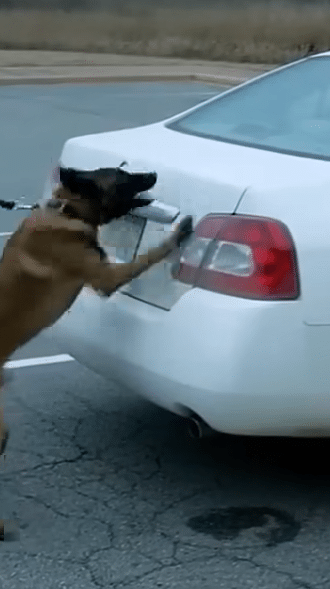
The second made Ranger slam both front paws against the white Nissan’s bumper.
The third stopped my heart.
Three weak taps came from inside the locked trunk, each one separated by a trembling pause. Not random movement. Not luggage shifting.
A person was inside.
“Hey!” I shouted, pressing my palm against the hot metal. “Can you hear me?”
For one terrible second, there was nothing.
Then came three more knocks.
Faster this time.
Ranger barked so hard his whole body shook. At nine years old, with titanium pins in both hips and enough scar tissue to map an entire career, he should not have had that kind of strength left in him.
But training does not retire just because a badge does.
Neither does instinct.
My name is Wayne Barksdale. I spent twenty years with the Bureau of Alcohol, Tobacco, Firearms and Explosives, fourteen of them in the field. Ranger had been beside me for seven of those years, trained in explosive detection, human scent tracking, and search-and-rescue.
He had found survivors under collapsed concrete.
He had tracked armed fugitives across riverbeds.
He had never given a false human-detection alert.
Not once.
The dispatcher told me officers were twelve minutes away.
Twelve minutes.
In a sealed trunk under the Oklahoma sun, twelve minutes could mean the difference between a frightened child and a dead one.
I turned toward the rest stop bathrooms and planted myself between the Nissan and the only path back to it.
The Samaran Creek rest area was almost empty. Wind swept over the flat land, carrying grit across the parking lot in thin gray ribbons. A family loaded drinks into a minivan near the vending machines. An elderly couple stood beside a Buick, arguing quietly over a paper map.
Nobody seemed to notice the dog losing his mind at the far end of the lot.
Then the men’s room door opened.
A man stepped outside, looking down at his phone.
He was painfully ordinary. Mid-thirties. Thin. Cheap jeans. Gray T-shirt. Short brown hair. A forgettable face.
That was the part I hated most.
Monsters rarely look like monsters.
He walked twenty feet before he noticed me.
Then he stopped.
His eyes went first to my leather vest, then to Ranger, then to the Nissan.
Not confusion.
Calculation.
“That your car?” I asked.
“Yeah.” His voice was flat. “Why?”
“My dog alerted on your trunk.”
He glanced at Ranger and gave a dismissive laugh. “Dogs bark.”
“This one spent seven years working federal search and rescue.”
His expression changed by half an inch.
That was enough.
“Open the trunk,” I said.
His jaw tightened. “I don’t have to open anything for some biker.”
“There’s a pink backpack in the back seat. There are knocks coming from the trunk. Police are on the way.”
The man’s eyes flicked toward the highway.
He was measuring distance now.
Calculating whether he could run.
“You’re insane,” he said. “That backpack belongs to my niece.”
“Then you won’t mind proving it.”
He stepped toward me.
I stepped forward too.
I am six-foot-four and weighed two hundred forty pounds on a bad day. My left knee was mostly screws and resentment, but the rest of me still remembered exactly how to stop a man from getting past.
His nostrils flared.
“You need to move.”
“No.”
That single word seemed to strip away the last layer of his disguise.
His right hand twitched toward his pocket.
Ranger growled.
Then the sound of engines rolled across the plains.
Low. Heavy. Fast.
Four Harley-Davidsons came off the interstate ramp in a tight formation and thundered into the rest area. Pike led the group, his black Road King leaning hard into the turn. Boon, Dutch, and Keel followed behind him.
The Burnt River Motorcycle Club did not look like the kind of men anyone called for help.
That was one of the reasons I trusted them.
They parked without blocking the patrol route and moved in silence.
Pike took one look at Ranger and then at the white Nissan.
“What do we have?”
“Someone alive in the trunk.”
The man backed away.
Only one step.
But we all saw it.
And then Ranger stopped barking.
He lowered his head.
Whined once.
And stared at the trunk with a look I had only seen on him twice before.
Both times, someone had been running out of air.
We did not have twelve minutes anymore.
We had seconds.
And that was when the man reached into his pocket.
Act II
Pike moved before I did.
He caught the man’s wrist, twisted it outward, and slammed him chest-first against the Nissan without throwing a single punch. A black key fob dropped from the man’s hand and hit the pavement.
The trunk release button was still under his thumb.
“You were going to open it?” Pike asked.
The man said nothing.
“No,” I said. “He was going to unlock the doors and drive.”
The man began struggling.
“I didn’t do anything! Get off me!”
The weak knocking came again from inside the trunk.
Once.
Then nothing.
Ranger clawed at the seam.
I grabbed the key fob and pressed the trunk button.
The lid lifted less than an inch before something inside caught against it.
I shoved both hands under the edge and pulled.
A child’s sneaker appeared first.
Then a small hand.
The trunk opened.
The girl inside could not have been older than ten.
Her wrists were bound in front of her with silver duct tape. A strip of cloth had been tied around her mouth, and her face was red from heat and panic. She was curled beside a gray duffel bag, knees pulled tightly to her chest.
Her eyes were open.
Barely.
“Easy,” I said, reaching in. “You’re safe.”
She flinched away from me.
Ranger pushed his muzzle into the trunk and gave a soft whine.
The girl froze.
Her eyes moved toward him.
Something in her expression changed.
Not trust.
Recognition.
She leaned forward and pressed her forehead against his nose.
Then she collapsed.
The next few minutes became a blur of movement. Boon called the dispatcher back and demanded an ambulance. Dutch pulled a blanket from his saddlebag. Keel kept the family near the vending machines from coming closer.
Pike held the man against the Nissan until the first state trooper arrived.
The girl was still breathing when the paramedics placed an oxygen mask over her face.
Her name was Lily.
We learned that from a plastic hospital bracelet hidden under the tape around her wrist.
LILY MARSH.
Age nine.
The name meant nothing to me.
But the logo on the bracelet did.
St. Vincent’s Children’s Hospital in Tulsa.
The same hospital where Ranger and I had spent three months visiting pediatric trauma patients after my retirement.
Ranger had always hated hospitals. The antiseptic smell made him restless, and the polished floors bothered his hips.
But he had loved the children.
Lily opened her eyes inside the ambulance and began fighting the paramedics until they let Ranger stand beside the open doors.
She reached for him.
Her fingers sank into the thick fur behind his ears.
“Don’t let him take me back,” she whispered.
The paramedic leaned closer. “Who?”
Lily’s eyes moved past us.
Toward the man in handcuffs.
“My uncle.”
The man’s name was Curtis Vale.
At least, that was the name on his driver’s license.
He told police Lily was his sister’s daughter and claimed she had suffered a behavioral episode. He said she had climbed into the trunk herself during an argument, and he had panicked.
Nobody believed him.
Not with the duct tape.
Not with the gag.
Not with the prepaid phones found in the glove compartment.
But what police discovered in the gray duffel bag was worse.
Inside were children’s clothes in three different sizes, disposable gloves, sedatives, zip ties, and six hospital identification bands.
Each band carried a different child’s name.
All of them were from hospitals across Oklahoma and northern Texas.
Lily was not the first.
She might not even have been the latest.
That night, I sat outside the emergency room with Ranger lying at my boots.
A detective named Mara Ellis took my statement twice.
On the third visit, she brought a photograph.
It showed Curtis Vale standing in a charity banquet hall wearing a suit. Beside him stood a tall woman in a white medical coat.
Dr. Evelyn Marsh.
Lily’s mother.
“She’s a pediatric neurologist,” Ellis said. “Well-known. Wealthy. Widowed.”
“Where is she?”
“Missing.”
I looked up.
“How long?”
“Forty-eight hours.”
The hospital had reported Dr. Marsh missing after she failed to appear for surgery. Her vehicle was found abandoned at Tulsa International Airport, making it look as though she had left the state voluntarily.
But her passport was still at home.
So was her purse.
And inside her office, police found one torn page from Lily’s medical file.
The page showed that Lily had been admitted six months earlier after a fall down a staircase.
Curtis Vale had been the only adult present.
Dr. Marsh had started asking questions.
Then she disappeared.
Ellis placed a second photograph on the table.
It was older, grainier, taken nearly twenty years before.
Curtis stood outside a county courthouse beside another man.
A man I recognized immediately.
Special Agent Raymond Kessler.
My former supervisor.
The man who had signed the paperwork that ended my career.
The man who had led the raid that shattered my knee.
And the man who had once tried to take Ranger away from me.
Until that moment, I thought I had stumbled onto a kidnapping.
I was wrong.
I had stumbled into something that had been waiting for me for four years.
Act III
Raymond Kessler built his reputation on rescue stories.
He knew how to stand in front of cameras.
He knew when to lower his voice, when to pause, when to use the words public service and sacrifice.
After the raid that ended my career, Kessler received a promotion.
I received surgery, pills, and a retirement package designed to keep me quiet.
The official report said our team had entered the wrong warehouse because of an informant’s bad intelligence. The floor had been rigged. An explosion collapsed a steel platform and crushed my knee beneath it.
Two agents were injured.
One suspect escaped.
The investigation concluded there had been no misconduct.
I had never believed that.
Ranger had alerted on the west entrance before the breach, but Kessler ordered us through the east. When I questioned him, he said the dog was reacting to residue from an old weapons shipment.
Minutes later, the east floor gave way.
For years, I told myself I was bitter because my body had failed.
But Ranger had not failed.
Someone had ignored him.
Detective Ellis confirmed that Curtis Vale had worked as a confidential informant for Kessler during the same period. He was never charged despite being named in three trafficking investigations, two fraud cases, and the disappearance of a seventeen-year-old girl.
Each file had been sealed.
Each investigation had died.
“What does this have to do with Lily?” I asked.
Ellis slid a folder across the table.
Dr. Evelyn Marsh had spent the previous year quietly reviewing pediatric sedation records at St. Vincent’s. She had noticed a pattern: children from unstable homes were being admitted for minor injuries, sedated far beyond medical necessity, then transferred to private rehabilitation facilities.
Some never returned for follow-up care.
Others disappeared into the foster system under altered records.
The transfers had been approved by a nonprofit called New Passage Foundation.
Raymond Kessler sat on its board.
Curtis Vale handled transportation.
The six hospital bands in his trunk belonged to children who had vanished over a seven-year period.
Dr. Marsh had uncovered forged signatures, falsified discharge documents, and payments routed through shell companies.
She had prepared to take the evidence to federal prosecutors.
Then Curtis learned she had copied the files.
Lily had seen him attack her mother.
That was why he took the child.
Not for ransom.
To erase the only witness.
“Where is Dr. Marsh?” I asked.
Ellis did not answer.
She did not need to.
The police searched Curtis’s apartment, two storage units, and a hunting cabin registered to his cousin.
They found blood in the cabin.
Not enough to prove murder.
Enough to prove someone had been hurt.
Then Lily woke fully and asked for Ranger.
I brought him to her room.
She was small beneath the white blankets, her face pale against the pillow. A nurse had cut the tape from her wrists, leaving raw red circles around the skin.
Ranger rested his chin beside her hand.
Lily touched the old scar above his eye.
“My mom said dogs remember the truth,” she whispered.
I sat beside the bed.
“What truth did your mom want remembered?”
Lily looked toward the door.
Then she reached under the blanket and pulled out the glittery unicorn keychain from her backpack.
She twisted its plastic horn.
The toy separated into two pieces.
Inside was a tiny memory card.
“Mom gave me this when Uncle Curtis came to the house,” she said. “She told me not to let anyone have it.”
Detective Ellis loaded the card onto an evidence laptop.
There were hundreds of files.
Patient records.
Bank transfers.
Audio recordings.
Photographs of children entering unmarked vans.
And one video.
Dr. Evelyn Marsh had recorded herself in her office the night before she vanished.
She looked exhausted, but her voice was steady.
“If you are watching this, I was unable to deliver the evidence myself,” she said. “The New Passage Foundation is not a charity. It is a pipeline. Children are being moved through hospitals, foster agencies, and private facilities under fraudulent records.”
She named Curtis Vale.
Three hospital administrators.
Two judges.
And Raymond Kessler.
Then she said something that made every person in the room turn toward me.
“Four years ago, Agent Wayne Barksdale’s raid was sabotaged because his K9 detected a concealed holding area beneath the warehouse floor. That room contained records linking Kessler to New Passage. The explosion destroyed the evidence and ended Barksdale’s career.”
My mouth went dry.
The pain in my knee seemed to return all at once.
The pills.
The lost years.
The nights I had sat alone with a bottle in my hand, believing I had become useless.
None of it had been an accident.
Kessler had not simply ignored Ranger.
He had tried to bury us.
The video continued.
“I copied the original warehouse transfer ledger before the fire. Kessler believes it was destroyed. It was not.”
Dr. Marsh looked directly into the camera.
“The ledger is hidden where he will never search. With the officer he tried hardest to destroy.”
The video ended.
Everyone stared at me.
I had no idea what she meant.
Then Ranger stood.
He walked toward my old leather riding bag in the corner of the hospital room.
And began scratching at the bottom panel.
Act IV
The bag had belonged to me since my ATF days.
I had carried it to every operation, every training field, every hospital visit, and every motorcycle trip after retirement.
I thought I knew every tear in the leather.
I was wrong.
Beneath the reinforced bottom was a narrow stitched compartment.
Inside lay a sealed envelope wrapped in plastic.
My name was written across the front.
Dr. Evelyn Marsh had treated Ranger after the warehouse explosion. She had been a surgical resident then, working under the veterinary trauma liaison program attached to the federal task force.
She had saved his hips.
While Kessler focused on controlling the investigation, Evelyn had found a ledger fragment caught inside Ranger’s damaged tactical vest.
She must have realized what it was.
She hid it where Kessler would never think to look.
With the broken agent everyone expected to disappear.
Inside the envelope was a handwritten note.
Wayne,
If you are reading this, then I was right to be afraid.
Your dog found what the rest of us missed.
Trust him again.
The ledger contained dates, payments, names, transfer routes, and coded references to more than forty children.
It was enough to reopen the warehouse case.
Enough to connect Kessler to Curtis.
Enough to bring federal agents into the investigation.
But Kessler still had power.
By sunrise, he knew the ledger existed.
He arrived at St. Vincent’s wearing a federal badge and an expression of practiced concern.
He claimed he had been assigned to oversee a multi-state kidnapping investigation.
Ellis met him outside Lily’s room.
“This is now federal,” Kessler told her. “Turn over the evidence.”
Ellis did not move.
Kessler looked past her and saw me.
For the first time in four years, the mask slipped.
Just slightly.
“Wayne,” he said. “You look well.”
“You don’t.”
His eyes dropped to Ranger.
The dog stared back without making a sound.
Kessler smiled. “Still dragging that animal around?”
Ranger’s ears lifted.
I stood slowly.
“He remembers you.”
Kessler asked to speak with me alone.
I agreed because Ellis had already placed two recording devices in the room.
He closed the door behind us.
“You have no idea what you’ve involved yourself in,” he said.
“I know you sabotaged the warehouse.”
His expression remained calm.
“You were injured during a lawful operation.”
“You tried to kill evidence.”
“I contained a situation.”
“You buried children.”
His face hardened.
“Do you think the system cares about every missing child from every broken home? I created funding. Facilities. Jobs. I made people useful.”
“You sold them.”
“I moved them.”
The distinction seemed to matter to him.
That was the horror of it.
He did not think of himself as evil.
He thought of himself as efficient.
Kessler stepped closer.
“Give me the ledger. Curtis takes the fall. Lily gets protection. You keep your pension. Your club stays out of federal scrutiny.”
“And Evelyn?”
His silence answered.
My hands curled into fists.
He smiled.
“You were always too emotional for leadership.”
A knock sounded at the door.
Three taps.
Kessler turned.
Lily stood in the hallway behind the glass panel, holding Ranger’s leash.
Detective Ellis stood beside her.
So did two agents from the Office of Inspector General.
Kessler’s face drained of color.
The recording had transmitted every word.
He reached for the door.
Ranger moved first.
The old Malinois lunged forward, not attacking, but blocking Kessler’s path with his body and a growl so deep the windows seemed to vibrate.
Kessler froze.
For years, he had treated Ranger like equipment.
A tool.
A number.
K9-1174.
But Ranger remembered exactly who had led us into that warehouse.
He remembered who had ignored his warning.
He remembered the man standing between us and the door.
The Inspector General agents entered and placed Raymond Kessler under arrest.
Outside the hospital, reporters gathered as the story broke.
New Passage facilities were raided in three states.
Records were seized.
Children were located.
Judges resigned.
Hospital administrators were led away in handcuffs.
Curtis Vale accepted a plea agreement only after prosecutors threatened him with life without parole.
He revealed the location of the hunting property where Evelyn had been taken.
She was not dead.
They found her in a storm cellar beneath an abandoned farmhouse, dehydrated, injured, and barely conscious.
But alive.
When Lily saw her mother wheeled through the hospital doors, she ran so fast that three nurses tried and failed to stop her.
Evelyn fell to her knees despite the pain.
Mother and daughter collided in the middle of the corridor.
Neither let go.
Ranger sat beside them.
Watching.
Waiting.
As if he had known all along that his work was not finished.
Act V
Raymond Kessler was convicted on federal charges including obstruction, conspiracy, kidnapping, evidence destruction, and trafficking.
Curtis Vale received multiple life sentences.
The New Passage Foundation was dismantled.
Thirty-two children were eventually identified and recovered. Some returned to family. Others entered protected placement under new oversight.
Not every ending was clean.
Some families had already spent years grieving children they thought were gone forever.
Some children came home carrying memories no courtroom could erase.
Justice does not undo damage.
It only stops the damage from continuing.
My warehouse case was reopened.
The official record was corrected.
My injury was declared the result of deliberate operational misconduct.
The Bureau offered me a formal apology, a commendation, and a ceremony in Washington.
I declined the ceremony.
I accepted the corrected record.
Not for myself.
For Ranger.
He had been right at the warehouse.
He had been right at the rest stop.
He had been right every time people with more rank and cleaner suits chose not to listen.
Evelyn recovered slowly.
Months later, she brought Lily to the Burnt River clubhouse outside Tulsa. The place looked rough from the highway, all corrugated metal, black motorcycles, and men with enough scars to make polite society nervous.
Lily loved it instantly.
The brothers built her a wooden bench beside the firepit.
Pike painted a small white Nissan on it, then crossed it out with a red line.
Boon added a unicorn beneath it.
Ranger spent most afternoons asleep in the shade beside Lily while she read books aloud to him.
His hips grew worse that winter.
Some mornings he could barely stand.
I built a ramp for the sidecar and added another layer of padding. He still pressed his face against the windshield whenever we rode, eyes narrowed into the wind.
Like nothing had changed.
Like we were still young.
One cold morning in early spring, Lily asked me why Ranger had found her.
I told her the scientific answer first.
Human scent.
Body heat.
Training.
She listened politely.
Then she shook her head.
“No,” she said. “Why did he choose my car?”
I looked at Ranger lying between us.
His muzzle had gone almost completely gray.
“Maybe he knew someone needed him.”
Lily considered that.
Then she rested her small hand on his head.
“Maybe he needed us too.”
That was the truth I had missed for years.
I thought I had fought the Bureau to keep Ranger because he needed a home.
I thought I had built the sidecar because he needed help.
I thought I had saved him from being reassigned, forgotten, or put down when his body could no longer do the job.
But Ranger had been saving me the entire time.
He pulled me through addiction.
Through anger.
Through the long, empty mornings when I could not remember why I should get out of bed.
And on a forgotten stretch of I-40, beside a random white Nissan, he reminded me that broken things can still have purpose.
Old instincts can still matter.
And sometimes the smallest sound in the world—a paw against metal, a child’s weak knock, a dog refusing to walk away—can bring an entire buried truth back into the light.
I still ride the Oklahoma highways.
Ranger still rides beside me.
We stop more often now.
We move slower.
But whenever he lifts his head and stares into the distance, I pay attention.
Because once in a while, the world tries to hide something terrible in a locked place.
And once in a while, an old dog remembers how to find it.