Act I
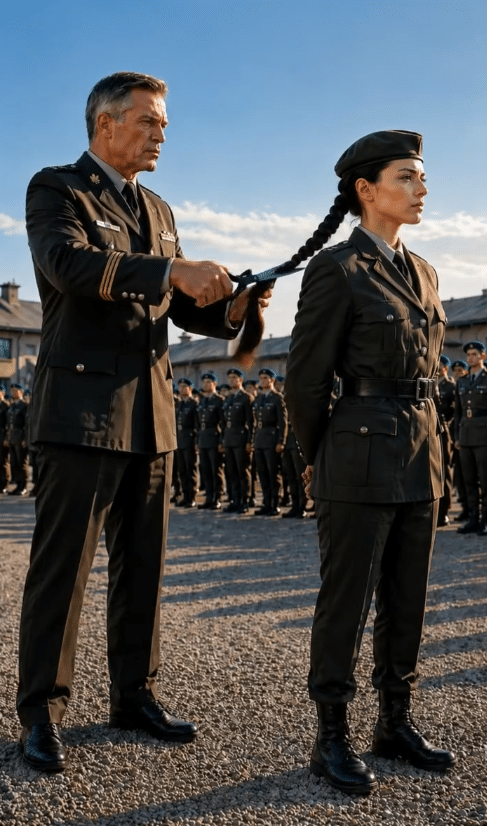
The scissors closed with a hard metallic snap.
Anna’s braid fell onto the parade ground like a severed rope.
For one endless second, no one moved.
More than a hundred soldiers stood beneath the white blaze of the morning sun, their boots aligned, their faces fixed forward. Yet every pair of eyes had seen what Colonel Viktor Sokolov had done.
Anna remained at attention.
Her dark hair, once braided almost to her waist, now ended in an uneven line near her shoulders. A few loose strands moved against her cheek in the hot wind.
She did not cry.
She did not lower her head.
She did not give the colonel the satisfaction of seeing her break.
That silence unsettled him more than any protest could have.
Sokolov let the scissors hang loosely at his side as he studied her face.
“Do you think you’re special?” he asked.
Anna stared straight ahead.
“You’re just a recruit.”
Still nothing.
His jaw tightened.
“People like you always break first.”
A murmur moved through the ranks, faint but unmistakable. The soldiers knew they were witnessing something that had nothing to do with discipline.
This was punishment.
Personal punishment.
Three days earlier, Anna had disobeyed an order during a training exercise. A young soldier named Pavel Morozov had fallen from an obstacle wall and landed violently on his back.
The colonel had ordered the exercise to continue.
Anna had stepped out of formation.
“He needs a doctor,” she had said.
Sokolov had told her to return to her position.
She had refused.
Now he had gathered the entire company to teach her what happened to soldiers who challenged him in public.
He stepped closer.
“Without your pretty hair, perhaps you’ll finally look like a real soldier instead of a spoiled little girl.”
Several men in the front rank shifted uncomfortably.
Anna’s face remained calm.
But inside, something had changed.
The braid on the ground was not merely hair.
It was the last thing her father had touched before he died.
Every morning at the academy, Anna had braided it exactly as he once had when she was a child. Clumsy at first, then careful. He used to tell her that strength did not mean becoming hard.
It meant knowing what must never be surrendered.
The colonel believed he had taken something precious from her.
He had no idea what he had just awakened.
Anna slowly turned her head.
For the first time, she looked directly at him.
“Permission to speak, Colonel.”
The entire parade ground seemed to inhale.
Sokolov smiled.
He thought the apology was finally coming.
“Granted.”
Anna bent down, picked up the severed braid, and held it in one hand.
Then she reached inside her uniform jacket.
What she pulled out made the colonel’s smile disappear.
And that was only the beginning.
Act II
Anna placed a small black recorder on the ground between them.
Its red light was still blinking.
Sokolov stared at it.
“What is that?”
“A record of this morning,” Anna said.
Her voice was steady, almost quiet.
The soldiers in formation could hear every word.
The colonel looked toward the officers standing near the command building. Captain Mikhail Orlov, his deputy, immediately lowered his eyes.
Sokolov’s expression hardened.
“You recorded a superior officer without authorization?”
“I documented an unlawful punishment.”
The air changed.
Until that moment, most of the soldiers had assumed Anna would either submit or lash out. No one expected precision.
No one expected preparation.
Sokolov stepped toward the recorder.
Anna moved one boot over it.
Not aggressively.
Simply enough to stop him.
“Remove your foot,” he said.
“No, sir.”
A sharper murmur moved through the ranks.
The colonel’s face darkened.
“You are refusing another direct order?”
“I am preserving evidence.”
The word evidence struck harder than a shout.
Sokolov glanced toward the company. Some soldiers quickly looked away, but not all of them.
For years, he had controlled the unit through fear.
He withheld leave for minor mistakes. He forced injured soldiers to continue exercises. He humiliated recruits in front of their peers and called it character-building.
Complaints disappeared before they reached regional command.
Medical reports were rewritten.
Witnesses learned to forget.
Pavel’s fall had not been the first serious accident.
It was simply the first one Anna had seen.
She had arrived at the unit with an unusual reputation. Top marks at the academy. Exceptional field scores. A near-perfect disciplinary record.
Most assumed she was ambitious.
Few knew why she had requested this particular posting.
Anna’s father, Major Sergei Volkov, had served in the same unit fifteen years earlier.
Officially, he had died during a mountain exercise after ignoring safety procedures.
That was the version written in his file.
Anna had never believed it.
Her father had been methodical to the point of obsession. He checked ropes twice. He documented equipment failures. He never dismissed an injury.
Two weeks before his death, he had sent Anna’s mother a letter.
In it, he wrote about a young officer who was ordering dangerous drills, altering reports, and threatening anyone who objected.
The officer’s name had been Viktor Sokolov.
At the time, he was only a captain.
After Sergei’s death, the investigation lasted four days.
Sokolov received a promotion within the year.
Anna’s mother kept the letter hidden in a wooden box until the night before Anna left for the academy.
“Do not spend your life chasing revenge,” she had told her.
Anna had promised she wouldn’t.
She had not promised to ignore the truth.
Now, standing beneath the sun with her hair cut and her father’s old letter sealed against her chest, Anna understood something clearly.
The colonel had not merely humiliated the wrong recruit.
He had exposed himself in front of witnesses.
Sokolov pointed toward two military police officers near the gate.
“Detain her.”
Neither man moved immediately.
The delay was small.
But everyone noticed it.
Anna looked toward the company.
Then she said the words that turned the colonel’s anger into fear.
“Before you arrest me, perhaps you should ask Captain Orlov why he sent Pavel’s medical report to regional command last night.”
Captain Orlov went pale.
Sokolov turned toward him.
And for the first time, the soldiers saw their commander look uncertain.
Act III
Captain Orlov had served under Sokolov for six years.
He had signed altered reports.
He had repeated false statements.
He had watched injured men limp back into formation because admitting pain was considered weakness.
For years, he told himself he was protecting his career.
Then Pavel fell.
The sound of the young soldier striking the ground had silenced even the instructors.
Pavel could not move his legs.
Sokolov had walked over, looked down at him, and ordered the next group to climb.
Anna had run forward before anyone else.
She stabilized Pavel’s neck, stopped two soldiers from dragging him, and demanded a medic.
Those actions likely prevented permanent damage.
At the hospital, doctors discovered a spinal fracture. They also noted that movement immediately after the fall could have caused paralysis.
Sokolov ordered Orlov to change the incident report.
Write that Pavel had stood up on his own.
Write that Anna had panicked.
Write that the injury was discovered later.
Orlov had done it before.
This time, he could not.
His younger brother had been a recruit in the same unit eleven years earlier. During a winter march, he developed severe hypothermia.
Sokolov accused him of pretending.
The boy died before reaching the infirmary.
Orlov had lived with that silence ever since.
The night after Pavel’s fall, he copied the original medical report, the training schedule, and three years of suppressed injury records.
Then he sent them to regional command.
Anna had not known whether he would do it.
She had only given him the opportunity.
Now Sokolov stared at his deputy as if betrayal were more offensive than suffering.
“You sent internal documents outside this unit?”
Orlov lifted his eyes.
“Yes, Colonel.”
The admission rippled across the parade ground.
Sokolov marched toward him.
“You have no idea what you’ve done.”
“I know exactly what I’ve done.”
The colonel’s hand curled into a fist.
Then an engine sounded beyond the gate.
A dark military vehicle entered the compound, followed by two more.
The entire company remained frozen in formation as the vehicles stopped beside the command building.
A woman in a general’s uniform stepped out.
Lieutenant General Elena Markova, commander of the regional military district.
Behind her came investigators, legal officers, and military police from outside the unit.
Sokolov’s face drained of color.
General Markova approached slowly.
Her gaze moved from the scissors in his hand to Anna’s uneven hair, then to the severed braid she still held.
“What happened here?” she asked.
Sokolov recovered quickly.
“Disciplinary action, General. The recruit repeatedly refused lawful orders and displayed insubordination.”
Markova looked at Anna.
“Did you refuse an order?”
“Yes, ma’am.”
“Why?”
“To provide emergency aid to an injured soldier.”
“Were you ordered to leave him?”
“Yes, ma’am.”
“Did you believe obeying that order would put him at greater risk?”
“Yes.”
Markova turned to the colonel.
“Then we are not discussing simple insubordination.”
Sokolov raised his voice.
“She undermined command authority in front of the company.”
“No,” Anna said.
Everyone looked at her.
She met Sokolov’s eyes.
“You undermined it yourself.”
The colonel took one step toward her.
General Markova lifted a hand.
He stopped.
Anna reached into her jacket again and removed an old envelope, yellowed at the edges.
“My father served here,” she said. “Major Sergei Volkov.”
For the first time, Sokolov looked genuinely frightened.
Not angry.
Frightened.
Anna saw it.
So did General Markova.
She opened the envelope.
“This letter was written twelve days before my father died. It describes falsified safety inspections, unauthorized training conditions, and threats made by a junior officer.”
She paused.
“That officer was Colonel Sokolov.”
The silence that followed was no longer uneasy.
It was electric.
Sokolov shook his head.
“A dead man’s letter proves nothing.”
Anna nodded.
“By itself, no.”
Then she looked toward Captain Orlov.
“But the archived equipment records might.”
Orlov handed one of the investigators a thick folder.
Inside were copies of maintenance logs recovered from an old storage room scheduled for demolition.
The ropes used in Sergei Volkov’s final exercise had failed inspection two days earlier.
Someone had crossed out the warning.
Someone had authorized their use.
The signature belonged to Viktor Sokolov.
But the darkest detail was still buried beneath the paperwork.
And Anna had carried it with her for fifteen years.
Act IV
The final piece was a photograph.
It showed Anna at seven years old, sitting on her father’s shoulders beside a mountain training station. Sergei was smiling, one hand holding her ankle.
Behind them stood several officers.
One was a young Viktor Sokolov.
On the back of the photograph, Sergei had written a date and a locker number.
Anna had never understood why.
Not until she arrived at the unit and saw the old training station listed on a restricted map.
Two nights earlier, after Pavel had been taken to the hospital, Anna went there with Captain Orlov.
The station had been abandoned for years.
Inside locker 214, behind a rusted metal panel, they found a sealed notebook wrapped in oilcloth.
It belonged to Anna’s father.
Page after page documented unauthorized drills, damaged equipment, and injuries hidden from inspectors.
There were names.
Dates.
Orders.
At the end was a final entry.
If anything happens to me during tomorrow’s exercise, it was not carelessness. I formally objected to using the eastern climbing line. Captain Sokolov ordered us onto it anyway.
General Markova read the entry twice.
Sokolov laughed, but the sound lacked strength.
“A notebook can be forged.”
“It has already been examined,” Markova said. “The handwriting and materials are consistent with the period.”
His eyes darted toward Anna.
“You came here planning this.”
“I came here hoping I was wrong.”
Her answer landed harder than accusation.
Sokolov turned toward the company.
“This is a conspiracy. A failed recruit, a weak deputy, and a group of cowards who resent discipline.”
No one responded.
He pointed at Anna.
“She violated regulations. She disobeyed a superior. She secretly recorded an officer.”
General Markova stepped between them.
“And you publicly assaulted a subordinate, interfered with emergency medical care, falsified reports, concealed injuries, and may be connected to the death of an officer.”
The colonel’s authority vanished in a single breath.
Two investigators moved beside him.
For years, soldiers had feared the sound of his boots approaching.
Now he took one step backward.
“You cannot remove me over the accusations of a recruit.”
General Markova’s expression did not change.
“This is not based only on her accusation.”
She turned toward the formation.
“Anyone who has been ordered to hide an injury, alter a report, continue unsafe training, or remain silent about misconduct may step forward.”
At first, no one moved.
Sokolov smiled faintly.
Fear had protected him for years.
He believed it still would.
Then a soldier in the third row stepped out.
“My knee was fractured during a march last winter. I was ordered to report it as an off-duty injury.”
Another stepped forward.
“I was told to remove a medic’s written recommendation from my file.”
Then another.
“My roommate collapsed during heat training. The colonel refused to stop the exercise.”
Five soldiers became twelve.
Twelve became thirty.
Captain Orlov stepped forward too.
Soon nearly half the company stood outside formation.
The rest were not defending Sokolov.
They were simply gathering the courage to move.
At last, an older sergeant named Lev Petrov stepped out from the final row.
He had been present the day Sergei Volkov died.
For fifteen years, he had said nothing.
His hands trembled as he saluted General Markova.
“Major Volkov did not ignore procedure,” he said. “He refused the line twice. Captain Sokolov threatened to end his career. Then he ordered him onto it.”
Anna’s breath caught.
Petrov looked at her.
“I should have spoken then.”
Sokolov lunged toward him.
The military police seized the colonel before he reached the sergeant.
The scissors fell from his hand and struck the pavement.
Their metallic clatter echoed across the parade ground.
The same sound that had marked Anna’s humiliation now marked the end of his command.
But Anna was not finished.
She walked to the center of the formation, still holding her braid.
Then she did something no one expected.
She handed it to Sergeant Petrov.
“My father used to braid my hair before school,” she said. “He taught me that courage does not erase fear. It means deciding that something else matters more.”
Petrov’s eyes filled with tears.
Anna looked across the company.
“This is not about my hair.”
Her voice carried through the ranks.
“It is about every person who was taught that obedience mattered more than another soldier’s life.”
No one looked away.
Not anymore.
Act V
The investigation lasted six months.
Colonel Viktor Sokolov was removed from command on the same morning he cut Anna’s hair.
Later, he faced charges connected to abuse of authority, falsified military records, obstruction of medical care, and the concealment of safety violations.
The inquiry into Major Sergei Volkov’s death was reopened.
His official record was corrected.
The finding of negligence was removed.
In its place, the report stated that he had attempted to prevent an unsafe exercise and had been overruled.
Anna’s mother received the amended document in a plain envelope.
She read it at the kitchen table with both hands pressed over her mouth.
For fifteen years, she had lived with the quiet cruelty of a lie.
Now, at last, her husband’s name had been cleared.
Pavel survived his injury.
After surgery and months of rehabilitation, he regained movement in both legs. Doctors said Anna’s immediate response had prevented the fracture from becoming catastrophic.
He returned to the unit on a cold morning in early spring.
The company gathered on the same parade ground where Anna had been humiliated.
But this time, no one had been summoned to witness punishment.
They had gathered for a ceremony.
General Markova stood before the ranks.
Anna’s hair had grown only slightly. She wore it short now, neatly tucked beneath her cap.
For weeks after the incident, people had expected her to hide the uneven cut.
She never did.
She said it reminded her that shame belonged to the person who inflicted humiliation, not the one who survived it.
General Markova called Anna forward.
“For decisive action in a medical emergency, moral courage under pressure, and service to the integrity of the armed forces…”
She pinned a commendation to Anna’s uniform.
The company erupted in applause.
Anna stood still for a moment, overwhelmed by the sound.
Then Pavel walked toward her with the help of a cane.
In his hands was a narrow wooden box.
“I thought this should come back to you,” he said.
Inside lay Anna’s severed braid, carefully tied with a dark ribbon.
Sergeant Petrov had kept it safe during the investigation.
Anna touched it gently.
The braid no longer felt like something stolen.
It felt like evidence of the moment fear had lost its power.
She closed the box and handed it to her mother, who stood beside General Markova.
“Keep it with Dad’s letters,” Anna said.
Her mother nodded, unable to speak.
A year later, new safety regulations were introduced across the district. Medical personnel were given greater authority to halt training. Injury reports could no longer be altered by a single commanding officer.
Captain Orlov testified fully and accepted responsibility for the documents he had signed in the past.
He was disciplined, but his cooperation helped expose years of abuse.
Sergeant Petrov retired soon after.
At the small ceremony, Anna attended in uniform.
Before leaving, he apologized to her one final time.
“I was afraid,” he said.
Anna looked at the old soldier who had carried guilt for half his life.
“So was I.”
He lowered his eyes.
“But you spoke.”
“This time,” she replied.
That was the truth beneath everything.
Courage was not something Anna had been born with in greater measure than anyone else.
She had simply inherited an unfinished choice.
Her father had tried to speak.
Others had remained silent.
Years later, when the same kind of order placed another soldier in danger, Anna had been given the choice again.
Return to formation.
Or step forward.
The colonel believed cutting her hair would teach her obedience.
Instead, he gave an entire company permission to stop being afraid.
And long after his name was removed from the command building, the soldiers who stood on that parade ground remembered the young recruit who did not cry, did not beg, and did not bow her head.
They remembered the braid falling.
They remembered the recorder blinking.
And they remembered the moment one quiet woman looked directly at a powerful man and showed everyone watching that rank could command movement—
but it could never command silence forever.