Act I
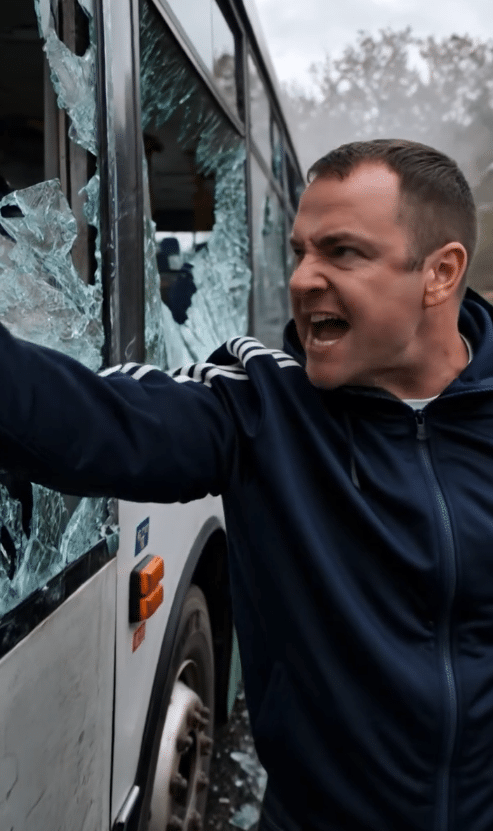
The first bandit entered the bus with a baseball bat resting across one shoulder.
He was broad, unshaven, and smiling.
Behind him came three others carrying metal pipes and hammers. Two more remained outside near the black SUV, watching the empty forest road.
The leader struck the handrail beside Viktor’s seat.
“Phones. Wallets. Jewelry.”
His voice filled the bus.
“Put everything in the aisle, and nobody gets hurt.”
Viktor kept both hands visible on the steering wheel.
The broken windshield hissed in the cold morning air. Glass fragments covered the dashboard and front steps.
The passengers did not move.
That was the first thing the bandits noticed.
There were around twenty people inside.
Several men sat alone beside the windows. Two women occupied the seats near the middle. An elderly passenger leaned against the back wall with his cap pulled low over his face.
They looked ordinary.
Cheap jackets.
Tracksuits.
Work boots.
Canvas bags.
Nothing about them suggested wealth.
Nothing suggested danger.
The leader frowned.
“Did you hear me?”
A man in a gray sweatshirt near the front looked up from his phone.
“Yes.”
“Then throw it down.”
The passenger placed the phone inside his jacket.
“No.”
The word was not loud.
It did not need to be.
The leader stared at him.
“What did you say?”
The man rested both hands on his knees.
“I said no.”
The bandit laughed and looked at his companions.
“Someone wants to be brave.”
He stepped into the aisle and raised the bat.
The passenger did not flinch.
Viktor saw the man’s shoulders shift slightly.
Not backward.
Forward.
The movement was almost invisible, but Viktor knew enough about violence to recognize preparation.
The bandit swung.
The passenger moved before the bat reached him.
One hand caught the attacker’s wrist.
The other struck just above the elbow.
There was a sharp crack as the bat fell.
The bandit barely had time to shout before the passenger turned him, drove him against the seat, and pinned him face-first to the floor.
Everything happened in less than two seconds.
The other criminals froze.
Then half the bus stood up.
The woman who had been speaking quietly near the middle pulled a plastic restraint from her coat pocket.
The man beside the terrified elderly passenger removed his glasses and folded them carefully.
Two passengers near the rear stepped into the aisle at the same time, blocking every escape route.
The old man who had appeared to be sleeping lifted his cap.
His eyes were not tired.
They were alert and cold.
He looked toward the gang leader.
“You chose the wrong bus.”
The leader backed toward the door.
Outside, one of the bandits shouted a warning.
The man in the gray sweatshirt raised his voice.
“Viktor, close it.”
The driver pressed the button.
The damaged doors folded shut behind the criminals.
And for the first time that morning, the people holding the weapons realized they were trapped inside.
Act II
Viktor had driven the route for eleven years.
He knew farmers, teachers, nurses, students, and factory workers by name.
But he did not know the people riding his bus that morning.
They boarded at different stops.
Never greeted one another.
Never sat together.
One paid with coins.
Another stared through the window.
A woman near the front complained about the cold.
They had behaved like strangers because that was the point.
The bus was part of an operation.
For four months, a gang had been attacking vehicles on rural roads outside the city.
At first, they targeted private cars.
Then delivery vans.
Then buses.
The attacks were growing more violent.
One driver suffered a fractured skull.
A teenage passenger lost hearing in one ear after being struck with a metal bar.
An elderly couple had their savings stolen while traveling to pay for their granddaughter’s surgery.
Local police arrested two suspects, but the attacks continued.
Someone always seemed to know which roads had no patrols.
Which buses carried cash.
Which drivers were likely to stop.
And exactly how long emergency response would take.
The gang had help.
The man in the gray sweatshirt was Captain Anton Sokolov of the regional organized-crime unit.
The quiet woman near the middle was Major Elena Markovic, a military investigator specializing in weapons trafficking.
The elderly man in the back was not elderly at all.
Colonel Sergei Orlov had retired from active service three years earlier, but he still trained police response teams.
The remaining passengers were officers, investigators, and two emergency medics.
Only three people on the bus were genuine civilians.
Viktor.
The frightened elderly woman.
And a young schoolteacher sitting behind her.
The operation had been planned around one assumption.
The bandits would attack again.
Investigators had leaked information that an unguarded bus would be transporting pension payments between two towns.
The rumor moved through the criminal network exactly as expected.
That morning, the officers boarded in plain clothes.
They carried no visible firearms because the plan was to force the gang into committing the attack while preserving the lives of everyone involved.
They expected intimidation.
They expected damaged glass.
They did not expect the attackers to begin swinging hammers so quickly.
When Viktor opened the door, he believed he was surrendering.
He had no idea he was giving the people behind him the only opening they needed.
The gang leader recovered from his shock first.
He swung a metal pipe toward Anton’s head.
Anton ducked.
The pipe struck the luggage rack.
Elena stepped behind the attacker, trapped his arm, and drove him to his knees.
Another bandit charged from the side.
The schoolteacher screamed and covered the elderly woman.
Sergei moved faster than anyone his apparent age should have been able to.
He caught the man’s coat, pulled him off balance, and sent him crashing into the floor between two rows of seats.
The narrow aisle destroyed the bandits’ advantage.
Their heavy weapons required space.
The officers needed almost none.
A hammer struck a seatback.
A baton clattered beneath the driver’s pedals.
Someone shouted.
Another man hit the emergency-release lever and tried forcing the rear door open.
Two officers dragged him backward before he escaped.
Within thirty seconds, four bandits were on the floor.
But the gang leader was still standing.
He seized the terrified elderly woman and pressed a jagged piece of broken glass against her neck.
Everyone stopped.
Her face turned white.
“Move,” he shouted, “and she dies.”
Anton raised his empty hands.
“Let her go.”
“Open the door.”
“No.”
The leader tightened his arm around the woman.
A thin red line appeared beneath the glass.
“Open it!”
Viktor looked toward Anton.
Anton looked toward Sergei.
No one moved.
Then the schoolteacher did something none of them expected.
She reached into her canvas bag.
The leader saw the movement.
“What are you doing?”
She slowly withdrew a small inhaler.
“She cannot breathe,” the teacher said. “You’re crushing her chest.”
The elderly woman’s breath came in short, panicked gasps.
The bandit glanced down.
That moment was enough.
The woman stamped hard on his foot.
Sergei crossed the aisle.
Anton caught the hand holding the glass.
Elena pulled the hostage free.
The leader hit the floor with three officers on top of him.
The elderly woman collapsed into the teacher’s arms.
Viktor stared at her.
“You did that on purpose?”
She nodded weakly.
“My husband taught me never to wait for permission to survive.”
The officers restrained the criminals with plastic cuffs.
Outside, the remaining bandits finally understood something had gone wrong.
One ran toward the SUV.
The other raised a shotgun.
And the bus was no longer the safest place on the road.
Act III
The shotgun blast struck the side of the bus.
Metal screamed.
The elderly woman cried out.
Viktor ducked behind the dashboard as pellets tore through the shattered front glass.
Anton pushed the nearest passengers down.
“Stay below the windows!”
The bandit outside fired again.
This time, the shot hit the front tire.
The bus shifted slightly.
Viktor looked at the road.
They were stopped near a steep embankment.
The SUV blocked the lane ahead. A drainage ditch ran along the right side. Dense trees stood on the left.
There was nowhere to drive.
The second attacker reached the SUV and pulled open the rear door.
Elena looked through a broken window.
“He’s taking something out.”
A long black case appeared.
Sergei’s expression changed.
“That isn’t robbery equipment.”
The attacker opened the case.
Inside was a military-grade launcher.
Not a large battlefield weapon.
A compact anti-vehicle system designed to destroy engines and disable armored transports.
The criminal did not handle it like an amateur.
He checked the sight.
Adjusted the tube.
Shouldered it correctly.
Sergei watched him.
“These are not just highway thieves.”
The operation had uncovered something much larger.
For months, investigators believed the gang stole from travelers for cash.
But several attacks occurred near routes used by military contractors.
One stolen van carried electronic detonators.
Another transported specialized radio equipment.
The robberies had been dismissed as coincidence because the cargo later appeared untouched.
Now the truth became clear.
The gang was using bus attacks as cover.
Robbery created noise.
Noise distracted police.
While patrols responded to frightened civilians, weapons and equipment moved through nearby forest roads.
The black SUV was not carrying random criminals.
It was escorting a shipment.
The launcher proved it.
Anton grabbed the radio hidden beneath his jacket.
“Command, operation compromised. Armed suspect outside with military hardware. Send tactical response now.”
Only static answered.
The signal was being jammed.
Viktor looked toward the hills.
“There’s an old logging road two kilometers east. No mobile coverage.”
“That’s why they chose this location,” Elena said.
The bandit outside aimed the launcher at the bus.
The passengers dropped between the seats.
Viktor studied the dashboard.
The engine still worked.
The front tire was damaged, not destroyed.
The windshield was almost gone.
The SUV remained sideways across the road.
He had driven buses through snowstorms, floods, and mountain roads where one wrong movement meant death.
He knew his vehicle’s weight.
Its turning radius.
Its braking distance.
And exactly how much force the steel frame could survive.
“Hold on,” he said.
Anton looked toward him.
“What are you doing?”
“My job.”
Viktor started the engine.
The bus shook to life.
The launcher operator adjusted his aim.
Viktor shifted into reverse.
He drove backward thirty feet.
Then stopped.
The gang leader, restrained on the floor, began laughing.
“You can’t get around the SUV.”
Viktor looked at him in the mirror.
“I’m not going around it.”
He accelerated.
The bus surged forward.
The damaged tire screamed against the asphalt.
The launcher fired.
Viktor turned the wheel at the last moment.
The projectile passed across the front of the bus and struck the embankment.
Dirt and smoke exploded into the air.
Then the bus hit the SUV.
The impact threw everyone sideways.
The smaller vehicle spun across the wet road, crashed into the ditch, and rolled onto its side.
The launcher operator barely escaped being crushed.
He dropped the weapon and ran toward the trees.
The second bandit followed.
Viktor fought the steering wheel as the bus swerved.
The right wheels left the road.
For one terrifying second, the entire vehicle leaned toward the ditch.
Passengers screamed.
Viktor turned into the slide.
The bus slammed back onto the asphalt.
The engine coughed.
Smoke rose from the front.
But they were moving.
“Go!” Anton shouted.
Viktor drove through the opening where the SUV had been.
The bus limped forward on the damaged tire.
Behind them, the restrained gang leader began laughing again.
“You think you won?”
Anton turned.
The man smiled through blood on his lip.
“That bus never reaches town.”
Then the dashboard warning lights came on.
Fuel pressure dropped.
Brake failure flashed red.
Someone had tampered with the bus before the journey began.
The gang had known which vehicle they would stop.
And that meant someone inside the transport company had helped them.
Act IV
Viktor pressed the brake pedal.
It sank almost to the floor.
The bus continued rolling downhill.
“Brakes are gone.”
Anton moved to the front.
“How long?”
“Three minutes before the steep descent.”
The old road curved repeatedly through the forest before reaching a narrow bridge.
Without brakes, the bus would gain speed.
If Viktor missed one turn, they would strike trees or fall into the ravine.
He downshifted.
The engine roared.
The speed dropped slightly.
Smoke entered through the broken windshield.
The terrified passengers remained low while officers secured the prisoners to the seat frames.
Elena searched the gang leader.
She found a radio, three phones, and an employee access card.
The card belonged to Viktor’s depot supervisor.
Mikhail Petrov.
Viktor stared at it.
Mikhail had worked beside him for twelve years.
They drank coffee every morning.
Mikhail approved vehicle maintenance.
Assigned routes.
Knew which buses carried school groups, cash couriers, or elderly passengers.
He had selected Viktor’s bus that day.
“He knew about the operation?” Viktor asked.
Anton examined the card.
“Possibly.”
The gang leader smiled.
“He knows more than you.”
Viktor’s hands tightened on the wheel.
The first sharp turn approached.
He used the transmission to reduce speed, then pulled the parking brake in controlled bursts.
The rear wheels locked.
The bus slid.
Branches scraped the windows.
Everyone leaned with the turn.
Viktor released the brake at the precise moment the tires regained traction.
They cleared the curve.
The next was worse.
Anton looked ahead.
“Can we stop before the bridge?”
“Not on the road.”
“What options?”
Viktor remembered a maintenance path near an abandoned quarry.
It climbed uphill for half a kilometer.
The surface was dirt and loose rock.
If he could turn onto it, gravity might slow them.
If the path collapsed beneath the bus, they would roll.
“It’s bad,” he said.
Anton held the rail.
“Better than no option.”
The engine temperature climbed.
Viktor approached the junction.
The path appeared between two trees, barely wider than the bus.
He turned hard.
The damaged front tire burst.
The bus dropped onto the rim.
Metal sparks shot along the ground.
The vehicle entered the quarry road and began climbing.
Speed fell.
Twenty-five kilometers per hour.
Twenty.
Fifteen.
The engine groaned.
Viktor pressed the accelerator to keep forward momentum.
The bus crawled uphill.
Then stopped.
For half a second, there was relief.
Then it began rolling backward.
“Everybody to the front!” Viktor shouted.
The officers understood immediately.
They moved forward, shifting the vehicle’s weight.
Viktor turned the wheel toward the rock wall.
The rear of the bus swung.
It struck the embankment and stopped at an angle.
Silence followed.
No one moved.
Then one of the emergency medics began checking injuries.
The elderly woman had a shallow cut at her neck.
Two officers had bruised ribs.
One restrained bandit had a broken wrist.
Everyone was alive.
Anton looked at Viktor.
“You saved this bus twice.”
Viktor stared at the cracked dashboard.
“I want to know who tried to kill it.”
They were still outside radio range.
The attackers who escaped into the forest knew their location.
The engine would not restart.
Tactical teams were coming, but they might be searching the main road.
Sergei examined the seized phones.
One contained a map.
A red marker flashed near the quarry.
Not where the bus had stopped.
Farther uphill.
Elena zoomed in.
An abandoned concrete facility stood beyond the trees.
“What is that?” she asked.
Viktor knew.
“Old civil-defense storage. Closed twenty years ago.”
The gang leader began struggling against his restraints.
Anton noticed.
“What’s inside?”
The man said nothing.
Sergei checked the phone again.
A convoy icon moved toward the facility.
Three vehicles.
Arrival in seventeen minutes.
The bus attack had never been the real operation.
It had been a diversion to pull police west.
The abandoned facility was the destination.
And whatever the convoy carried was important enough for the gang to deploy military weapons to protect it.
Anton looked around the damaged bus.
They had prisoners.
Three civilians.
Limited equipment.
No working communications.
And less than twenty minutes.
Sergei stood.
“We can wait for rescue.”
Elena looked toward the forest.
“And let the convoy disappear.”
The schoolteacher held the elderly woman’s hand.
“You are not thinking of going after them.”
Anton checked the stolen shotgun.
“No.”
Then he looked at the men and women who had boarded the bus pretending to be ordinary passengers.
“We are thinking of stopping them before anyone else gets hurt.”
Viktor picked up the depot access card.
Mikhail’s photograph stared back at him.
“I’m coming.”
“You’re a civilian,” Anton said.
“I know the facility.”
“That does not make this safe.”
Viktor looked at his ruined bus.
“They used my route. My passengers. My name.”
Then his voice hardened.
“I’m coming.”
They left four officers and a medic behind to guard the prisoners and protect the civilians.
The rest moved uphill through the trees.
At the top of the ridge, they saw the convoy arrive.
Two vans.
One armored truck.
Mikhail Petrov stepped from the lead vehicle.
And beside him stood the man who had ordered every bus attack in the region.
The deputy chief of police.
Act V
Deputy Chief Leonid Varga had appeared on television after every attack.
He promised justice.
Visited injured passengers.
Shook hands with drivers.
Blamed understaffing and difficult terrain.
All the while, he controlled the patrol routes.
He knew which units would respond.
Which roads would remain open.
Which evidence would disappear.
The bus robberies served two purposes.
They created cash for the network.
And they tested police response times for a much larger operation.
The armored truck carried stolen military guidance systems.
Small enough to hide.
Valuable enough to sell internationally.
The old civil-defense facility contained a tunnel leading to an abandoned rail spur. Once the equipment entered, it could leave the region without passing a checkpoint.
Viktor watched Mikhail unlock the facility gate.
His friend.
His supervisor.
The man who joked about retirement every morning.
Mikhail had weakened the bus brakes and marked the route for attack.
Had the undercover passengers not been aboard, Viktor and twenty civilians might have died on the mountain road after the robbery.
Anton quietly assigned positions.
They could not defeat an armed convoy in open ground.
They did not need to.
They needed to delay it.
Viktor showed them an old ventilation entrance behind the facility.
As a young driver, he had once delivered maintenance workers there.
The tunnel opened above the loading chamber.
Sergei and Elena entered through the vent.
Anton remained outside with two officers.
Viktor circled toward the generator building.
The convoy crew began unloading metal cases.
Varga stood near the armored truck, speaking into a radio.
“Road diversion successful?”
A voice answered.
“Bus escaped initial position.”
Varga’s face changed.
“Find it.”
Mikhail looked nervous.
“The brakes should have finished them.”
Viktor recorded every word on one of the seized phones.
Then he entered the generator room.
The controls were old but labeled.
He shut down the main power.
The facility went dark.
Men shouted.
Emergency lights flickered red.
Sergei dropped from the upper platform and disarmed the nearest guard.
Elena activated the internal fire doors.
Heavy steel barriers descended, separating the convoy crews.
Anton’s team opened fire only after Varga’s men fired first.
The exchange was short.
Confused.
Contained.
Mikhail ran toward the generator building.
He found Viktor waiting inside.
For a moment, neither spoke.
Mikhail looked older than he had that morning.
“Move.”
Viktor held the phone behind his back.
“You cut my brakes.”
“You were supposed to stop.”
“They had a launcher.”
“That was not the plan.”
“But you knew they would attack.”
Mikhail’s face twisted.
“I owed people money.”
“So you sold routes?”
“It began with schedules. Nobody was supposed to die.”
“Someone always says that after people die.”
Mikhail pulled a knife.
Viktor had no weapon.
He stepped backward between the generators.
Mikhail advanced.
“You should have opened the doors immediately.”
“I did.”
“Then why are they all tied up?”
Viktor looked toward the dark corridor.
“Because you chose the wrong passengers.”
Mikhail lunged.
Viktor caught his wrist with both hands.
They struck the wall.
The knife fell, skidding beneath a control panel.
Mikhail hit Viktor in the stomach.
Viktor doubled over.
Mikhail grabbed his coat and drove him against the generator.
“You think you are a hero because you drive a bus?”
Viktor looked at him.
“No.”
Then he pulled the emergency fuel-release lever.
A metal alarm clanged.
The generator automatically vented steam through the maintenance line.
A burst of hot vapor erupted between them.
Mikhail recoiled.
Viktor tackled him.
They fell onto the concrete.
Anton entered seconds later and placed Mikhail in restraints.
By then, the tactical response teams had located the damaged bus.
They followed the quarry road and reached the facility before Varga could open the rail tunnel.
The deputy chief attempted to surrender.
Then tried blaming Mikhail.
The recordings destroyed that defense.
So did the phones seized from the gang.
They contained payment records, route assignments, police radio schedules, and photographs of previous victims.
Varga, Mikhail, and fourteen others were arrested.
The stolen military systems were recovered.
The bus attackers received long prison sentences.
Several officers inside the regional department were dismissed or charged.
Viktor returned home three days later.
His wife opened the door, saw the bandage above his eye, and slapped him before pulling him into her arms.
The damaged bus remained at the depot for months.
Its windshield was shattered.
The side panels were dented.
One wheel was destroyed.
Management planned to scrap it.
Viktor asked them not to.
After the trials ended, the transport authority restored the vehicle and placed it outside the central station.
A small plaque was fixed beside the door.
It did not mention special forces.
It did not mention investigators.
It did not call anyone a hero.
It read:
THIS BUS COMPLETED ITS ROUTE.
The elderly woman returned for the dedication.
Her name was Galina.
She brought flowers for Viktor and a new inhaler for the schoolteacher who helped save her.
Anton arrived in an ordinary gray sweatshirt.
Elena stood near the back.
Sergei wore the same old cap he had used while pretending to sleep.
Viktor looked at them and laughed.
“You could have warned me.”
Anton smiled.
“You acted naturally.”
“I nearly drove us into a quarry.”
“You drove us out.”
The black SUV had seemed powerful when it blocked the empty road.
Six armed men believed a bus full of civilians would be easy prey.
They saw an aging driver.
Cheap clothes.
Tired faces.
An old woman.
They mistook calm for fear.
Silence for surrender.
Ordinary appearances for weakness.
That was their final mistake.
Because courage does not always arrive wearing a uniform.
Sometimes it sits quietly beside a window.
Sometimes it holds a frightened stranger’s hand.
Sometimes it grips a damaged steering wheel while the brakes fail.
And sometimes, when violent men force their way through a bus door expecting helpless victims, they discover too late that the nightmare waiting inside is not brutality.
It is twenty people who refuse to be afraid of them.