Act I
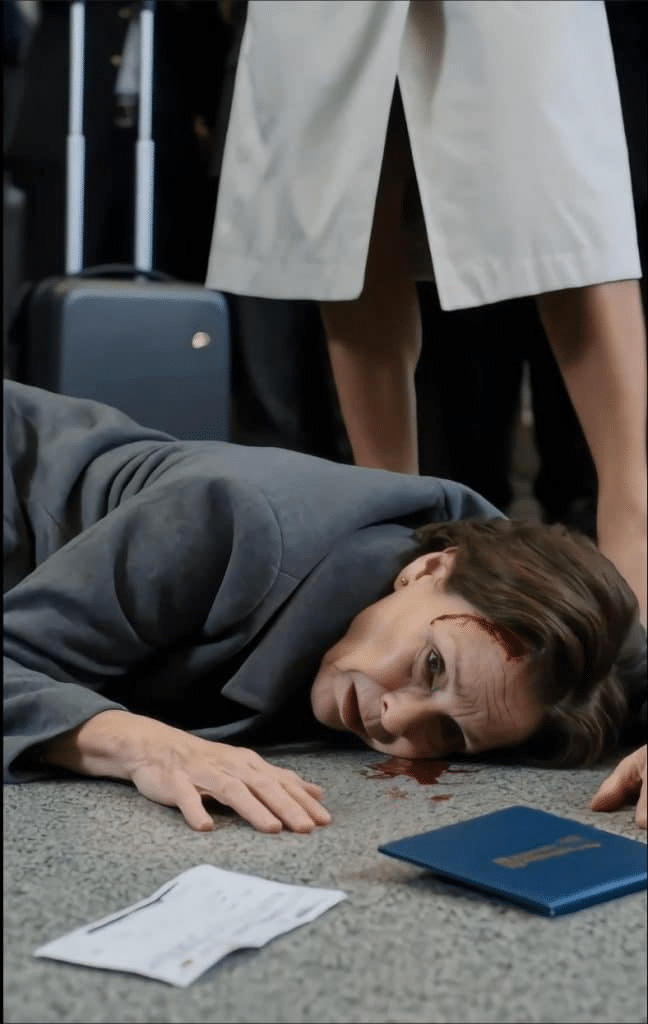
The passport hit the airport floor before the old woman did.
A polished boot struck seventy-two-year-old Evelyn Carter squarely in the back.
She pitched forward.
Her forehead and shoulder slammed into the edge of the business-class counter before her body twisted and fell onto the hard terminal floor.
Her paper ticket skidded beneath the luggage belt.
The passport opened face-down near a row of designer suitcases. Evelyn’s small rolling bag tipped over, spilling a folded sweater and a plastic pouch of medication.
For one stunned second, the international check-in hall went quiet.
Then came the gasps.
Airline staff froze behind the counters. Wealthy travelers turned from the business-class queue. A child near the flight board covered his mouth while two security officers several lanes away snapped their heads toward the impact.
Evelyn pressed one scraped palm against the floor.
A thin line of blood appeared near her forehead. Her lips trembled as she tried to breathe through the dizziness.
Standing over her was Cassandra Blake.
Forty-four years old, dressed in a white trench coat and dark sunglasses, Cassandra held the handle of a designer suitcase with one hand and a first-class boarding folder in the other.
Her face showed no fear.
Only irritation.
“Move, trash.”
The words cut through the terminal.
Evelyn lifted her head slowly.
Cassandra pointed toward the counter.
“People like you should fly last, not block business class.”
Several travelers stared in disbelief.
No one moved quickly enough.
The confrontation had begun less than two minutes earlier.
Evelyn had arrived at the airport carrying a paper ticket because she did not trust digital boarding passes. She kept her passport inside a small envelope and checked the flight number three times before joining the line.
She was not in the wrong queue.
An airline employee had personally directed her to the business-class counter.
Her ticket had been upgraded.
Evelyn did not know why.
She assumed there had been a mistake.
Cassandra arrived behind her already impatient.
Her flight to London was boarding in ninety minutes, but she behaved as though every person ahead of her had stolen something from her life.
She tapped her heel.
Checked her watch.
Then leaned around Evelyn and asked the agent to serve her first.
The agent politely refused.
“This passenger is next.”
Cassandra looked at Evelyn’s gray coat.
Her worn shoes.
The paper ticket.
Then she laughed.
“She’s clearly in the wrong line.”
Evelyn turned.
“I was told to stand here.”
“By whom?”
“The woman at the entrance.”
Cassandra removed her sunglasses.
“Then she made a mistake.”
The check-in agent began to explain that Evelyn’s reservation was valid.
Cassandra ignored her.
She grabbed the handle of Evelyn’s suitcase and pulled it aside.
Evelyn reached for it.
“Please don’t touch that.”
The word please should have ended the confrontation.
Instead, it convinced Cassandra that Evelyn was weak.
She stepped backward.
Gathered force.
And kicked her into the counter.
Now the old woman lay beneath the business-class sign while Cassandra stood above her, certain money would explain everything.
A young baggage assistant moved toward Evelyn.
Cassandra snapped at him.
“Stay out of it.”
He froze.
Evelyn saw the fear on his face.
Not fear of violence.
Fear of a complaint from an important passenger.
She reached toward her passport.
Cassandra’s shoe landed beside it.
“You should be grateful they let you fly at all.”
Evelyn looked up at her.
The pain in her face hardened into something colder.
“I have been flying longer than you have been alive.”
Before Cassandra could answer, a black airport cart cut through the terminal crowd.
Its brakes caught hard beside the check-in area.
An airline executive stepped down with the airport security chief behind him.
He saw the overturned suitcase.
Then the passport on the floor.
Then Evelyn.
His face changed.
The man crossed the terminal at a run, dropped beside the old woman, and supported her carefully into a seated position.
“Mom.”
Cassandra stopped breathing.
The executive retrieved Evelyn’s passport and slowly turned toward the crowd.
“Who kicked my mother?”
Cassandra’s lips parted.
“Your mother…?”
And the woman she had dismissed as an inconvenience was about to reveal why the airline’s oldest route existed at all.
Act II
The executive’s name was Michael Carter.
At fifty-three, he served as chief operating officer of Atlantic Crown Airlines, one of the largest international carriers in the country.
Employees recognized him instantly.
So did frequent travelers.
Michael rarely appeared at ordinary check-in counters. He spent most of his time in operations centers, boardrooms, and airport authority meetings.
But that morning, he had come personally to meet Evelyn.
She was taking her first international flight in twenty-eight years.
Michael had arranged the upgrade without telling her.
He wanted the trip to feel special.
Instead, he found her bleeding beside the counter.
“Can you see clearly?” he asked.
“Yes.”
“Any nausea?”
“No.”
“Do you know where you are?”
“At an airport where everyone is asking foolish questions.”
The airport medic almost smiled.
Michael did not.
He looked toward the blood near her forehead.
“You hit the counter.”
“The counter won.”
A medical team arrived and examined her for a possible concussion.
Michael stayed beside her.
He held her passport in one hand and the paper ticket in the other.
Only after the medic confirmed that Evelyn was conscious and stable did he stand.
Cassandra had put her sunglasses back on.
The gesture was almost absurd now.
Michael faced her.
“Did you assault my mother?”
Cassandra adjusted the collar of her coat.
“There was an unfortunate misunderstanding.”
“That was not my question.”
“She was blocking the priority counter.”
The check-in agent spoke.
“She was the next passenger.”
Cassandra turned sharply.
The agent’s voice shook, but she continued.
“Mrs. Carter had a confirmed business-class reservation.”
Cassandra looked at Michael.
“I was not informed.”
Evelyn spoke from the chair.
“You were.”
The terminal became silent again.
Michael looked toward the ceiling cameras.
“Secure all footage from this area.”
The airport security chief nodded.
Cassandra’s confidence weakened.
“There is no need to turn this into a major incident.”
Michael looked at his mother’s scraped hand.
“You made it one.”
Evelyn Carter did not come from wealth.
She grew up in a small town near an airfield where military transport planes crossed the sky every afternoon.
Her father repaired engines.
Her mother cleaned offices at night.
Evelyn left school at seventeen and began working at the airport cafeteria.
That was where she met Michael’s father, Daniel Carter.
He was a junior mechanic with grease under his fingernails and an impossible idea.
Daniel believed regional airlines treated working families as though flying belonged only to the wealthy.
He wanted to build a carrier connecting industrial towns to major cities at prices ordinary people could afford.
Banks refused him.
Investors laughed.
Evelyn did not.
She used her savings to help him lease the first aircraft.
She worked the ticket desk.
Prepared food.
Cleaned the cabin.
Balanced the books at night.
When a pilot called in sick, she drove three hours to find a replacement.
When fuel prices nearly destroyed the company, she mortgaged their home without telling her parents.
The airline survived.
Then it grew.
Atlantic Crown began with two aircraft and one route.
Michael grew up sleeping in airport offices while his parents worked.
He remembered Evelyn carrying passenger lists in one hand and him in the other.
Years later, Daniel became the public founder.
Evelyn preferred to remain out of photographs.
She said people trusted a company more when they did not see a tired woman arguing over invoices.
After Daniel died, Michael expanded the airline internationally.
Evelyn stepped away completely.
She never asked for a title.
She never accepted special treatment.
And she still carried paper tickets because the first Atlantic Crown tickets had been written by hand at her kitchen table.
Cassandra saw an old woman in a gray coat.
Michael saw the woman who helped build every counter in the terminal carrying the airline’s name.
But Evelyn’s trip involved more than nostalgia.
She was flying to London to meet a former employee who had uncovered evidence of a dangerous maintenance cover-up.
And Cassandra Blake’s husband sat on the airline board.
Act III
Michael had not known why Evelyn insisted on traveling alone.
She told him she wanted to visit an old friend.
That was partly true.
The friend was Margaret Shaw, Atlantic Crown’s first international station manager.
Margaret had retired fifteen years earlier.
Three weeks before the flight, she called Evelyn.
Her voice shook.
She said she had found archived maintenance reports connected to several long-haul aircraft.
The reports showed recurring pressure problems in a particular component used across the fleet.
Engineers recommended replacement.
Executives delayed it.
The component had not yet caused a disaster.
But two flights experienced cabin-pressure warnings that were officially blamed on sensor errors.
Margaret believed the reports were being altered.
She did not trust digital communication.
So she asked Evelyn to come.
Evelyn agreed before telling Michael.
She knew her son was already fighting the board over cost reductions.
She feared someone inside the airline would intercept the evidence.
The paper ticket, old coat, and ordinary arrival were deliberate.
She wanted to travel unnoticed.
Cassandra’s assault destroyed that plan.
When Michael picked up the passport envelope, another folded paper slipped out.
The airport security chief retrieved it.
It contained a handwritten note from Margaret.
Do not discuss the Aster valve reports with anyone on the board until you see the originals.
Michael read the sentence twice.
The Aster valve was manufactured by Blake Aeronautics.
Cassandra’s husband, Richard Blake, controlled the company.
Michael looked toward her.
She saw the name on the note.
Her face changed.
“You know what this is?” he asked.
“No.”
The answer came too quickly.
Cassandra glanced toward her phone.
Security had already asked her to keep it visible.
Michael noticed the message preview on the screen.
From Richard.
Did she board?
The terminal seemed to narrow around her.
Michael looked at Evelyn.
“Who knew you were traveling?”
“Margaret.”
“Anyone else?”
“I called the board office yesterday. I asked whether Richard Blake would be in London.”
Michael’s expression hardened.
Someone informed him.
Cassandra had not arrived behind Evelyn by chance.
She was scheduled on a later flight.
Her original reservation showed departure that evening.
It had been changed less than an hour after Evelyn called the board office.
Cassandra moved to the morning flight.
She arrived at the same counter.
She recognized Evelyn from an old company photograph.
Her impatience was real.
So was her contempt.
But beneath both was purpose.
She needed to know whether Evelyn carried evidence.
The assault began after Evelyn refused to let her touch the suitcase.
Michael looked at the security footage in the airport control room.
The camera showed Cassandra studying Evelyn before joining the line.
It showed her taking a photograph.
Sending it.
Then provoking the confrontation.
The kick was deliberate.
But the footage also captured something else.
When Evelyn fell, Cassandra looked toward the open passport envelope before looking at the injured woman.
She was searching for documents.
The airport security chief returned with phone records authorized through police.
Cassandra had sent Richard a message seconds after the assault.
She dropped everything. No file visible.
Michael stared at her.
“This was not only about the queue.”
Cassandra’s face hardened.
“You have no right to inspect private communications.”
“The police will determine that.”
She stepped backward.
“I want my attorney.”
Evelyn watched her.
“You knew who I was.”
Cassandra looked away.
That hurt differently.
The insult had not come from ignorance.
Cassandra knew Evelyn helped found the airline.
She still called her trash because she believed public humiliation would discredit anything Evelyn later claimed.
A confused elderly woman.
A disturbance at check-in.
An unfortunate accident.
The story was already prepared.
Then the airline’s maintenance director called Michael.
A technician had just been suspended for attempting to access archived Aster valve reports.
The suspension was approved by a board committee chaired by Richard Blake.
The cover-up was active.
And Evelyn’s flight to London had triggered panic at the highest level of the company.
Act IV
Police escorted Cassandra to a private airport office.
Her attorney arrived within thirty minutes.
She refused to answer questions.
The assault footage made one charge unavoidable.
The messages raised more serious concerns.
Attempted evidence interference.
Conspiracy.
Possible obstruction of an aviation safety investigation.
Michael contacted federal transportation authorities.
He did not warn the board first.
That decision would cost the airline millions.
He made it anyway.
All aircraft using the suspect component were grounded for inspection.
Flights were canceled across the network.
Passengers became angry.
News outlets gathered outside terminals.
The board called an emergency meeting and demanded that Michael reverse the order until engineers confirmed an immediate danger.
He refused.
Richard Blake joined by video.
His face remained controlled.
“You are reacting emotionally because your mother was involved.”
Michael looked toward Evelyn, who sat with a bandage near her forehead.
“My mother was assaulted.”
“That does not prove the component is defective.”
“The reports were hidden.”
“Preliminary reports are not conclusions.”
“Then why was a technician suspended for accessing them?”
Richard paused.
The board members looked at one another.
Michael continued.
“Why did your wife change flights after my mother called the board office?”
Cassandra’s attorney attempted to end the call.
Federal investigators had already entered the room.
The meeting continued under recorded supervision.
The maintenance files were pulled from multiple servers.
Versions differed.
Original engineering notes described metal fatigue.
Later reports replaced urgent language with monitor during routine service.
Signatures had been copied.
Inspection intervals were extended without approval from the engineers who designed them.
Blake Aeronautics knew replacing the valves would cost hundreds of millions.
Atlantic Crown executives feared grounding aircraft during peak travel season.
So they delayed.
No plane had crashed.
That fact had become their defense.
Evelyn listened.
Then she asked one question.
“How many chances do you need before a disaster counts?”
No one answered.
Richard Blake resigned from the board before the vote to remove him.
It did not protect him from investigation.
Cassandra was formally arrested.
As officers prepared to escort her through the terminal, she looked at Michael.
“You will destroy the airline your parents built.”
Evelyn stood slowly.
The medic tried to stop her.
She waved him away.
She looked at Cassandra.
“My husband and I did not build an airline to keep planes flying at any cost.”
Cassandra’s lips trembled.
“You don’t understand what grounding the fleet will do.”
Evelyn’s expression remained cold.
“I understand what funerals do.”
The words silenced the room.
Michael stood beside her.
Cassandra looked from him to the old woman she had kicked.
“Your mother…?”
“Yes,” Michael said.
Evelyn stepped forward.
“But you knew that.”
Cassandra lowered her eyes.
The truth was worse than a mistaken identity.
She had not attacked someone because she believed Evelyn was unimportant.
She attacked her because she knew exactly how important her evidence could become.
Police led Cassandra past the business-class counter.
Travelers watched.
Some raised phones.
Others moved aside in silence.
Evelyn’s fallen paper ticket had been recovered.
A small blood mark stained one corner.
Michael offered to print another.
She refused.
“I paid for this one.”
“You did not pay for business class.”
“I know.”
He almost smiled.
Then she looked toward the flight board.
Dozens of Atlantic Crown departures now displayed canceled.
The company’s reputation was collapsing in real time.
Yet for the first time in years, Evelyn believed it might deserve to survive.
Act V
The grounding lasted nine days.
Every aircraft using the Aster valve was inspected.
Twenty-one components showed signs of premature fatigue.
Four required immediate replacement.
Investigators concluded that continued delay could have caused serious failures.
No passengers had died.
Only because the problem was found in time.
Atlantic Crown lost hundreds of millions of dollars.
The stock price fell.
Competitors absorbed routes.
The board attempted to remove Michael for disclosing internal records without completing corporate review.
Evelyn attended the vote.
She carried the original founding agreement from the airline’s first office.
Under its terms, the Carter family trust retained emergency voting rights when passenger safety was knowingly compromised.
She activated them.
The directors involved in the cover-up were removed.
Independent safety experts replaced them.
Michael remained chief operating officer but surrendered direct authority over internal accident review.
He insisted on it.
“No executive should control the investigation of decisions made under his leadership,” he said.
The airline created an independent safety office with authority to ground aircraft without financial approval.
Engineers gained legal protection for reporting risk.
Maintenance reports could no longer be edited without preserving every version and signature.
Supplier relationships were reviewed outside the commercial division.
The technician suspended for accessing the files was reinstated with back pay.
Margaret Shaw testified from London.
She revealed that reports had been hidden for nearly four years.
She and Evelyn met by video before the hearing.
“You still planning to visit?” Margaret asked.
“When the airline can keep a schedule.”
“That may take a while.”
“I have waited longer.”
Cassandra pleaded guilty to assault and obstruction-related charges.
Her attorneys argued that she acted under pressure from her husband.
Messages showed Richard encouraged her to find out what Evelyn carried.
He did not explicitly tell her to use violence.
That choice was hers.
Cassandra received a custodial sentence, probation after release, and a permanent airport-security restriction.
Richard Blake was charged with conspiracy, falsification of safety records, and obstruction.
Blake Aeronautics lost major contracts.
The company entered restructuring and paid for fleet repairs across multiple airlines.
At sentencing, Cassandra’s attorney described her public humiliation and loss of social standing.
Evelyn listened from the back row.
When invited to speak, she carried the same gray coat over one arm.
“My forehead healed,” she said. “That is not the part of this story that frightens me.”
Cassandra looked up.
“You believed a line moved faster when the person ahead of you mattered less.”
Evelyn paused.
“Your husband believed safety moved faster when warnings mattered less.”
The courtroom remained still.
“It is the same habit. Decide someone is beneath the cost of patience.”
The judge imposed sentence.
Evelyn did not ask for revenge.
She asked that Cassandra’s actions remain part of the public record.
No private settlement.
No sealed apology.
The truth had already spent too long hidden behind privilege.
Atlantic Crown eventually recovered.
Not quickly.
Passengers remained skeptical.
Employees questioned leadership.
Michael visited maintenance hangars, check-in counters, and baggage facilities without press.
At one airport, a gate agent told him staff feared punishment for delays even when safety required caution.
He changed the policy that week.
No performance bonus could depend on avoiding safety-related delays.
At another airport, wheelchair users described being boarded last even when early boarding was promised.
Evelyn heard about it.
She called Michael.
“Fix it.”
“We are reviewing procedures.”
“Fix it.”
The procedure changed.
Evelyn became an unpaid adviser to the passenger dignity council.
She refused an office.
She attended meetings from her kitchen table.
Her recommendations were brief.
Do not make elderly passengers repeat information because staff failed to read it.
Do not treat paper tickets as proof of confusion.
Do not assume expensive luggage means importance.
Do not hide bad news until it becomes dangerous.
The council printed the rules.
Evelyn told them common sense should not require printing.
One year after the assault, she returned to the same airport.
Her London trip had been postponed repeatedly by investigations, hearings, and her own refusal to leave while the company was unstable.
This time, she traveled alone again.
Michael objected.
She ignored him.
She wore the same gray coat.
The check-in hall remained crowded.
Business-class passengers stood beneath polished signs.
Families reorganized luggage on the floor.
Announcements echoed overhead.
Evelyn joined the line.
A man behind her checked his watch.
She glanced back.
He smiled politely.
“No rush.”
The words mattered more than he knew.
At the counter, the agent scanned Evelyn’s passport.
“Mrs. Carter, you have been upgraded.”
Evelyn sighed.
“My son.”
The agent tried not to smile.
“Would you prefer economy?”
“No. I am old, not foolish.”
Her suitcase was tagged.
The agent returned the paper boarding pass.
No one hurried her.
No one questioned whether she belonged.
Before leaving, Evelyn noticed an older passenger in the next line struggling to understand a kiosk.
A staff member approached.
Not impatiently.
Not from behind a counter.
He stood beside her and explained each step.
Evelyn watched until the woman smiled.
Then she continued toward security.
Michael waited near the gate.
“You said you were traveling alone.”
“I checked in alone.”
“That is not the same.”
“It is close enough.”
He took her small suitcase.
She allowed it.
Through the windows, an Atlantic Crown aircraft waited beneath the morning light.
Every Aster valve had been replaced.
Every maintenance record had been independently reviewed.
The plane was delayed twelve minutes for an additional inspection.
No executive demanded that it depart sooner.
Evelyn looked at the delay notice.
“Good.”
Michael laughed.
Most passengers did not.
Eventually, the aircraft boarded.
Evelyn settled into her seat and placed the old paper ticket inside her passport.
Cassandra Blake had looked at a gray coat, a trembling hand, and a woman moving slowly through a business-class line and decided Evelyn should fly last.
She saw age as inconvenience.
Simplicity as inferiority.
And privilege as permission to move people out of her way.
She never understood that Evelyn had helped build the airline.
But that was not why the kick was wrong.
Evelyn deserved patience before anyone learned her son’s title.
She deserved safety before the airport cart arrived.
She deserved to stand at the counter without proving that her life had once helped create it.
An airline could divide cabins by price.
It could divide boarding groups by status.
But the moment it divided human dignity the same way, it had forgotten what flight was for.
Not to prove who belonged above everyone else.
To carry people safely from one place to another.