Act I
The basket hit the grass before Mrs. Eleanor Whitmore did.
Fresh roses, hydrangeas, and pale gardenias spilled beneath the white brunch umbrellas as the seventy-four-year-old woman stumbled beside a linen-covered table.
Her hand reached for the edge.
It missed.
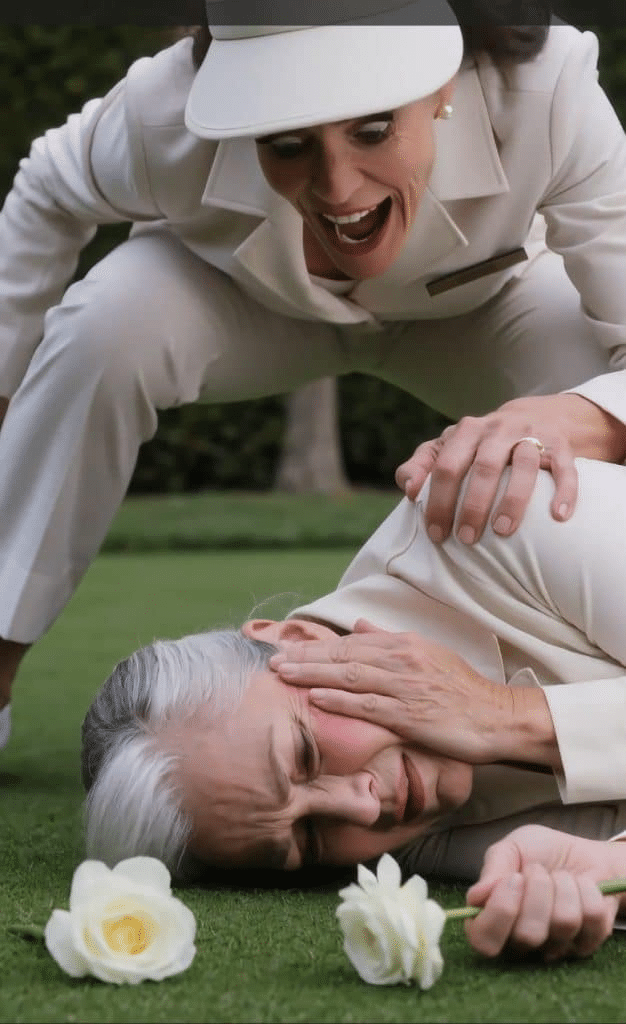
Eleanor fell onto one knee, then onto her side, crushing several flower stems beneath her sleeve. Her palm scraped against the dry ground, and a red mark spread quickly across the cheek where the slap had landed.
The country club garden went silent.
Servers froze with silver coffee pots in their hands. Golfers stopped near the edge of the lawn. Wealthy members turned away from conversations about property, travel, and summer tournaments.
At the center of it all stood Victoria Caldwell.
She wore a fitted white golf dress, a matching visor, pearl earrings, and the expression of someone who believed outrage became more legitimate when spoken by the wealthy.
Her hand remained lifted.
She had slapped Eleanor in front of everyone.
Now she looked down at the older woman with disgust.
“Move, trash,” Victoria said. “People like you work behind the hedges.”
The words carried across the garden.
Eleanor’s lips trembled, but she did not beg.
She did not answer.
She reached toward the overturned basket and carefully rescued one white rose from the grass.
That calmness irritated Victoria more than tears would have.
She stepped closer.
“I told you not to bring those through the members’ area.”
Eleanor looked up.
“I was asked to arrange them.”
“By whom?”
“The club manager.”
Victoria gave a sharp laugh.
“Of course he did.”
She turned toward the guests beneath the umbrellas.
“This is exactly what happens when staff forget boundaries.”
No one agreed.
No one challenged her either.
That silence gave Victoria confidence.
For twelve years, she had been one of Briarwood Country Club’s most visible members. Her husband’s investment firm sponsored two annual tournaments. Her name appeared on charity committees, donor walls, and private dinner lists.
She had never owned the club.
But she had spent so many years being accommodated that she no longer recognized the difference between membership and authority.
That morning, Victoria had reserved the garden’s central table for a private brunch with several potential business partners.
The garden staff had prepared everything before sunrise.
White umbrellas.
Crystal glasses.
Silver service.
Fresh flowers cut from the beds bordering the eighteenth fairway.
Then Eleanor appeared carrying another basket.
Her clothes were simple: tan gardening pants, a faded green shirt, flat shoes, and a wide-brimmed straw hat that had seen many summers.
Victoria saw the dirt beneath her fingernails.
She saw the basket.
She decided the rest.
Eleanor stepped near the brunch table to replace a wilted arrangement.
A few petals fell onto Victoria’s chair.
That was the entire offense.
Victoria demanded she use the service path behind the hedges.
Eleanor explained that the central walkway was shorter and the event was about to begin.
Victoria told her not to argue.
Eleanor said quietly, “The flowers will not survive another ten minutes in the heat.”
Victoria ripped the basket from her hands.
Then she slapped her.
Now Eleanor sat among the flowers while club members stared at their plates.
A young server moved forward.
Victoria raised one finger.
“Stay where you are.”
The girl stopped.
Eleanor noticed.
Even in pain, her expression softened toward the server.
“It’s all right,” she said.
It was not.
And someone approaching the garden in a black luxury SUV was about to make that clear.
The vehicle braked near the golf path.
The rear door opened.
A man in a navy blazer stepped out, followed by the club’s general manager.
The owner looked toward the brunch tables.
Then he saw Eleanor on the ground.
His face changed.
And the woman who had called her trash was about to discover why the garden carried the Whitmore name.
Act II
Jonathan Pierce crossed the lawn at a run.
The general manager followed close behind him, but Jonathan reached Eleanor first.
He dropped to one knee beside her.
“Mrs. Whitmore, are you hurt?”
Eleanor held the rescued rose in one hand.
“My knee is unhappy.”
Jonathan looked at the red mark on her cheek.
His expression hardened.
“What happened?”
Before she could answer, the young server stepped forward.
“That woman hit her.”
Every face turned toward Victoria.
She stiffened.
Jonathan helped Eleanor sit upright. The manager gathered the scattered flowers and placed the overturned basket beside her.
Only after making sure she could move her leg did Jonathan stand.
He looked at Victoria.
She recognized him immediately.
Everyone did.
Jonathan Pierce had purchased Briarwood Country Club four years earlier after the previous ownership group nearly drove it into bankruptcy. He restored the golf course, renovated the clubhouse, and rebuilt the club’s finances.
He also changed its culture.
At least, he believed he had.
Victoria adjusted her visor.
“Jonathan, there has been an unfortunate misunderstanding.”
He looked at Eleanor’s cheek.
“What part did I misunderstand?”
“She entered a private members’ section without permission.”
The manager shook his head.
“She had permission.”
Victoria turned toward him.
“You told her to work here?”
“I asked her to help arrange the garden flowers.”
“Why would you ask an ordinary groundskeeper to work during a donor brunch?”
The manager’s face went still.
Jonathan glanced toward Eleanor.
She closed her eyes briefly.
Not from pain.
From disappointment.
Jonathan’s voice became colder.
“Mrs. Whitmore, forgive us. This garden was named after you.”
Victoria’s mouth parted.
“Named after her?”
A murmur passed through the brunch guests.
Eleanor lowered her gaze toward the flowers.
She had never liked public recognition.
That was why many newer members did not know her face.
But Briarwood’s oldest staff remembered.
Thirty years earlier, the garden did not exist.
The land behind the clubhouse was an abandoned drainage field filled with weeds, broken irrigation pipes, and soil damaged by years of chemical runoff.
Eleanor Whitmore saw something else.
Her husband, James, served as Briarwood’s grounds director. He dreamed of creating a public botanical garden where local families, schoolchildren, and veterans could walk without paying club fees.
The board rejected the idea.
Too expensive.
Too open.
Too charitable.
James died before he could build it.
Eleanor continued alone.
She sold a lake property she inherited from her parents and donated the money to restore the land. Then she spent years working beside gardeners, students, and volunteers.
She planted the first rose bed herself.
She designed pathways wide enough for wheelchairs.
She convinced the club to open the garden to the public every Sunday afternoon.
When the project was completed, the board named it the Whitmore Garden.
Eleanor refused a statue.
She refused a portrait.
She agreed only to a small plaque near the eastern gate.
The garden became the most beloved part of the club.
Weddings were held there.
Memorials took place beneath the oak trees.
Children learned the names of flowers along the stone paths.
And every spring, Eleanor returned in ordinary clothes to help prune, plant, and arrange.
She did not consider herself an honored guest.
She considered herself a gardener.
That was all Victoria had seen.
The gardening clothes.
The dirt.
The work.
She never saw the sacrifice beneath it.
Jonathan stood between the two women.
“Did you strike her?”
Victoria glanced around at the guests.
“She refused to move.”
“That was not my question.”
Victoria swallowed.
“I touched her.”
The young server looked horrified.
“You slapped her.”
Jonathan’s gaze did not leave Victoria.
“And then?”
No one answered.
Eleanor slowly stood with the manager’s help.
She held the white rose against her chest.
Victoria looked toward her as if searching for weakness.
What she found was dignity.
But the garden’s name was not the only reason Jonathan had rushed there that morning.
Eleanor had asked him to come.
She had been investigating something inside Briarwood for months.
And Victoria Caldwell was at the center of it.
Act III
Three months earlier, one of the gardeners disappeared from the Sunday schedule.
His name was Luis Ortega.
He had worked at Briarwood for eleven years.
Eleanor noticed because Luis always trimmed the rose arches before public visiting hours. When she asked where he was, a supervisor said he had resigned.
That was not true.
Luis had been dismissed after Victoria complained that his presence near the terrace made her guests uncomfortable.
The complaint did not mention poor work.
It mentioned his accent.
His uniform.
The way his lunch smelled.
Eleanor asked for the written record.
Management delayed.
Then another worker disappeared.
A brunch server named Maya Bennett was removed from member events after refusing to let Victoria enter a staff-only kitchen.
A golf attendant lost weekend shifts after Victoria accused him of being disrespectful for asking her to return a cart before closing.
Each complaint came from the same small group of members.
Each employee was working-class.
Most were immigrants, older workers, or young people who could not risk losing a paycheck.
Jonathan knew nothing about it.
The general manager knew pieces.
But department supervisors kept resolving the complaints quietly because Victoria’s family spent heavily at the club.
Eleanor began documenting the pattern.
She spoke with workers privately.
She collected copies of schedules, complaint forms, and disciplinary notices.
That morning, she planned to present everything to Jonathan.
The flower basket carried more than roses.
Beneath the stems was a sealed folder containing twelve employee statements.
When Victoria ripped the basket away, the folder slipped beneath the brunch table.
Eleanor looked toward it now.
Victoria followed her gaze.
Something in her face changed.
She stepped toward the table.
Jonathan blocked her path.
“What are you reaching for?”
“Nothing.”
The manager bent down and retrieved the folder.
Victoria’s composure cracked.
“That is club property.”
Eleanor looked at her.
“No. Those are statements from people you tried to remove.”
The garden went quiet again.
Jonathan opened the folder.
The first report came from Luis.
He described being ordered to avoid the west terrace whenever Victoria hosted guests.
The second came from Maya.
She wrote that Victoria called her “kitchen help” and told her educated people did not argue with members.
The third came from a caddie whose family had worked at Briarwood for two generations. Victoria accused him of stealing after he found her bracelet in a golf cart and returned it.
He was suspended before security footage cleared him.
Jonathan read in silence.
Victoria crossed her arms.
“Disgruntled employees say all kinds of things.”
Eleanor’s expression tightened.
“You made them disgruntled.”
“I upheld standards.”
“What standards?”
Victoria gestured toward the white umbrellas, the elegant tables, and the manicured lawn.
“This is an elite institution.”
Jonathan closed the folder.
“It is a country club.”
“That distinction matters to people who built their lives around membership.”
Eleanor stared at her.
“My husband built this garden.”
Victoria glanced at the dirt on Eleanor’s knees.
“And yet you insist on behaving like staff.”
The sentence stunned even those who had defended her privately.
Eleanor looked down at her hands.
The hands that planted the first garden bed.
The hands that raised money.
The hands that helped workers no member bothered to learn by name.
“Yes,” she said. “I work.”
Victoria mistook the answer for shame.
It was pride.
Jonathan turned to the general manager.
“Pull every complaint filed by Mrs. Caldwell during the past five years.”
The manager hesitated.
“There are many.”
“How many?”
He checked his tablet.
“Forty-seven.”
The guests shifted.
Victoria’s face reddened.
“Most were legitimate.”
Jonathan looked through the list.
Late coffee.
Visible maintenance equipment.
Children from the public garden tour near the clubhouse.
A server with a tattoo.
A groundskeeper using the members’ restroom during a storm.
The complaints were not about safety.
They were about proximity.
Victoria wanted workers present enough to serve her and distant enough to remain invisible.
Then Jonathan reached the final file.
It was a proposal submitted by Victoria to the membership committee.
Close public garden access on Sundays.
Convert east lawn to members-only event space.
Remove the Whitmore dedication plaque during renovation.
Jonathan read it twice.
Eleanor said nothing.
Victoria lifted her chin.
“The public program attracts the wrong crowd.”
“What crowd?” Jonathan asked.
“People who do not contribute financially.”
Eleanor’s voice was quiet.
“They contribute by being alive.”
Victoria rolled her eyes.
That tiny gesture ended whatever sympathy remained in the garden.
But the proposal contained one more surprise.
Victoria had not written it alone.
Three board members had already signed.
And one of them was Jonathan’s business partner.
Act IV
The club’s board gathered in the garden before noon.
Jonathan refused to move the meeting indoors.
The white umbrellas remained open. The brunch food went untouched. Eleanor sat beneath the oak tree with an ice pack against her cheek while the board members stood before her.
Among them was Thomas Reed, Jonathan’s longtime partner.
He had helped finance the purchase of Briarwood.
His signature appeared beneath Victoria’s proposal.
Jonathan held up the document.
“Explain.”
Thomas glanced toward the members.
“The public access program is expensive.”
“So is the golf course.”
“The garden does not produce enough revenue.”
“It was not built to.”
“That is the problem.”
Eleanor looked toward him.
“No. That was the promise.”
Thomas avoided her eyes.
When the original garden agreement was signed, the club accepted Eleanor’s donation under one permanent condition:
The Whitmore Garden would remain open to the public at least one day each week.
Closing access could trigger a transfer clause.
If Briarwood violated the agreement, legal ownership of the garden land would pass to the Whitmore Community Trust.
Jonathan had forgotten the clause.
Thomas had not.
He and Victoria planned to pressure Eleanor into surrendering it.
The employee complaints were part of the strategy.
Make the public garden feel unwelcome.
Remove workers loyal to Eleanor.
Reduce visitor access.
Then claim the program was failing.
Victoria’s husband’s development company had already offered to convert the land into private villas for club members.
The garden was worth millions.
Eleanor’s folder did not merely expose classism.
It exposed a coordinated attempt to steal land entrusted to the public.
Jonathan stared at Thomas.
“You were going to sell the garden?”
“Develop it.”
“It was donated.”
“It is underused.”
On Sundays, nearly a thousand people visited during peak season.
Families picnicked.
Veterans attended horticultural therapy sessions.
Schools toured the native plant beds.
Underused was not a fact.
It was language designed to make theft sound efficient.
Victoria stepped forward.
“This club cannot survive on sentiment.”
Eleanor slowly rose.
Her knee hurt, but she refused assistance.
“Sentiment planted every tree you are standing beneath.”
Victoria’s mouth tightened.
“You do not understand modern business.”
Eleanor looked around the garden.
“I understand promises.”
Jonathan turned to the club’s legal counsel.
“Is the transfer clause enforceable?”
“Yes.”
Thomas went pale.
“If Mrs. Whitmore files notice, the club loses the eastern property.”
The brunch guests began murmuring.
Victoria looked toward Eleanor for the first time with genuine fear.
“You would destroy the club over one disagreement?”
Eleanor touched her bruised cheek.
“This is not about the slap.”
It was.
But it was also about everything that made the slap possible.
The belief that workers existed without dignity.
The belief that wealth could erase commitments.
The belief that beauty belonged more to those who admired it than those who built it.
Jonathan faced Thomas.
“You are removed from the board pending investigation.”
“You cannot do that alone.”
Four board members stepped beside Jonathan.
“We support the motion.”
Thomas stared at them.
The vote passed.
Then Jonathan looked at Victoria.
“Your membership is suspended immediately.”
Her eyes widened.
“My family has belonged here for twenty years.”
“You assaulted a guest.”
“I did not know who she was.”
Eleanor met her eyes.
“You knew I was old.”
Victoria said nothing.
“You knew I was carrying flowers.”
Silence.
“You knew I was working.”
Her shoulders dropped.
“That should have made me safer, not easier to hurt.”
Club security approached.
Victoria glanced toward the guests she had expected to impress.
No one defended her.
Her brunch partners avoided her eyes.
The young server stood beside Eleanor.
The gardeners gathered near the path.
Victoria’s authority vanished as completely as if someone had switched off a light.
She looked at Jonathan.
“This garden was really named after her?”
He stepped beside Eleanor.
“Yes.”
Victoria’s lips trembled.
“Named after her…?”
The question sounded smaller than the woman who asked it.
Security escorted her toward the clubhouse.
Her white shoes crossed the grass where Eleanor’s flowers had scattered.
But Eleanor did not file the transfer notice that day.
She gave the club thirty days.
Not to protect its reputation.
To prove the garden still deserved to remain there.
Act V
The thirty-day review changed Briarwood.
Jonathan hired an independent investigator to examine employee complaints, board decisions, and the proposed land deal.
The findings were worse than expected.
Supervisors had buried reports from workers.
Members with large accounts received informal authority over staffing.
Public garden funding had been redirected toward private tournament events.
Thomas Reed had exchanged emails with Victoria’s husband about future development profits.
Both men faced civil claims.
Thomas resigned from the ownership group.
Victoria’s husband withdrew the villa proposal after investigators began reviewing whether confidential board information had been shared with his company.
Victoria was charged with assault.
She pleaded guilty and received probation, counseling, and community service.
Eleanor made one request.
Victoria’s service would take place in a public garden.
Not the Whitmore Garden.
Somewhere she had no name, no influence, and no table reserved beneath a white umbrella.
For months, Victoria weeded public flower beds beside retirees, students, and city workers.
At first, she complained about the heat.
Then the dirt.
Then the tools.
The other volunteers ignored her status because they did not know it.
One afternoon, she worked beside an elderly woman named June who moved slowly after hip surgery.
Victoria became impatient.
Then she remembered Eleanor on the grass.
She stopped.
She carried June’s watering can.
It was a small act.
No cameras recorded it.
No membership depended on it.
Change rarely announces itself.
At Briarwood, the club adopted a new charter.
Workers gained voting representation on the operations committee.
Member complaints required evidence.
No employee could be disciplined solely because a wealthy guest demanded it.
The public garden agreement was renewed for fifty years.
Sunday access expanded.
The plaque Victoria wanted removed was restored and moved to the central entrance.
Eleanor objected.
“It was fine by the eastern gate.”
Jonathan smiled.
“No one could find it.”
“That was the idea.”
He ignored her.
The new plaque carried a brief inscription:
The Whitmore Garden was created so beauty would never belong only to those who could afford the view.
Eleanor approved that sentence reluctantly.
One year after the assault, Briarwood hosted another garden brunch.
This time, half the tables were reserved for club members.
The other half welcomed public visitors, volunteers, veterans, teachers, and families who had supported the garden.
There was no velvet rope between them.
Eleanor arrived early.
She wore the same gardening clothes.
Her silver hair was tucked beneath the same straw hat.
She carried another basket of freshly cut flowers.
A new server approached.
“Mrs. Whitmore, may I carry that for you?”
“No, thank you.”
“It looks heavy.”
“It is.”
The server smiled.
Eleanor surrendered the basket.
Together, they walked toward the central table.
Jonathan waited beneath the umbrellas.
“You are late.”
“I am four minutes early.”
“You were supposed to come as a guest.”
“I brought flowers.”
“We hired florists.”
“They arranged lilies in direct sun.”
Jonathan looked toward the tables.
“They did.”
“They should be arrested.”
He laughed.
Eleanor began moving the arrangements into shade.
No one tried to stop her.
Near the hedge, several gardeners watched with quiet amusement.
The garden was alive around them.
Children followed a guide through the butterfly beds. Veterans worked in raised planting boxes. Club members drank coffee beside families who had entered through the public gate.
The people Victoria once wanted hidden were everywhere.
And the garden was more beautiful because of it.
Eleanor reached the place where she had fallen.
For a moment, she remembered the slap.
The petals against her sleeve.
The silence of people afraid to intervene.
Then the young server placed the flower basket beside her.
“Where should these go?”
Eleanor looked toward a table occupied by groundskeepers finishing their morning shift.
“Start there.”
The server carried the flowers to them.
Jonathan stood beside Eleanor.
“You could have taken the garden away.”
“I know.”
“Why didn’t you?”
She looked across the lawn.
“Because the garden did not fail me.”
Her gaze moved toward the managers, members, and workers now sharing the same space.
“People did.”
“And now?”
“They are trying.”
For Eleanor, that mattered.
Victoria had looked at gardening clothes and seen someone who belonged behind a hedge.
She saw gray hair, dirty hands, and a basket of flowers.
She never saw the woman who turned abandoned land into a place of beauty.
She never saw the sacrifice beneath the soil.
And she never understood that the garden was not named after Mrs. Whitmore because she was wealthy or important.
It carried her name because she had spent her life making sure beauty reached people whom places like Briarwood were built to keep outside.