At first, the farmer thought he had found something unusual buried in the wet soil.
The small round eggs were clustered together, shining like tiny pearls after the morning rain. They looked too perfect to be ordinary mud, too strange to be seeds, and too delicate to be stones. From a distance, they almost resembled beads scattered across the ground.
Naturally, the discovery raised questions.
What kind of creature had left them there?
Were they dangerous?
Would something unusual hatch from them?
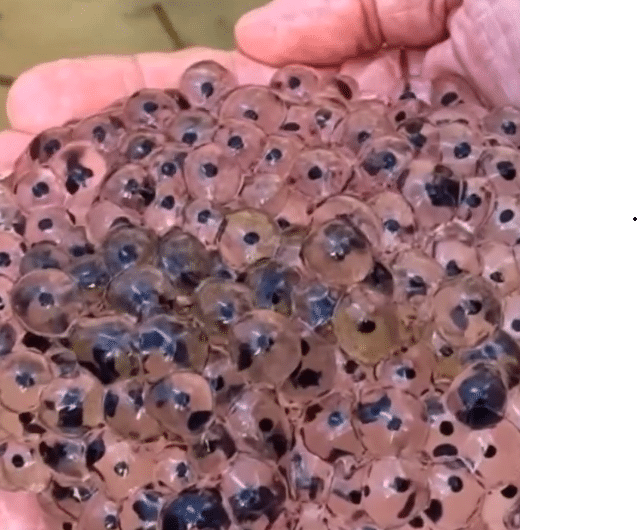
Photos of similar mysterious egg clusters often spread quickly online, with people offering wild guesses. Some call them alien eggs. Others think they might belong to snakes, insects, or fish. But in many cases, the truth is far more natural — and just as fascinating.
The strange “eggs” are often frog eggs, commonly known as frog spawn.
Because of their shiny, bead-like appearance, many people online have given them a playful nickname: frog caviar.
What are frog eggs?
Frog eggs are the earliest stage in the life cycle of a frog.
They are usually laid in water or very damp environments, often in ponds, ditches, flooded fields, marshes, or slow-moving streams. After heavy rain, frog spawn can sometimes appear in places where people do not expect it, especially if temporary pools form in low areas of a field.
Each egg is protected by a soft, clear jelly-like coating. Inside the transparent layer is a tiny dark center, which is the developing embryo.
When many eggs are laid together, they form a floating or clustered mass that looks glossy, round, and almost artificial.
That is why people often stop and stare when they find them.
They do not look like something ordinary. They look like nature’s version of tiny glass marbles.
Why people call them “frog caviar”
The nickname “frog caviar” comes from the way the eggs look.
Caviar is made of fish eggs, and it is known for its small, round, shiny appearance. Frog eggs can look visually similar because they also appear as clusters of wet, pearl-like spheres.
But frog eggs are not luxury food.
They are living amphibian embryos and an important part of freshwater ecosystems.
The nickname is mostly used online because it sounds dramatic and makes people curious. A close-up image of frog spawn can easily make viewers stop scrolling and ask, “What am I looking at?”
That curiosity is one reason these images often go viral.
Why frog eggs look so strange
Frog spawn looks unusual because of its natural design.
The clear jelly surrounding each egg acts like protection. It helps shield the developing embryo from minor damage while still allowing oxygen to pass through. The jelly also helps keep the eggs moist and grouped together.
The dark center makes each egg stand out visually, especially when sunlight shines through the outer layer. In photos, this creates a striking contrast between the black embryo and the transparent coating.
When hundreds or thousands of eggs appear together, the pattern can look almost artistic.
But the beauty is not decoration.
It is biology.
Every part of the egg structure helps protect new life during one of its most delicate stages.
What hatches from frog eggs?
After some time, depending on the frog species and environmental conditions, the eggs begin to change.
The tiny embryos develop into tadpoles.
Tadpoles are aquatic young frogs. They hatch with tails and live in water, where they feed and grow. Over time, they begin one of nature’s most remarkable transformations.
First, they grow larger.
Then their back legs develop.
Later, front legs appear.
Their tails slowly shrink.
Their bodies change shape.
Eventually, they become young frogs capable of living both in water and on land.
This transformation is called metamorphosis, and it is one of the most fascinating life cycles in the animal world.
So when someone finds frog eggs in a field or pond, they are not just looking at a strange cluster of jelly-like beads. They are looking at the beginning of a dramatic journey from egg to tadpole to frog.
Why frog eggs may appear in fields
Although people usually associate frog eggs with ponds, they can appear in fields after rain or flooding.
If a field has low spots where water collects, frogs may use those temporary pools for breeding. Wet ditches, puddles, irrigation channels, and marshy areas can also attract frogs during breeding season.
To a farmer, the eggs may seem to appear overnight.
One day, the field looks normal.
The next, there are strange clusters of transparent eggs resting in waterlogged patches of soil.
This does not usually mean anything dangerous. In fact, it may be a sign that the local environment supports amphibian life.
Frogs often depend on clean, moist habitats. Their presence can suggest that an area still has enough natural balance to support wildlife.
Why frog spawn matters to the ecosystem
Frog eggs are more than a visual curiosity.
They play an important role in nature.
Some eggs become tadpoles and eventually frogs. Others become food for fish, birds, insects, and other aquatic creatures. This makes frog spawn part of the food chain and a valuable source of energy for many animals.
Frogs themselves also help ecosystems. As adults, they eat insects, including mosquitoes and pests that can affect gardens, crops, and outdoor areas.
For farmers and homeowners, frogs can be helpful natural pest controllers.
A healthy frog population can be a good sign for wetlands, ponds, and freshwater areas. Because amphibians are sensitive to pollution and environmental changes, their presence can sometimes indicate that a habitat is functioning well.
Why these images go viral online
Frog eggs often become viral content because they create instant mystery.
Most people do not see frog spawn up close in daily life. When photographed with a macro lens, the eggs can look unreal — like pearls, bubbles, glass beads, or something from a science fiction movie.
That visual surprise makes people want to click, comment, and share.
Captions such as “farmer finds strange eggs” or “you won’t believe what hatched” add drama and curiosity. But behind the viral hook is a real natural process that is already impressive without exaggeration.
The truth is not scary.
It is fascinating.
Those strange eggs are part of a cycle that has been happening in ponds, wetlands, and fields for millions of years.
Should you touch or move frog eggs?
If you find frog eggs, it is usually best to leave them alone.
They are delicate, and moving them can damage the embryos or place them in an environment where they cannot survive. If the eggs are in a safe wet area, nature should be allowed to continue on its own.
If the eggs are in immediate danger, such as on a road or in a drying puddle, it may be best to contact a local wildlife organization for advice. Rules about handling amphibians can vary depending on location and species.
It is also a good idea to avoid using chemicals, pesticides, or pollutants near areas where frog spawn appears. Clean water is essential for healthy tadpole development.
A small discovery with a big lesson
What looked like a strange mystery in the field turned out to be something natural, delicate, and full of life.
Frog eggs may look like shiny pearls or unusual caviar, but they are actually the beginning of a remarkable transformation. Inside each tiny orb is the possibility of a tadpole, and eventually, a frog.
For the farmer, the discovery may have been surprising. For nature, it was simply another quiet miracle happening in plain sight.
Sometimes the most fascinating things are not hidden in distant places. They are sitting in a puddle, floating in a pond, or resting in a wet field after rain.
All we have to do is look closely.
Because nature does not need to be dramatic to be extraordinary.
Sometimes, it only needs a cluster of tiny eggs and enough time to hatch.


