It started as a completely normal morning.
Like many people, I headed to the kitchen planning to make a simple breakfast. I grabbed a few eggs, heated a pan, and began cracking them into a bowl.
Then I noticed something strange.
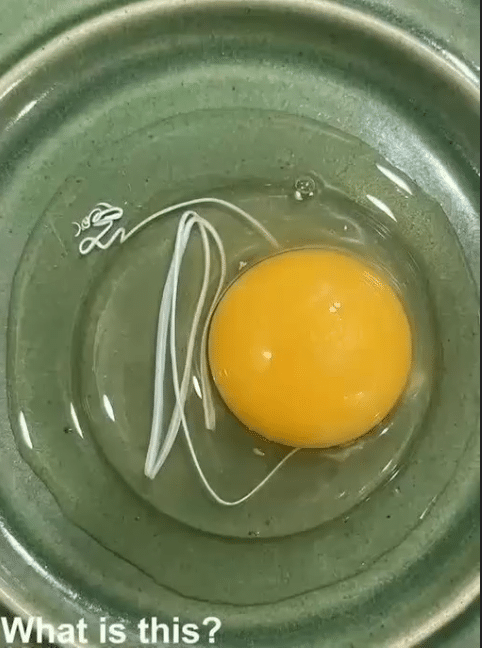
Floating beside the yolk was a white, ribbon-like strand attached to the egg.
At first glance, it looked unusual enough to make me stop what I was doing. My appetite disappeared immediately.
The more I stared at it, the more questions I had.
Was the egg spoiled?
Was it contaminated?
Could it be some kind of parasite?
When Unfamiliar Things Trigger Concern
Food safety is something most people take seriously, and for good reason.
We constantly hear stories about contaminated products, recalls, and hidden dangers in everyday foods. As a result, seeing something unexpected can quickly cause alarm.
That was exactly what happened.
Instead of continuing with breakfast, I sat at the kitchen counter examining the egg and wondering whether it was safe to eat.
A Closer Inspection Raised Even More Questions
Determined to figure out what was going on, I opened the remaining eggs from the carton one by one.
Surprisingly, none of them contained the same visible white strand.
Every other egg looked perfectly normal.
Rather than making me feel better, this only increased my curiosity.
If the eggs came from the same carton, why did only one look different?
The Search for an Answer
Eventually, curiosity overcame concern.
I started researching food safety websites, cooking resources, and discussions from experienced home cooks.
Within minutes, I discovered the answer.
The mysterious white strand had a name: the chalaza.
And it turns out that it is completely normal.
What Is the Chalaza?
The chalaza is a natural structure found inside eggs.
These white, rope-like strands are made primarily of protein and serve an important purpose during egg development.
Their job is to keep the yolk centered within the egg.
Think of them as tiny support cords that help suspend the yolk and prevent it from shifting too much inside the shell.
Without them, the yolk would move more freely and become less stable.
Why Some Eggs Show It More Clearly
Many people assume that seeing a chalaza is a sign something is wrong with the egg.
In reality, the opposite may be true.
The chalaza tends to be more visible in fresher eggs.
As eggs age, these structures gradually weaken and become less noticeable.
That means a prominent chalaza is often considered an indicator of freshness rather than spoilage.
Is It Safe to Eat?
Yes.
The chalaza is completely edible and harmless.
Many people consume it regularly without ever realizing it is there.
In cooked eggs, it usually becomes unnoticeable. Some cooks remove it for appearance reasons when preparing delicate recipes, but there is no health reason to do so.
Why So Many People Mistake It for Something Else
The chalaza is one of those food features that many people encounter without understanding.
Because it appears only occasionally—or at least only occasionally catches our attention—it can look unusual the first time someone notices it.
Its string-like appearance sometimes causes people to mistake it for:
- A parasite
- Spoiled egg material
- Foreign contamination
- An abnormal growth
Fortunately, it is none of those things.
It is simply a normal part of the egg’s internal structure.
A Good Reminder About Everyday Assumptions
This experience served as an interesting reminder about how quickly unfamiliar things can create unnecessary worry.
Sometimes, the things that look alarming at first glance turn out to be completely natural.
The white strand that initially ruined breakfast was actually evidence that the egg was functioning exactly as nature intended.
Final Thoughts
If you ever crack open an egg and discover a white ribbon-like strand attached to the yolk, there is no need to panic.
What you’re seeing is most likely the chalaza—a natural protein structure that helps keep the yolk centered inside the egg.
Far from being a sign of spoilage, it is often associated with freshness and quality.
So the next time you spot one, you can skip the worry and enjoy your breakfast with confidence.


