A giant turtle moving through the middle of town is the kind of sight that would make anyone stop walking.
Imagine looking up from your phone and seeing a huge shelled animal being carefully transported down the street on a special trailer. People gather on sidewalks. Children point. Drivers slow down. Cameras come out. For a few minutes, everyday life pauses because something ancient, rare, and almost unbelievable has appeared in public view.
That is the viral image behind the story of a so-called 350-year-old, 650-pound turtle nicknamed “Titan.”
But before presenting this as a verified news event, one important thing needs to be clear: the source material does not identify a documented animal, sanctuary, city, zoo, or official conservation program confirming that a 350-year-old turtle named Titan was transported through town. The story works best as an unverified viral wildlife tale inspired by real facts about giant tortoises, some of the longest-living animals on Earth.
Why the Story Captures So Much Attention
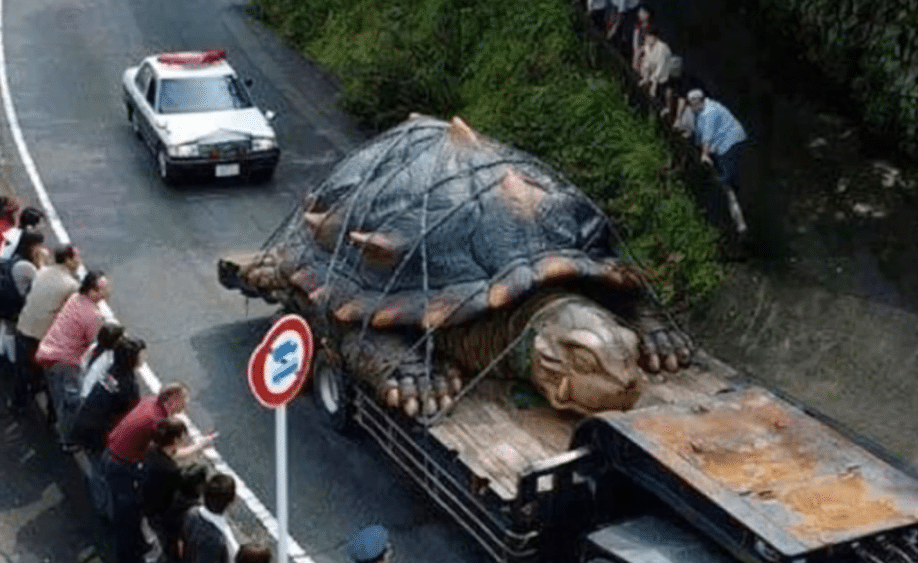
The idea is powerful because giant tortoises already feel prehistoric.
Their thick legs, heavy shells, slow movements, and calm expressions make them look like living pieces of natural history. A huge tortoise on a trailer would naturally draw a crowd, not because it is dangerous or dramatic, but because it reminds people how extraordinary the natural world can be.
The number in the viral claim—650 pounds—is not impossible for the largest giant tortoises. Galápagos giant tortoises can weigh more than 660 pounds, according to the International Fund for Animal Welfare.
Aldabra tortoises are also among the world’s largest land tortoises. The Smithsonian’s National Zoo says Aldabra tortoises can reach up to 550 pounds and live up to 150 years.
So the weight is within the range of known giant tortoises.
The age claim is where the story becomes much harder to verify.
Can a Turtle Really Be 350 Years Old?
Giant tortoises are famous for longevity, but a verified age of 350 would be extraordinary.
Guinness World Records currently identifies Jonathan, a Seychelles giant tortoise living on St. Helena, as the oldest known living terrestrial animal. Guinness lists him as 194 years old in 2026, with his age estimated from records showing he was already fully mature when he arrived on St. Helena in 1882.
That does not mean no tortoise has ever lived longer than Jonathan, but it does show why a 350-year-old claim needs strong evidence. A number that high would require reliable historical records, veterinary documentation, and confirmation from a credible institution.
Without that evidence, the safer and more honest way to tell the story is as a viral conservation-style narrative rather than confirmed news.
A Realistic Version of the Scene
Even if “Titan” is not verified, the scene itself is believable in a broader sense.
Large tortoises are sometimes transported by zoos, sanctuaries, and conservation teams. Moving one safely requires planning, strong equipment, veterinary oversight, and a calm environment. A giant tortoise cannot simply be lifted into an ordinary vehicle. Its weight, shell structure, stress levels, temperature needs, and health must all be considered.
A responsible move would involve trained handlers, a secure platform or crate, soft support, slow travel, and careful monitoring. The goal would not be spectacle. The goal would be safety.
That is what makes the viral image so compelling. People are not only looking at a huge animal. They are imagining centuries of life contained in one quiet creature.
Why Giant Tortoises Matter
Giant tortoises are more than impressive animals. They are important symbols of conservation.
Many island tortoise populations suffered because of hunting, habitat destruction, invasive species, and human expansion. Some species and subspecies disappeared entirely. Others survived only because conservationists worked for decades to protect habitats, breed tortoises responsibly, and restore wild populations.
Their slow lives make them especially vulnerable. They mature late, reproduce slowly, and depend on stable environments. When a population is damaged, recovery can take generations.
That is why public interest matters. A viral story, even an unverified one, can still open the door to a real conversation about wildlife protection, environmental education, and respect for endangered species.
A City-Wide Moment of Wonder
In the imagined version of Titan’s journey, the city becomes something rare: an open-air classroom.
Children ask how long turtles live. Adults wonder how an animal can grow so large. Teachers explain the difference between turtles and tortoises. Wildlife experts talk about habitat loss, conservation programs, and the need to protect old animals that have survived far longer than most people can imagine.
For a few minutes, the busy city slows down.
People who might normally rush past one another stand shoulder to shoulder, watching the same gentle giant pass by. There is something deeply human about that reaction. We are drawn to creatures that remind us life is bigger, older, and more mysterious than our daily routines.
Turtle or Tortoise?
The viral caption calls the animal a turtle, but a 650-pound land animal in this context would more likely be described as a giant tortoise.
In everyday language, people often use “turtle” broadly for shelled reptiles. Scientifically, tortoises are land-dwelling turtles with heavy shells and sturdy legs built for walking rather than swimming. That distinction matters because the biggest long-lived species people usually picture—Galápagos and Aldabra giants—are tortoises.
So a more accurate headline would be:
Crowds Stopped as a Massive Giant Tortoise Rolled Through Town
It may be less sensational, but it is more precise.
The Real Lesson Behind the Viral Claim
The story of “Titan” works because it taps into something people want to believe: that somewhere out there, an ancient creature has survived centuries and still moves quietly through the world.
But responsible storytelling matters.
A 350-year-old turtle should not be presented as fact without proof. At the same time, the fascination behind the story is worth preserving. Giant tortoises really are remarkable. Some live well over a century. Some weigh hundreds of pounds. Some become beloved ambassadors for their species. And many depend on conservation programs to survive in a changing world.
That truth is powerful enough.
Final Thoughts
The viral story of a 350-year-old, 650-pound turtle rolling through town may not be verified, but it still points to a real sense of wonder.
Giant tortoises are living reminders of patience, endurance, and the fragile beauty of the natural world. Whether moving through a sanctuary, being relocated by conservation experts, or simply resting in the sun, these animals deserve attention for the right reasons.
Not because of exaggerated claims.
Not because of impossible numbers.
But because they show us what long life, resilience, and careful conservation can look like.
If a giant tortoise ever did roll through town, it would stop crowds for good reason.
Sometimes nature does not need to move fast to leave everyone speechless.


