A simple store puzzle has been making people stop, think, and argue in the comments. At first, it sounds easy. A man walks into a store, steals money, uses that same money to buy something, and walks away with both goods and change.
But once people start adding the numbers, the answers quickly get confusing.
Some say the store lost $100.
Others say the store lost $130.
A few even argue the store lost $200.
So what is the correct answer?
Let’s break it down carefully.
The Puzzle
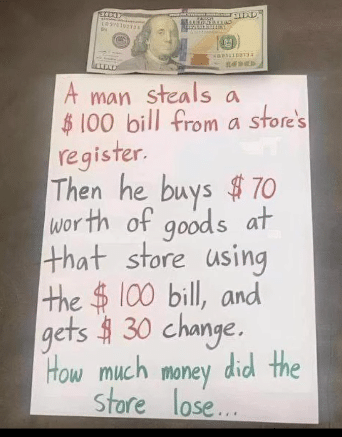
Here is the situation:
A man steals $100 from a store.
Then he returns and uses that same stolen $100 to buy $70 worth of goods.
The cashier accepts the $100 bill and gives him $30 in change.
The question is:
How much money did the store lose?
It sounds tricky because the same $100 appears more than once in the story. But that is exactly where most people get confused.
Step 1: The Initial Theft
The first thing that happens is simple.
The man steals $100 cash from the store.
At that moment, the store is down $100.
If nothing else happened, the answer would obviously be $100.
But then the man comes back and spends that same stolen money.
This is where the puzzle becomes interesting.
Step 2: The Purchase
The man uses the stolen $100 to buy $70 worth of goods.
From the cashier’s point of view, it looks like a normal transaction. The man gives the store $100, receives $70 in merchandise, and gets $30 back in change.
But there is a problem.
The $100 he handed over was already the store’s money.
He did not bring new money into the store. He simply returned the cash he had stolen earlier and used it to make the store give him more value.
So the store is not actually gaining $100 from the sale. It is just receiving back the exact money it had already lost.
Step 3: The Change
The cashier gives the man $30 in change.
That $30 is a real additional loss because the store hands over cash to the thief.
By the end of the transaction, the thief leaves with:
$70 worth of goods
$30 in cash change
Together, that equals $100.
That is the true loss.
The Correct Answer
The store lost $100 total.
That loss is made up of:
$70 in merchandise
$30 in cash
Total: $100
The stolen $100 bill is not counted twice because it returns to the store during the purchase. The store does not lose the original $100 plus the merchandise and change. Instead, the final damage is measured by what the thief walks away with.
He walks away with $70 worth of goods and $30 in cash.
That equals $100.
Why People Think the Answer Is $130
Many people answer $130 because they add the first stolen $100 to the $30 in change.
But that overlooks what happened during the transaction.
The stolen $100 came back to the store when the man used it to pay. Since the store recovered that bill, it should not be counted as an active loss at the end.
The store’s final position is not:
$100 stolen + $30 change
The store’s final position is:
The thief now has $70 in goods and $30 in cash that he did not honestly pay for.
That equals $100.
Why People Think the Answer Is $200
Some people say the store lost $200 because they count:
$100 stolen
$70 in goods
$30 in change
At first, that seems reasonable. But again, this counts the same $100 twice.
The man stole $100, but then gave that same $100 back to the store. The bill itself returned. What the store lost in the end was what it gave away after that: the merchandise and the change.
This is why the puzzle is a good lesson in basic accounting and personal finance logic. You have to track the final balance, not just every movement of money.
A Simple Way to Understand It
Imagine the store started with $100 in the cash register and $70 worth of goods on the shelf.
The thief steals the $100.
Now the store has no cash but still has the goods.
Then the thief returns and gives the $100 back to buy the goods.
Now the store has the $100 again, but gives away the $70 item and $30 change.
Final result:
The store has the same $100 bill back, but it is missing $70 in goods and $30 in cash.
Total loss: $100.
The Lesson Behind the Puzzle
This brain teaser goes viral because it plays with how people think about money.
Most of us naturally follow the story step by step, adding each number as we hear it. But accounting works differently. The important question is not how many times the money moved, but what the final loss is.
At the end, the thief gained $100 in value.
The store lost $100 in value.
That is why the correct answer is not $130 or $200.
It is $100.
Final Answer
The store lost $100 total.
The clearest breakdown is:
$70 worth of goods lost
$30 cash change lost
Together, that equals:
$100
The puzzle feels complicated because the stolen $100 is reused in the purchase. But once you follow the final value, the answer becomes clear.
The man walked away with $100 worth of value, and the store ended up losing exactly $100.


