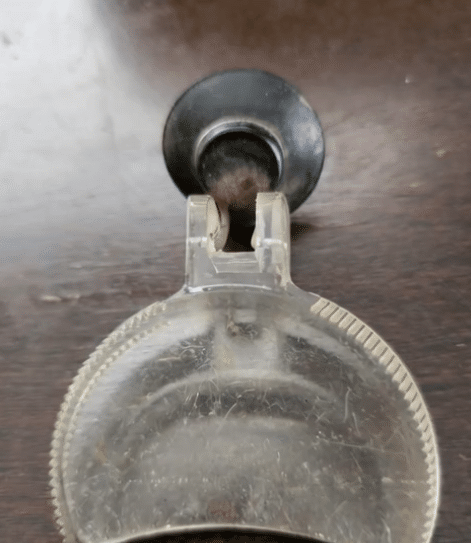
A strange chrome piece with a curved lens, a small arm, and a dash-mounted base might look like a tiny mirror, a decorative hood ornament, or part of an old radio antenna. But longtime classic-car fans may recognize it right away.
It is a traffic light viewer, also called a traffic light finder or stoplight prism.
This clever little accessory was once used by drivers of older cars, especially vehicles with low rooflines, external sun visors, chopped tops, or windshields that made it difficult to see overhead traffic signals. Instead of leaning forward awkwardly to check whether the light had changed, the driver could glance at the prism mounted on the dashboard or windshield area. The viewer reflected the traffic light into the driver’s line of sight.
Why Drivers Needed It
Modern drivers may wonder why anyone would need a special gadget just to see a red light.
The answer has to do with older car design.
Many mid-century vehicles had different windshield shapes, rooflines, and sun visor setups than today’s cars. Some classic cars also sat lower, and custom hot rods with chopped roofs made visibility even tighter. When a car stopped close to an intersection, the traffic signal could end up directly above the windshield, blocked by the roof or visor.
That meant the driver had to lean forward, duck down, or crane their neck just to see when the light turned green.
A traffic light viewer solved that problem in a simple way. The small glass or acrylic prism captured the light from above and redirected it so the driver could see the signal without changing position. Modern reproductions are still marketed for chopped classics, cars with lower sun visors, smaller windshields, and vintage-style builds.
How It Worked
The idea was simple but surprisingly smart.
The viewer used a curved or ribbed prism lens mounted in a small chrome frame. When positioned correctly, it acted almost like a tiny optical helper, bending or reflecting the view of the traffic signal down toward the driver.
Some versions mounted on the dashboard. Others attached near the windshield trim or used a magnetic base. Classic-car listings and enthusiast discussions often describe them as aftermarket or dealer-added accessories rather than standard equipment in every vehicle.
Once installed, the driver could stop at a light and watch the viewer instead of leaning forward to look past the roofline.
It was not high technology.
It did not need electricity.
It did not beep, flash, connect to a phone, or require a subscription.
It was just glass, chrome, and clever design.
A Favorite Among Classic-Car Collectors
Today, traffic light viewers are popular among people who restore vintage cars, hot rods, customs, and 1950s-inspired vehicles.
For collectors, the appeal is partly practical and partly nostalgic. The accessory looks right at home on a classic dashboard. Its polished chrome and curved lens match the era when cars were full of shiny trim, rounded forms, and mechanical gadgets that felt both useful and stylish.
Many reproductions are still sold today, often marketed for classic Chevrolets, Fords, GMC trucks, chopped coupes, and hot rods. Listings for traffic light viewers commonly describe them as dash-mounted or magnetic-base accessories that help drivers see signals blocked by the top of the car or windshield area.
That is why old-school drivers and collectors may recognize the object instantly, while younger people often have no clue what it is.
Why It Confuses People Now
The traffic light viewer is confusing because it solves a problem many modern drivers rarely think about.
Most newer vehicles have larger windshields, different seating positions, improved visibility, and interior layouts designed around modern traffic environments. While visibility problems can still happen, especially in low vehicles or modified cars, most drivers are not used to needing a separate prism to see a stoplight.
So when people find one at a flea market, in a garage drawer, or attached to an old car, they often guess wrong.
Some think it is:
A small vanity mirror
A decorative dashboard ornament
A broken radio part
A miniature spotlight
A windshield accessory with no clear purpose
A strange piece of medical or optical equipment
The real answer is much more automotive—and much cooler.
A Small Reminder of Old Driving Habits
Vintage car accessories often reveal little details about daily life in earlier decades.
Before backup cameras, lane warnings, touchscreen dashboards, and advanced driver-assistance systems, drivers relied on simple mechanical solutions. A small prism could solve a real problem. A hood ornament could help drivers judge the center of the car. Vent windows helped direct air before modern climate control became standard.
The traffic light viewer belongs to that world.
It shows how drivers adapted to the design of their cars and the roads around them. It also reflects a time when add-on accessories were a major part of car culture. Drivers customized vehicles not just for appearance, but for comfort, convenience, and everyday usability.
Is It Still Useful Today?
Yes, for certain vehicles.
A traffic light viewer can still be useful in classic cars, hot rods, chopped-top customs, and vehicles with external sun visors or limited upward visibility. Some drivers install modern reproductions because they genuinely help at intersections. Others add them mainly for period-correct style.
For an ordinary modern car, it is usually unnecessary.
But for vintage builds, it can be both functional and historically accurate.
Final Thoughts
So, what was this odd little gadget used for?
It was a traffic light viewer—a prism-style accessory that helped drivers see overhead traffic signals when the car’s roof, visor, or windshield angle blocked the direct view.
It may look strange today, but in its time, it was a practical solution to a real driving annoyance.
That is what makes vintage objects so fascinating. They remind us that every generation had its own clever tools, shortcuts, and inventions. Some disappeared because cars changed. Others survived because collectors kept them alive.
The traffic light viewer is one of those small pieces of history hiding in plain sight: a tiny chrome gadget that once saved drivers from leaning forward at every red light.


