A beach day can look calm and beautiful from the shore, but the ocean is never completely still. Beneath the surface, waves, currents, wind, tides, and underwater terrain are constantly interacting. Sometimes those forces create a pattern so unusual that it stops people in their tracks.
From above, the water may appear to form a grid.
The waves seem to cross each other at sharp angles, creating a checkerboard pattern across the surface. Many people online call them “square waves,” while the more accurate ocean term is cross sea.
The sight can be mesmerizing.
But it can also be a warning that the water is behaving in a complex and unpredictable way.
What Are Square Waves?
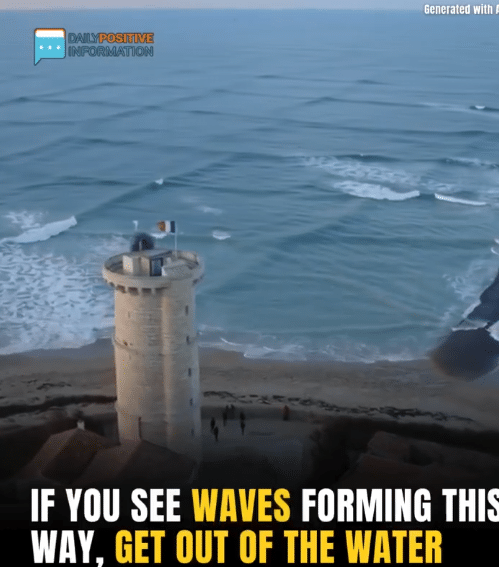
Square waves happen when two wave systems move through the same area from different directions.
Instead of one set of waves rolling toward shore in a regular pattern, another set intersects it. When those wave trains meet at an angle, the surface may form a grid-like pattern that looks almost artificial.
The Guardian’s weather column describes this as a cross sea, which can occur when waves from different weather systems meet each other, sometimes nearly at right angles. The same source notes that the famous checkerboard pattern has been seen near Île de Ré in France, where tourists often view it from above.
That elevated viewpoint is important. From a cliff, lighthouse, drone, or balcony, the pattern is much easier to see. From inside the water, however, a swimmer may experience it only as confusing, choppy movement coming from more than one direction.
Why People Warn Swimmers to Leave the Water
The viral warning—“Get out of the water right now!”—is dramatic, but it comes from a real safety instinct.
When waves approach from multiple directions, the water can become harder to read. A swimmer may find it more difficult to keep balance, face the waves, or understand which way the water is moving.
For small boats, kayaks, paddleboards, and personal watercraft, crossing wave patterns can also make the surface unstable. Waves hitting from different angles may cause rolling, swamping, or loss of control, especially when the waves are large or conditions are worsening.
Research into crossing sea states has examined their connection to extreme waves and maritime risk, including analysis of the tanker Prestige accident, where two wave systems were found crossing at nearly a right angle.
That does not mean every small square-wave pattern near shore is instantly deadly. Some viral posts exaggerate the danger. The Guardian specifically notes that online warnings about square waves can be misleading and that the biggest concern is large cross waves out at sea, especially for vessels.
Still, for ordinary beachgoers, the safest rule is simple: unusual water deserves caution.
Beautiful Does Not Always Mean Safe
The most dangerous part of square waves is that they can look strangely orderly.
People often associate danger with chaos—huge breakers, dark storm clouds, or rough surf. A grid pattern may look calm, geometric, and almost peaceful.
But the pattern exists because different wave energies are colliding.
Even if the surface does not look violent, the water may be moving in ways that are difficult to predict. A swimmer who expects waves from one direction may suddenly be hit from another.
That can lead to disorientation, fatigue, and panic.
The ocean does not need to look terrifying to become dangerous.
Square Waves Are Not the Same as Rip Currents
Square waves and rip currents are different phenomena, but both are reminders to pay attention before entering the ocean.
A rip current is a strong, narrow flow of water moving away from shore through the surf zone. The National Weather Service describes rip currents as seaward flows that can occur on almost any beach with breaking waves.
Rip currents may appear as darker gaps between breaking waves, choppy rippled water, or lines of foam and sand moving away from shore. They can also form near piers, jetties, groins, sandbars, and other coastal features.
The National Weather Service says rip currents kill more than 100 beachgoers in the United States each year and recommends swimming at beaches with lifeguards whenever possible.
So while square waves get attention because of their strange appearance, rip currents remain one of the most serious everyday hazards for swimmers.
What to Do If You See a Grid Pattern on the Water
If you notice square waves or a crisscross pattern forming, the best decision is to stay on shore.
Do not swim out to investigate.
Do not paddle into the pattern for a closer look.
Do not assume the water is safe because the waves appear small from a distance.
Instead, observe from a safe place and check for posted warnings. If lifeguards are present, ask them about current conditions. If red flags or beach hazard warnings are posted, follow them.
Square waves are best treated as a natural spectacle to watch, not a condition to test.
Other Signs You Should Stay Out of the Water
Before entering the ocean, take a few minutes to look carefully at the water.
Warning signs include waves coming from multiple directions, unusual crisscross surface patterns, fast-moving foam lines, darker channels between breaking waves, rough or choppy water, sudden weather changes, and lifeguard warnings.
The National Weather Service advises swimmers caught in a rip current not to fight directly against it. Instead, stay calm, swim in a direction following the shoreline, then return toward the beach when free of the current.
That advice applies specifically to rip currents, not every ocean hazard. But the broader lesson is the same: panic wastes energy, and understanding water movement can save lives.
Beach Safety Is About Respect, Not Fear
The goal is not to make people afraid of the ocean.
Beaches are places of beauty, relaxation, and recreation. Millions of people swim, surf, paddle, and boat safely every year.
But safe beach days depend on awareness.
The ocean changes quickly. Wind can shift. A swell can build. Tides can rise. Currents can strengthen. Water that looked harmless an hour earlier may become unsafe later in the day.
Square waves are a perfect example of how nature can look beautiful and complicated at the same time.
They are not a mythical sea monster.
They are not always an automatic death sentence.
But they are a sign that different wave systems are interacting, and that is enough reason to be cautious.
The Simple Rule
When the water looks unusual, stay out.
Watch from shore. Take photos from a safe distance. Ask a lifeguard. Check local surf and weather reports. Keep children away from the shoreline when conditions are changing.
The smartest beachgoers are not the ones who ignore warnings.
They are the ones who understand that the ocean does not need to prove its power.
If you ever see the sea forming a strange checkerboard pattern, admire it from land and wait for calmer conditions before swimming.
Sometimes the safest choice is also the simplest one:
Get out of the water and enjoy the view from shore.


