Look up at a power line almost anywhere in the world, and chances are you’ll spot birds calmly perched on the wires.
For many people, it raises an obvious question.
How can a tiny bird sit on a line carrying thousands of volts of electricity without being electrocuted?
After all, those same power lines deliver enough energy to power homes, businesses, and entire communities. Yet birds seem completely unaffected.
The answer lies in a fundamental principle of electrical science—one that explains not only why birds survive but also why electricity can be so dangerous under different circumstances.
Electricity Doesn’t Flow Just Because You Touch a Wire
One of the biggest misconceptions about electricity is that touching a live wire automatically results in an electric shock.
In reality, electricity requires more than simple contact.
For electric current to flow, there must be a complete path between two points that have different electrical potentials, commonly known as voltage.
Think of electricity like water flowing through a pipe. Water only moves when there is a difference in pressure. Similarly, electric current only moves when there is a difference in voltage.
Without that difference, there is little or no current flow.
And current—not voltage alone—is what causes electrical injury.
Why Birds Stay Safe
When a bird lands on a single power line, both of its feet are touching the same conductor.
Because both feet are at essentially the same electrical potential, there is almost no voltage difference across the bird’s body.
As a result, virtually no electric current flows through the bird.
No current means no shock.
The bird simply becomes part of the wire’s electrical environment without creating a pathway for electricity to travel through its body.
This is why birds can sit comfortably on energized lines for extended periods without harm.
When a Bird Can Be Electrocuted
Birds are not immune to electricity.
They can still be electrocuted if they accidentally create a connection between two points that have different voltages.
This can happen in several ways:
- Touching two power lines at the same time
- Touching a live wire and a grounded metal structure simultaneously
- Spreading their wings and contacting another energized conductor
- Landing in areas where electrical equipment creates multiple points of contact
In these situations, electricity suddenly has a pathway through the bird’s body.
Once current begins flowing from one voltage level to another, the risk becomes serious.
Large birds are particularly vulnerable because their wingspans can sometimes reach multiple wires or nearby grounded equipment.
What About Humans Hanging From a Power Line?
This question often sparks intense curiosity.
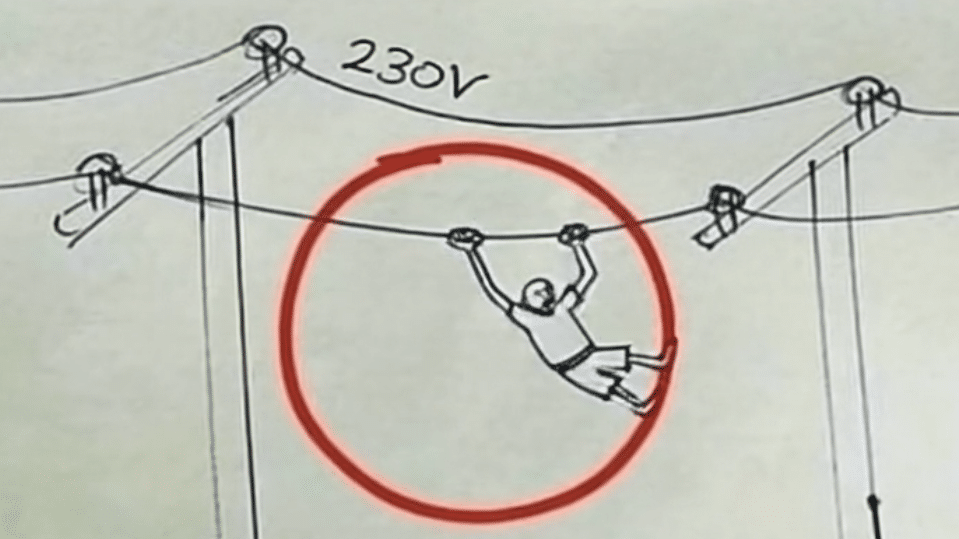
If a person somehow grabbed a single energized wire with both hands and avoided touching anything else, would they be shocked?
From a purely theoretical standpoint, the answer may seem surprising.
If the person touched only one conductor and remained completely isolated from the ground, nearby structures, and other voltage sources, very little current would flow through their body.
The situation would resemble the bird perched on a single wire.
However, this theoretical scenario does not make the situation safe.
Why Real Power Lines Are Extremely Dangerous
Real-world electrical systems are far more complex than textbook examples.
Power lines carry enormous amounts of energy, and many factors can create life-threatening hazards.
A person near a high-voltage line could:
- Accidentally contact another conductor
- Swing into a utility pole or grounded structure
- Encounter electrical arcs that jump through the air
- Experience unexpected voltage differences
- Be exposed to powerful electromagnetic fields
High-voltage electricity can sometimes travel through the air without direct contact. This phenomenon, known as electrical arcing, becomes more likely as voltage levels increase.
Because of this, simply getting too close to certain transmission lines can be dangerous.
How Utility Workers Stay Safe
Professional line workers occasionally perform maintenance on energized power systems, but they do so using highly specialized techniques and equipment.
These workers undergo extensive training and follow strict safety protocols designed to minimize risk.
Protective gear, insulated equipment, specialized vehicles, and carefully planned procedures all help prevent accidental contact with dangerous voltage differences.
Even with these precautions, working around high-voltage electricity remains one of the most demanding and carefully controlled jobs in the utility industry.
The Real Secret: Voltage Difference
The key lesson is surprisingly simple.
The danger is not merely touching electricity.
The danger occurs when electricity can travel through your body between two points that have different voltages.
Birds usually remain safe because both feet touch the same wire, meaning there is almost no voltage difference across their bodies.
Without that voltage difference, there is no significant current flow.
And without current flow, there is no electric shock.
A Real-Life Physics Lesson Happening Every Day
Every bird perched on a power line is demonstrating a basic law of electrical science.
What appears to be a mystery is actually a perfect example of how electrical circuits work.
The birds are not protected by special feathers, unique biology, or immunity to electricity.
They simply avoid becoming part of a complete circuit.
That small detail makes all the difference.
Conclusion
The next time you see birds sitting comfortably on power lines, you’ll know the science behind the phenomenon.
Electricity requires a complete path and a voltage difference to flow. Because birds typically touch only a single wire, there is almost no voltage difference across their bodies, preventing dangerous current from passing through them.
It’s a fascinating reminder that some of nature’s most puzzling sights can often be explained by simple scientific principles.
And in this case, the secret isn’t that birds can withstand electricity—it’s that they avoid giving electricity a reason to flow through them at all.