A series of strange photos recently went viral online after viewers became convinced they were looking at several angry snakes hiding in a tree.
At first glance, the image appeared genuinely terrifying.
The unusual shapes hanging from the branches seemed to resemble snake heads staring directly outward, complete with curved markings and intimidating patterns that looked almost too realistic to be accidental. Many social media users admitted the image startled them immediately, with some saying they had to zoom in several times before realizing what they were actually seeing.
But the shocking truth turned out to be something far more fascinating than dangerous reptiles.
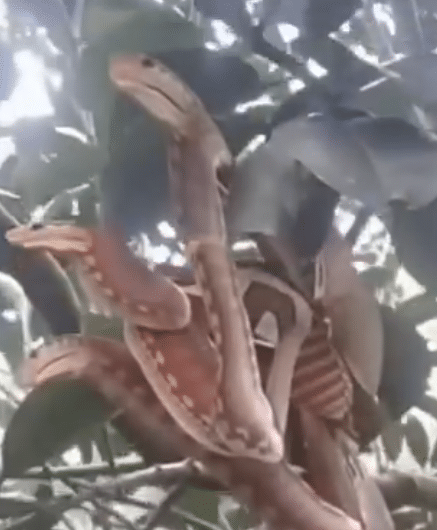
The mysterious “snakes” were not snakes at all — they were the wings of the incredible Atlas moth, one of the largest and most unusual moth species in the world.
Native primarily to forests across Asia, the Atlas moth is famous for its enormous size and one of nature’s most impressive camouflage defenses. The outer tips of its wings are designed in a way that remarkably resembles the head of a snake, helping frighten away predators in the wild.
Experts explain that this extraordinary illusion is a survival mechanism developed through evolution.
When threatened, the moth can move its wings in ways that make the snake-like patterns appear even more convincing. Predators that might normally attack a harmless insect can instead become hesitant, believing they are facing a dangerous reptile.
Many online viewers were stunned after learning the truth behind the viral image.
One user commented, “That disguise is unbelievably realistic,” while others admitted they initially thought the image showed multiple cobras hidden among tree branches.
The Atlas moth, scientifically known as Attacus atlas, is considered one of the largest moth species on Earth. Some individuals can reach wingspans of nearly 24 centimeters (around 9.5 inches), making them dramatically larger than most moths people commonly encounter.
Because of their enormous wings and unusual markings, Atlas moths have fascinated scientists, photographers, and insect enthusiasts for decades.
Wildlife experts note that the moth’s massive wings are not just visually impressive — they also help create the illusion that tricks predators into keeping their distance.
Interestingly, adult Atlas moths live very short lives.
After emerging from their cocoons, they survive for only about one to two weeks. During that time, their primary goal is reproduction. In fact, adult Atlas moths do not even eat because they lack fully developed mouths.
Instead, they survive entirely on energy stored during their caterpillar stage.
Despite being native to Asia, rare sightings of Atlas moths have occasionally been reported in parts of Europe and the United States, often after accidental transportation through international trade or insect collections.
Entomologists frequently describe the species as one of the most astonishing insects people can encounter in nature due to its size, appearance, and unique defensive adaptations.
The viral photos also sparked broader conversations online about how little many people know about the incredible camouflage techniques used throughout the animal kingdom.
From insects that resemble leaves to butterflies with eye-like markings and moths that imitate snakes, nature continues to produce survival strategies that appear almost unbelievable.
For many viewers, the Atlas moth served as a reminder that appearances in nature can be deeply misleading.
What first looked like a terrifying group of snakes hiding in a tree turned out to be one of the world’s most fascinating insects — a harmless creature using illusion and mimicry to survive.
And judging by the millions of shocked reactions online, its disguise is working perfectly.


