Most people barely notice a $2 bill when they see one.
Maybe you’ve received one in a birthday card, found one tucked in an old drawer, or kept one in your wallet as a lucky charm. For decades, the $2 bill has been treated like an odd piece of currency that almost never appears in everyday life.
But collectors know something many people don’t:
Certain $2 bills can actually be worth hundreds — or even thousands — of dollars.
And surprisingly, age alone is not what determines value.
Small details like serial numbers, seal colors, condition, and printing year can completely change what a bill is worth on the collector market.
Why the $2 Bill Was Once Considered Strange
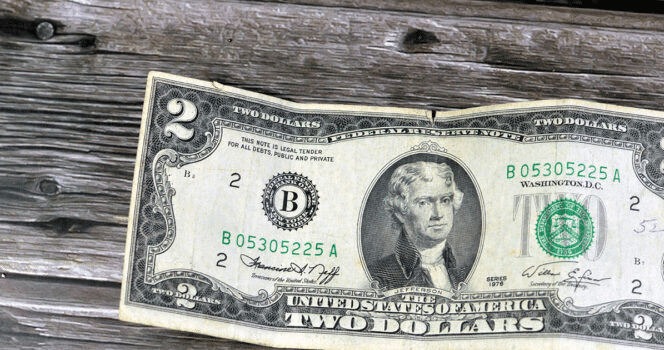
The history of the $2 bill dates all the way back to 1862.
Despite being official U.S. currency for more than a century, the bill never became as popular as other denominations.
In fact, it developed a reputation for being unusual or even unlucky.
Old superstitions connected the bill to gambling, betting, and bad luck. Some gamblers reportedly tore corners off the bills in an attempt to “break the curse.”
Over time, many people simply stopped using them regularly.
By the early 1900s, newspapers often described the $2 bill as one of the least circulated forms of American currency.
Ironically, that lack of popularity eventually made many older versions far more collectible.
Yes — The Government Still Prints $2 Bills
One of the biggest myths surrounding $2 bills is that they are no longer printed.
That is completely false.
The United States still produces $2 bills today, although far fewer are printed compared to other denominations.
Experts estimate there are roughly 1.6 billion $2 bills currently in circulation.
While that sounds like a large number, it is tiny compared to the more than 14 billion $1 bills circulating across the country.
Because people rarely spend or encounter them, many assume they are rare — and in some cases, certain versions truly are.
The Face of the Famous “Deuce”
Many people associate the $2 bill with Thomas Jefferson, whose portrait has appeared on the bill since 1869.
However, the very first version of the $2 bill actually featured Alexander Hamilton before the design changed.
The reverse side of the bill has also evolved over time.
Originally, it displayed Jefferson’s Monticello estate. But in 1976, the design was updated to feature a depiction of the signing of the Declaration of Independence — one of the bill’s most recognizable modern features.
That redesign added historical significance and renewed collector interest.
What Makes a $2 Bill Valuable?
Not every $2 bill is valuable, but certain features can dramatically increase collector demand.
Experts recommend checking several key details carefully.
1. Year of Issue
Older bills are generally worth more.
Bills printed between 1862 and the late 1800s are often highly collectible and can command significant prices depending on rarity and condition.
2. Seal Color
Most modern bills feature green seals.
However, older bills with unusual seal colors are often more desirable to collectors.
These include:
- Red seals
- Blue seals
- Brown seals
Rare seal variations can greatly increase value.
3. Condition Matters
Like coins, paper currency becomes more valuable when it remains crisp and undamaged.
Collectors pay the highest prices for bills considered “uncirculated” or close to mint condition.
A heavily worn bill may still hold value, but condition often makes a huge difference in pricing.
4. Serial Numbers Can Be Extremely Important
One of the most overlooked details is the serial number.
Collectors often search for:
- Repeating digits
- Low serial numbers
- Palindromes
- Sequential patterns
- “Star notes”
Bills with unusual serial numbers sometimes sell for far more than standard versions.
Valuable $2 Bills Collectors Love
Some specific types of $2 bills are especially popular among collectors.
Red Seal Bills (1928, 1953, 1963)
These are among the most recognizable collectible versions.
Depending on condition, they can range from roughly $10 to several hundred dollars.
Blue Seal Bills
Older blue seal notes are harder to find and often much more valuable.
Even average-condition versions may sell for hundreds.
Brown Seal National Currency Notes
These are considered extremely rare.
Collectors say some brown seal notes from the 1800s can be worth thousands of dollars depending on rarity and preservation.
Star Notes
If your bill has a small star symbol near the serial number, it may be a replacement note.
These are highly sought after because fewer were printed.
How to Check Whether Your $2 Bill Is Valuable
Experts recommend several ways to evaluate collectible currency safely.
Research Online Auction Prices
Websites like eBay and currency auction platforms often show completed sales for collectible bills.
Checking actual sold prices — not just listing prices — provides a more realistic estimate of value.
Visit a Professional Currency Dealer
Certified currency experts can inspect:
- Printing year
- Serial number
- Seal type
- Condition
- Rarity
Professional appraisals are especially important for potentially rare notes.
Attend Collector Events
Coin and currency expos are popular places where collectors buy, sell, and evaluate rare bills.
These events also help beginners learn how grading and valuation work.
Experts caution collectors to avoid rushing into sales before researching market value thoroughly.
Why the $2 Bill Is Suddenly Popular Again
Over the past several years, the $2 bill has experienced an unexpected comeback in popularity.
What was once considered strange or unlucky is now often viewed as:
- A collector item
- A conversation piece
- A novelty gift
- A lucky keepsake
- A piece of American history
Some people frame them, save them for special occasions, or pass them down through families.
Collectors say the bill’s unusual reputation is actually part of what makes it so appealing today.
That Small Bill Might Be Hiding Big Value
In an era dominated by digital payments, the idea that a small piece of paper currency could still surprise people financially feels almost unbelievable.
Yet experts say rare $2 bills continue attracting strong collector demand because of their history, rarity, and unique designs.
So before spending that old $2 bill sitting in your drawer, experts recommend taking a closer look.
Because under the right conditions, that forgotten piece of currency could be worth far more than just two dollars.


