In the center of London’s Trafalgar Square, where monuments traditionally honor military commanders and national leaders, a striking white marble sculpture once rose above the crowds.
It portrayed a pregnant woman sitting upright, her head held high. She had no arms and shortened legs, yet the sculpture did not present her as helpless. It portrayed confidence, dignity, and expectation.
The woman was Alison Lapper, a British artist born with phocomelia, a condition affecting the development of the limbs.
By the time the sculpture appeared in 2005, Alison had already spent decades confronting narrow assumptions about disability. She had become an accomplished artist, earned a first-class university degree, built an independent home, and welcomed a son.
The monument introduced her to millions, but Alison was never simply someone else’s artistic subject. She had already created a significant body of work based on identity, representation, and the human form.
A Childhood Defined by Other People’s Expectations
Alison Lapper was born in Burton upon Trent, England, on April 7, 1965. She entered the world without arms and with shortened legs.
At the time, many children with significant physical differences were separated from ordinary family and community settings. Alison was placed in institutional care when she was still an infant and spent much of her childhood among other children with disabilities.
Medical professionals initially approached her body as something that needed correction. She was fitted with artificial limbs, but they were uncomfortable and did not give her the freedom others assumed they would provide.
Eventually, Alison rejected the idea that she needed to imitate a conventional body to live successfully. She learned to perform daily tasks in ways that worked naturally for her.
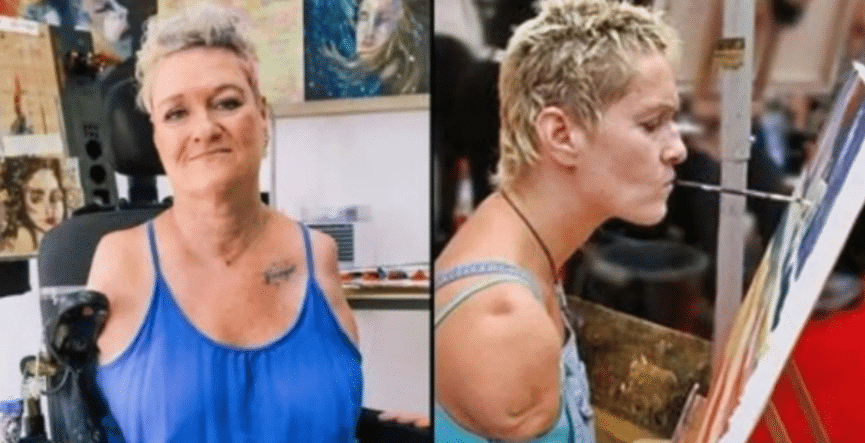
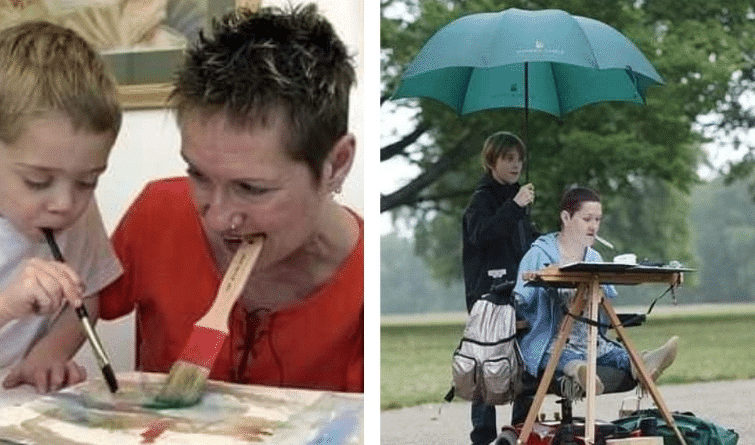
As a small child, she discovered that she could draw using her feet. Later, she learned to hold a brush in her mouth. Art became much more than an activity. It gave her a language through which she could examine her experiences and assert control over how the world saw her.
While adults often spoke about everything she might never accomplish, Alison concentrated on what she could create.
Art Became Her Path Toward Independence
Alison knew from an early age that she wanted to become an artist. That ambition required patience because education and professional spaces were not always designed with disabled students in mind.
She completed preparatory art courses before studying at the University of Brighton. In 1994, she graduated with first-class honors in Fine Art.
The achievement mattered not because it made Alison exceptional for a disabled woman, but because it recognized the quality and seriousness of her work.
Her art frequently explored the body, identity, motherhood, and society’s habit of judging people by appearance. She worked with painting, photography, digital imagery, and other visual forms.
Rather than hiding her physical difference, she often placed it at the center of her work. In doing so, she challenged an art tradition that had celebrated only a limited range of bodies.
Alison also became associated with the Mouth and Foot Painting Artists organization. Holding a brush in her mouth required exceptional control, yet she did not want audiences to value her paintings merely because of her technique. The meaning of the finished work remained more important than the method used to produce it.
Choosing Motherhood Despite Widespread Doubt
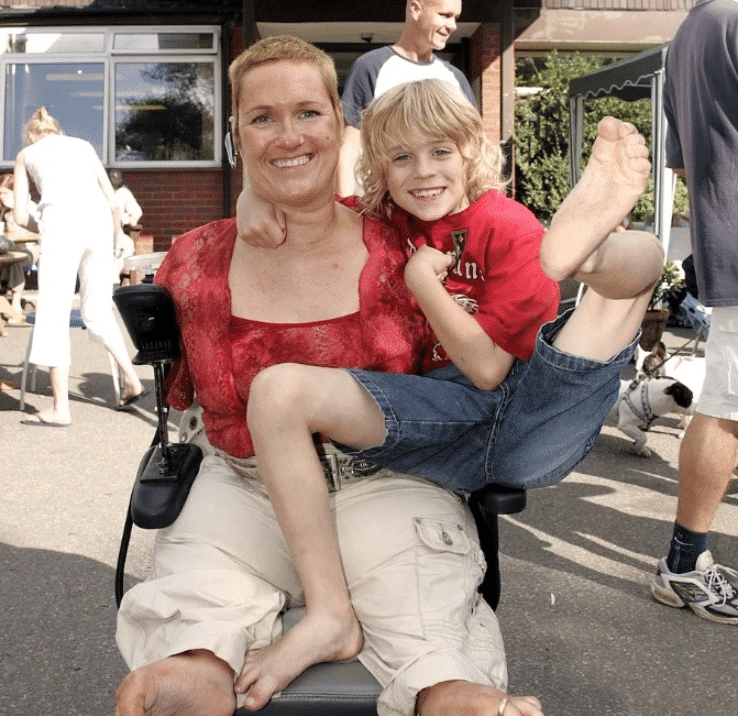
Throughout Alison’s younger years, people repeatedly told her that she would never become a mother.
Some questioned whether she could manage pregnancy. Others assumed she would be unable to care for a child without arms. Their doubts reflected a familiar social pattern: focusing on a disabled person’s body while overlooking intelligence, adaptability, preparation, and determination.
Alison refused to let those assumptions make the decision for her.
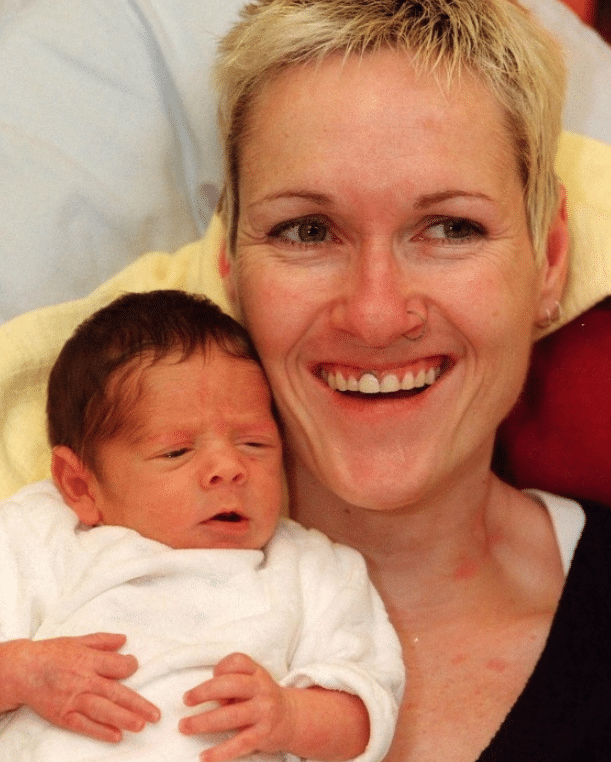
She became pregnant in the late 1990s and chose to continue the pregnancy even though she knew she would largely raise her child independently. In 1999, she welcomed her son, Parys.
Motherhood required Alison to develop practical methods suited to her body. She learned how to feed, comfort, dress, and care for her baby through adaptation and carefully planned routines.
Every parent finds individual ways to understand a child’s needs. Alison’s methods looked different, but the essential qualities were familiar: patience, responsibility, attentiveness, and love.
Her relationship with Parys later appeared in the BBC documentary series Child of Our Time, which followed a group of children born around the beginning of the new millennium.
The program allowed audiences to see Alison as a real parent navigating ordinary concerns, rather than as a distant symbol.
The Sculpture That Changed Trafalgar Square
While Alison was eight months pregnant, sculptor Marc Quinn invited her to pose for a portrait sculpture.
The finished work, titled Alison Lapper Pregnant, was carved from white Carrara marble. Standing more than eleven feet tall and weighing approximately 13 tons, it portrayed Alison without disguising or altering her body.
In September 2005, the sculpture was placed on the Fourth Plinth in Trafalgar Square.
The location gave the work extraordinary significance. Other monuments around the square depicted powerful men associated with politics, the military, and Britain’s imperial past. Suddenly, a contemporary disabled woman and expectant mother occupied the same monumental space.
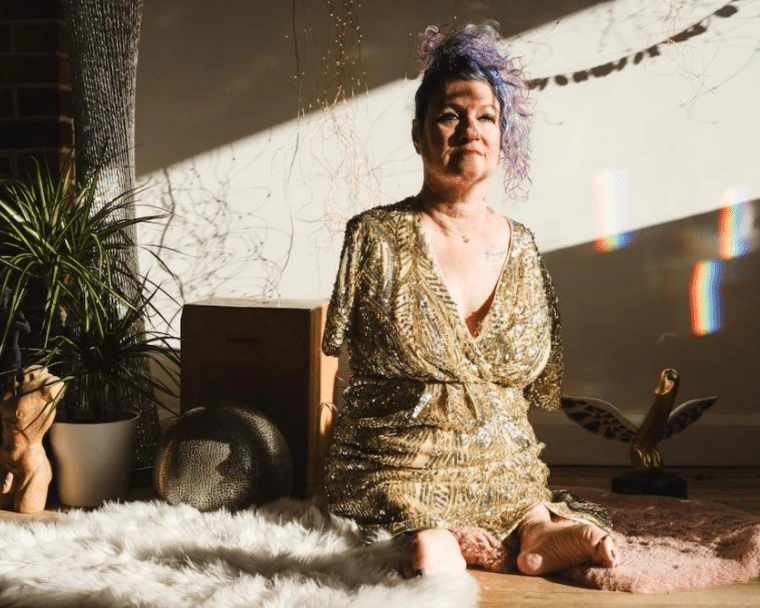
The sculpture generated admiration, criticism, curiosity, and debate. Some observers viewed it as a groundbreaking representation of disability and motherhood. Others questioned whether a male sculptor should receive recognition for depicting a disabled woman whose own artistic work remained less widely known.
Alison actively participated in those conversations. She understood the sculpture’s cultural power while continuing to remind audiences that she was an artist in her own right.
The monument remained on the Fourth Plinth until 2007. A much larger reproduction later appeared during the opening ceremony of the 2012 Paralympic Games in London, introducing its image to an international television audience.
Recognition Beyond the Famous Marble Portrait
The Trafalgar Square sculpture made Alison’s image instantly recognizable, but her achievements extended well beyond that public monument.
In 2003, she received an MBE for services to art. Her memoir, My Life in My Hands, was published in 2005 and translated into several languages.
Through exhibitions, lectures, television appearances, and public speaking, Alison challenged misconceptions about disability. She spoke openly about independence, parenting, body image, and the barriers created by inaccessible environments.
Her work asks an important question: How much of disability comes from the body itself, and how much comes from a society unwilling to accommodate difference?
A staircase becomes a barrier when no ramp or elevator exists. A workplace becomes limiting when employers assume incompetence before meeting an applicant. A public conversation becomes harmful when a person is discussed as an object of pity rather than included as an equal participant.
Alison’s art makes those invisible barriers easier to see.
Motherhood, Grief, and the Return to Art
Alison’s story also contains profound sorrow.
Parys faced mental-health struggles during his adolescence and endured cruel treatment from classmates who targeted him because of his mother’s disability. He passed away in 2019 at only 19.
For Alison, the loss altered everything. She later explained that she could not pick up a paintbrush for several years. The artist who had used creativity to process so many experiences suddenly found herself unable to return to it.
Gradually, she began creating again.
Her exhibition Lost in Parys explored love, grief, memory, and the complicated emotions surrounding her son’s struggles. The work did not attempt to reduce Parys to the circumstances of his final years. It remembered him as a complete person and as the child who had transformed Alison’s understanding of love.
She has also used art workshops to support young people facing emotional difficulties. Her advocacy has emphasized the importance of mental-health services, compassionate education, and listening to young people before their struggles become overwhelming.
This chapter of Alison’s work carries a different kind of strength. It does not suggest that courage means remaining untouched by sorrow. Instead, it shows how creative expression can slowly provide a path through experiences that cannot be neatly resolved.
Conclusion: A Legacy Created on Her Own Terms
Alison Lapper was once surrounded by predictions about what she could never do. She answered those predictions not with slogans, but with action.
She studied art, earned a first-class degree, established an independent identity, became a mother, published a memoir, received an MBE, and created work that continues to challenge audiences.
The marble sculpture in Trafalgar Square helped change public conversations about disability and motherhood. Yet Alison’s greatest legacy does not belong to the sculpture alone.
It lives in her own paintings and photographs. It appears in the young artists she encourages and in the difficult questions she asks about access, representation, grief, and human dignity.
Her story does not invite pity. It invites attention.
Alison Lapper has spent a lifetime insisting that no person should be reduced to a diagnosis, a physical characteristic, or someone else’s expectations. Her work reminds us that strength can take many forms—and that every individual deserves the freedom to define a meaningful future on their own terms.